'We just need a bed': Baby with 'days to live' can't access lifesaving treatment

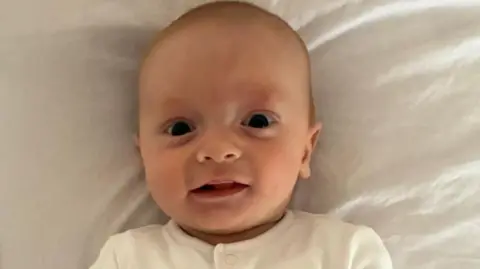 Family photo
The parents of a three-month-old boy who they fear has just days to live say they're frustrated at being unable to access lifesaving treatment due to a lack of suitable hospital beds.
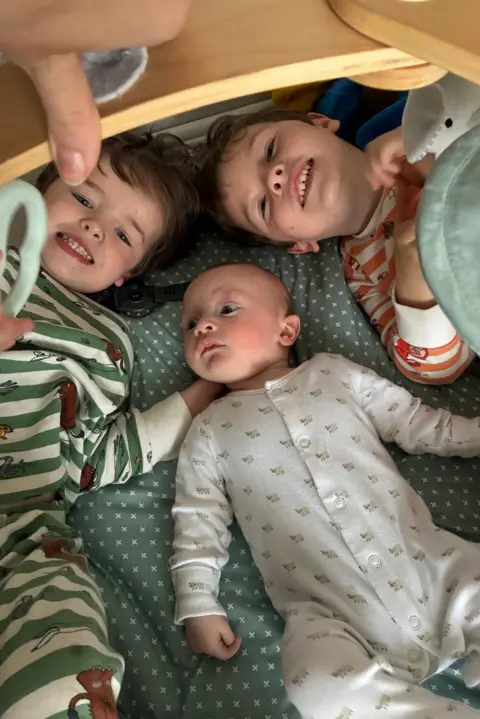
Dylan and Catrin Green, from Cardiff, said their "completely healthy baby" Macs started to struggle with his feeding, then caught a cold before later suffering two cardiac arrests.
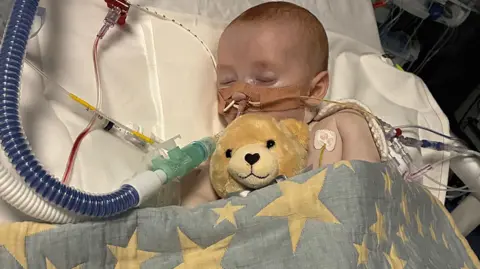
He has been diagnosed with dilated cardiomyopathy - a condition which can lead to heart failure - and now has a "matter of days" on a machine which pumps oxygen into his bloodstream, Dylan said.
He urgently needs a Berlin heart - a device used to take over the function of a child's own heart until a donor heart becomes available.
His family said Macs has been stuck at a specialist unit in Bristol for weeks, where his condition has since deteriorated and was now in an induced coma, as the beds he needs were not available.
The two specialist hospitals in the UK where the Berlin heart can be fitted are Great Ormond Street Hospital in London and the Freeman Hospital in Newcastle.
"Seeing him in hospital is so difficult for us," Catrin told BBC-produced Newyddion S4C.
"It's really frustrating knowing there is a treatment available which could save his life."
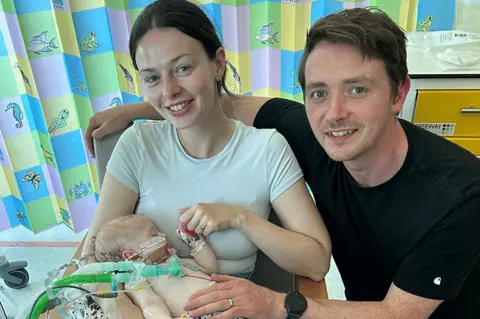 Family Photo
She continued: "He could lead a full life with the Berlin heart. Although he would have to remain in hospital for an extended period, he would be able to learn to crawl... to walk.
"It would be really nice to reach that stage."
She said they were "desperate for the hospitals to find a bed for him".
"The clock is ticking for him, we just need a bed."
 Family Photo
Figures from NHS Blood and Transplant (NHSBT) suggest fewer than five patients in Wales and England were currently using a Berlin heart - a device which can be used for several months prior to a transplant.
With only 2% of deceased organ donors in the UK being under 18, Macs' family was also eager to raise awareness about the importance of organ donation.
"It's not a nice subject to be discussing, but the more people who donate organs, they can help children like Macs lead a full and happy life," said Dylan.
 Family Photo
The NHS Wales Joint Commissioning Committee (NWJCC) said it recognised the "difficult and stressful time this must be for Macs' parents, family and friends".
It said, while funding was available for patients who required highly specialised services, capacity was managed on a UK-wide basis, and access to treatment was determined through clinical assessment.
"We understand that the specialist teams involved in Macs' case remain focused on supporting him to ensure he receives the care and treatment he needs."
