Projectionist's family loans cinema gems to exhibition

 Duncan Steel
The family of a man who dedicated his working life to a local cinema has said it is honoured to loan his collection of artefacts to a new exhibition.
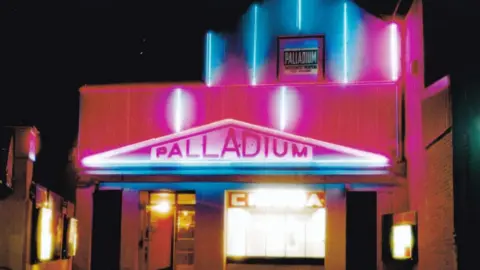
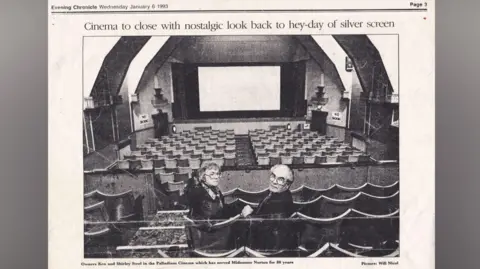
Ken Steel, who was first employed at the age of 14 at the Palladium in Midsomer Norton, Somerset, to rewind reels at the end of a film, worked his way up to become the owner and manager before the venue closed in 1993.
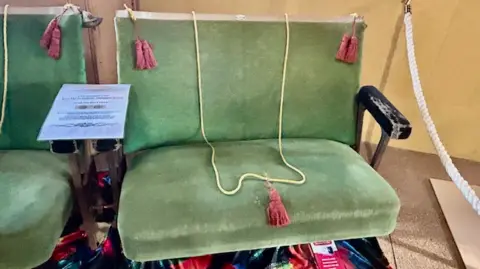
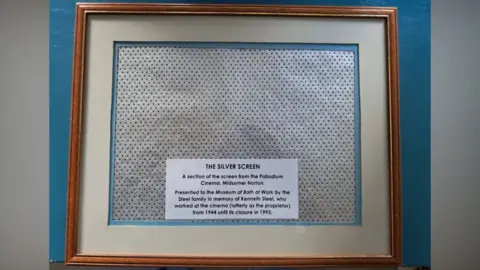
The Steel family has loaned historic items, including a rare double cinema seat and a section of the original silver screen.
Lights! Camera! Action! : 120 Years of Cinemas and Films in Bath explores the city's cinematic heritage and runs at the Museum of Bath at Work until 29 November.
 Duncan Steel
Ashley Steel, whose father died three years ago, said the Palladium was "very much a family cinema" and she and her four siblings grew up in a lean-to stone cottage next door.
"We all went to bed at night and we could hear the cinema through the wall," she said.
"Often, my father would open the doors at 6.45 for a 7 o'clock showing and then come home and say 'we've got no staff', and we would all have to stop what we were doing and go round and do whatever needed to be done, basically."
 Museum of Bath at Work
Ashley says she helped by cleaning toilets, selling tickets, ushering and "throwing noisy people out".
She said another early childhood job was sitting on a high stool watching the two carbon rods of the film projector's light source - which "burnt like cigarettes" - and required constant adjustment.
Ashley's sister, Melinda Dowling, said the cinema was her father's "first love".
"When you go and open those front doors and let people in, it felt a magical moment.
"[My dad] was totally gutted when it closed," she said.
 Duncan Steel
The exhibition has been curated by Ann Cullis, a volunteer and trustee at the museum.
She researched the history of cinema and film going back more than a century at the Bath Record Office and on family history websites.
Apart from surviving cinemas, such as the Little Theatre Cinema in Bath, which is celebrating its 90th anniversary this year, and the city's Everyman, Cullis discovered the history of venues that have long since closed.
Three former cinemas - the Electric, the Vaudeville and The Picturedrome - opened within two years of each other between April 1910 and December 1911.
Cullis said: "Once the talkies came in, cinema just really took off and it became the basic leisure activity.
"There were phenomenal queues, literally around the block," she said.
"It was a really lively industry with lots of people working and we found many names of individuals by using census returns," she said.
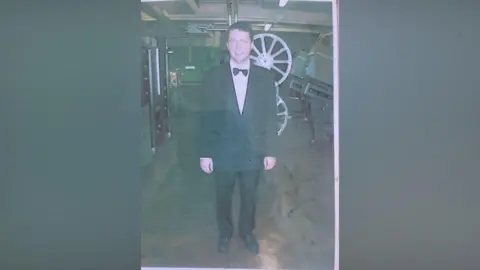 Michael Denner
Michael Denner, from Calne, in Wiltshire, who has worked in the cinema industry since the 1980s, first worked as a projectionist in Shepton Mallet and Street and said there had been a lot of change since the advent of digital technology.
"The skills of the projectionist are being lost, especially since the loss of 35mm. The modern systems are now basically running automatically.
"There's not even a projectionist who actually programmes the automaton systems; it's more of a theatre manager," he said.
Denner has also been the co-ordinator of the Pilton Palais cinema at Glastonbury Festival since 1982, after being asked personally by the founder, Michael Eavis.
Speaking to the BBC in 2024 he said: "I brought my 16mm projectors and did it in a small marquee.
"When I started doing it back in 1982, I would have no idea that it would progress to this, with state of the art digital cinema - I never dreamed it would get to this," he said.
Cullis added that although the heyday of the cinema had past, the industry was adapting and people still "really value that experience of sharing something in the same space".
Follow BBC Wiltshire on Facebook, X and Instagram. Send your story ideas to us on email or via WhatsApp on 0800 313 4630.
