'They were competing for supremacy': Which is the oldest English accent?

 BBC/ Serenity Strull/ Getty Images
Two BBC journalists go on a quest to find out whose accent is older – and uncover a dramatic history filled with hidden twists and surprises that have shaped the language we speak today.
Ey up m'duck!
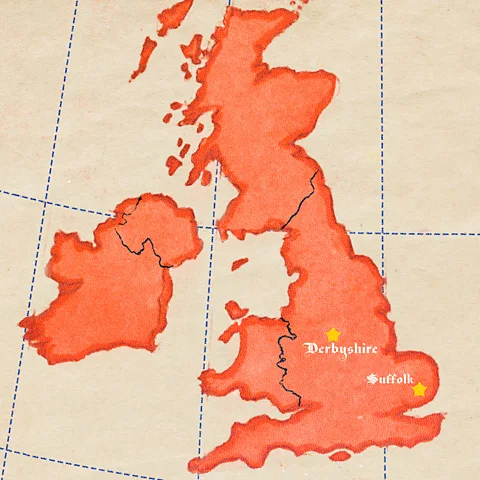
That means "hi", in my regional dialect. I'm Molly Gorman, a BBC journalist from Derbyshire, a county in the Midlands – a region that is roughly in the middle of England. My colleague William Park grew up in East Anglia, in the south-east of England. Together, we decided to track down the oldest English sounds still used commonly today – and in the process, have a friendly little competition over whose regional accent is older.
When it comes to English accents, one major dividing line runs between the north and the south of England. While my home region is more or less in the middle, there's one aspect of my accent that's typically northern: we tend to pronounce words like "bath", "grass" or "laugh" with a short "a", as in "cat". Also, we pronounce "strut" to rhyme with "foot" – we say both with a short "oo" sound (like "book" or "cook"). Will on the other hand…
William Park: ... would say "baaath", "graaass", and so on, with a long "ah"-sound. In my accent, "foot" rhymes with "put", but not with "strut" – the latter has an "uh"-sound, like in "upper". I grew up in Suffolk, in East Anglia, where the accent is a variation on southern standard English. We say a lot of things in the southern way with a stretched out "a" sound, for example. But we also have our own bit of regional flair. If you greeted me with "Ey up m'duck", I might ask how you are doing with "yer oroight buh?"
Today, the southern English accent is often associated with upper-class traditions and social prestige. For example, the King speaks in a type of southern-based accent, known as Received Pronunciation, as did the late Queen. This type of accent is also known as "BBC English" because of the way BBC news presenters spoke in the past.
But does that mean southern English accents are older, and more "original" than northern ones? Actually, a dive into history reveals a much more complex and surprising truth...
Molly: For a start, English is a language of many regional dialects (which are the words and grammar that a group of people use) and accents (the sounds of a person's speech). They reflect our place of birth and upbringing, and also our identity. "As humans, we like to be part of groups, and we like to differentiate ourselves from others," says Natalie Braber, a professor of linguistics at Nottingham Trent University in the UK.
To understand why some of these accents and dialects are older than others, let's travel back 1,500 years....
 BBC/ Serenity Strull/ Getty Images
William: ... to the Angles and the Saxons, groups of tribes who came to England from northern Germany during the 5th and 6th Centuries. They spoke a mix of Germanic languages and largely landed in the east of England and set up home there. East Anglia gets its name from the Angles and is the origin of the word "England".
"It makes sense to think of East Anglia as being the source of the earliest variety of English as we know it," says Kerri-Ann Butcher, a lecturer in English Language at the University of Leeds. A 5th-Century deer ankle bone from Norfolk with a runic inscription saying "roe deer" might be the earliest example of writing in Old English found in the UK.
So, that surely means my East Anglian home accent is the one that's closest to the original Anglo-Saxon sound, right? Well, not really – because there are few more linguistic twists and shifts to come.
The Anglo-Saxons began to settle among the British tribes they found and divided the country up into kingdoms: Kent, Wessex, Sussex, Essex, East Anglia, Mercia (middle England) and Northumbria. Northumbria encompassed northern England and some of Scotland – perhaps indicating the first signs of a north-south divide.
Over the course of the next few centuries, the Anglo-Saxons were followed by other groups that settled in England and transformed the language: the Jutes and Danes from modern Denmark, Friesians from Germany and the Netherlands, and the Vikings from Scandinavia. That's why modern English is not just an updated form of Old English – instead, it has absorbed many different languages. And those linguistic changes did not play out equally across England. They varied from region to region, depending on where the newcomers arrived and settled.
The north-south split
Molly: By the 9th Century, the area of England that is now Yorkshire, the East Midlands, and East Anglia were largely ruled by the Danes. The Anglo-Saxons were pushed into the southwest, West Midlands, and held a pocket of the north in Northumbria. Devon and Cornwall, Wales and Scotland remained Celtic language-speaking for now.
Records from this time show clear dialectical differences between the north and south of England. "A long time ago, lots of language and linguistic groups were competing for a sort of supremacy," says Chris Montgomery, senior lecturer in dialectology at the University of Sheffield in the UK.
The Norman invasion in 1066 brought Norman French to the island, gradually changing Old English to heavily French-influenced Middle English – which was then officially used in court and in official communications.
William: Over the course of all these influences and invasions, the English language became very messy. There were many words taken from other languages and spelling was inconsistent. The advent of the printing press in 1476 began to standardise some spellings and marked a useful point from which we can deduce past pronunciations – which is helpful for our quest to find the oldest living accent.
In those early days of printing, "the spelling system (...) was pretty good at reflecting the pronunciation," says Danielle Turton, a sociolinguist at Lancaster University in the north of England. Words that had similar spellings probably sounded the same at the time they were printed. "Blood", "good" and "food", for example, now have three different long "oo" sounds, but historically might have rhymed, says Turton.
Other vowels were also pronounced differently across England. "Foot" would have sounded the same as "strut" and "put", featuring a short "oo" sound.
The 'foot-strut' split
Between the 12th Century and the 18th Century, English vowel sounds changed dramatically, in what's known as the Great Vowel Shift. Long vowel sounds like "ee"s and "oo"s changed pronunciation – but not in all words, and not in all regions.
The reason for the shift is unknown, but it had a big effect on how English was spoken. And while the vowel sounds changed, the spellings of words tended to remain the same – which meant the spellings no longer consistently reflected the sound of words. "It has a lot to answer for when it comes to why English spelling is so complicated, and why there's so many different ways to pronounce an 'a' or an 'e,'" says Holly Dann, pronunciations editor at the Oxford English Dictionary (OED).
The shift didn't happen everywhere all at once. In some areas of the country older pronunciations were preserved, says Dann.
 BBC/ Serenity Strull/ Getty Images
One of the later changes in the Great Vowel Shift is called the foot/strut split – a rift that further divided the north and south.
From the 17th Century onwards people in the south of England began to pronounce "strut" with a short "uh" sound, as in "upper", not with a short "oo" as in "foot". However, that change didn't happen in the north, where people stuck to the short "oo" sound for both strut and foot. Today, northern speakers typically still pronounce foot/strut that way.
"The northern pronunciation [of those words] is absolutely the original one," says Turton. "It was the south that branched off and created this new vowel."
This means that even though East Anglia may have been the home of the earliest English sounds at one point, it didn't keep that position – it ditched some, but not all, of the early sounds.
Meanwhile, other northern regions, held on to those old vowels.
The north and south "drifted apart", says Montgomery, "and then you end up with this really important signifier of the north-south divide," meaning, whether you pronounce "strut" to rhyme with "foot", or not.
Molly: Erm, hello – there are some of us slap bang in the middle, too!
In the East Midlands, some of the words we use sound northern – if we were to say "foot" and "strut", they'd sound the same, like "put". We also use article reduction: instead of saying "I'm going to the shops", we might say "going t' shops". We also have what Braber calls the "happy vowel", which sounds more like "happ-eh".
While the East Midlands accent frequently gets lost in the research, it might have had more influence in forming Old English than I expected. "If you look at studies of historical English, people say there's actually quite a heavy influence of East Midlands English in the standard form," Braber says. "Around the time of the Black Death [the plague in 14th-Century England] … a lot of merchants from the East Midlands moved into the south and took up positions of power. Some said they took some of their language forms with them."
In fact, what we would now regard as a posh, upper-class English accent is surprisingly new. Take Received Pronunciation, for example: It didn't exist until the 18th Century. And while the Royal family now speaks with a southern accent, that wasn't always the case: it is believed that Richard III, King of England in the mid-1400s, spoke with a northern Yorkshire accent.
"Crucially, that southern vowel [the elongated "a" sound], you wouldn't have heard that [in the 1400s]," Montgomery says.
Ancient sounds in American English
Fossil sounds – ancient sounds in modern speech – show up in English varieties spoken around the world, too.
For example, rhoticity – which is when you heavily pronounce the "r"s in a word, such as in "harrderr" or "waterr" – is another feature that was common in English in the past, but then, faded in some regions. It remains alive in Irish, Scottish and American English, and in the southwest of England – another living fossil from the distant past.
Interestingly, American English has also held on to some older words that British English has let go of. "There are some older words that you think are peculiarly American, which actually have an interesting history in England," Montgomery says. Take "sidewalk" for example: in older forms of English, we would have used that word before we paved the sides of the roads, and sidewalk became pavement.
William: In my home region of East Anglia, some older sounds did actually make it through to the present day. How do we know?
Again, the clue is in how words are spelled – if they're spelled the same, they were probably pronounced the same way, and vice versa. So, "road" and "rowed" are spelled differently, but in most of the UK, they're pronounced the same. Same with "moan" and "mown" – different spelling, same pronunciation. But these vowels were once pronounced differently. "Road" was pronounced similarly to "rood". "Moan" was similar to "moon", Kerri-Ann Butcher tells me.
Meanwhile, the "o" in "rowed" and "mown" came from further back in the mouth than it does today. Perhaps in the East Anglian town of Lowestoft, the easternmost settlement in Great Britain, you will still hear some older folk mooning about the people up the rood.
The "yod" is another tell-tale sound from the past. This refers to how the letter "u" is pronounced. In some words, "u" is pronounced very clearly like "yew" (e.g. "volume", "menu"). This subtle, added "y"-sound is known as a yod – and leaving it out is known as "yod-dropping".
Yod-dropping varies from accent to accent. In classic Received Pronounciation, a person would say "Tuh-yews-day" for the day before Wednesday. Americans drop their yods quite readily and tend to say "Toos-day". And in a regional Suffolk accent, "Tuesday" sounds more like "choose-dee", because the yod is dropped, and there's a couple of other things going on: palatisation (the tongue coming forwards to soften the "t" – another example would be "train" sounding like "chrain") and a vowel reduction ("day" to "dee").
Overall, yod-dropping is much more common today than it was historically. "Luminous" or "lucid" would both have started with "luh-yew..." in the late Queen's English, but now it is much rarer to hear this.
So if you still say Tuh-yews-day and luh-yew-cid, you're giving an old sound – the yod – a bit of new life.
Accentism and accent bias
Molly: It's satisfying to hear that my home accent, and northern accents in general, are guardians of some really ancient English sounds – it goes against the common view in England that the southern accent is somehow more standard. In fact, in daily life, northern accents often face a struggle for respect and acceptance.
Texts show that northern English accents have been stigmatised by southerners since the 14th Century. This bias is an example of "language being used to highlight the differences in culture, and in socioeconomic status," says Montgomery. The midlands and north of England have long been associated with heavy industry, mills and factories – and therefore, the working classes. That link remains today.
"This country is still obsessed with social class," Montgomery says. "What you have is people making really quick judgements based on how you speak."
More like this:
In studies and surveys, southern voices are rated highly on "status traits", says Braber, meaning intelligence, wealth and clarity. However, they don't perform well on "solidarity traits", so they're not seen as friendly or as trustworthy. On the other hand, north-eastern accents tend to score highly on solidarity traits, but not on status. Accent bias research in the UK shows that having a less-prestigious accent can even affect access to housing and employment.
This north-south divide may, however, might not be forever: after all, accents continue to evolve. "Language is continually changing, dialects are continually changing. Nothing's frozen in time," says Montgomery.
So, which of us has the older accent – Molly or Will?
While we've both enjoyed discovering some surprisingly old sounds in our accents, it seems that there's no clear winner. My mid/northern accent has preserved the old "foot/strut" sound. Some southern accents have preserved the yod. And in some versions of Will's East Anglian accent, "road" both looks and sounds different from "rowed". Protecting our living fossils seems to be very much a group effort, then.
"I don't think we'd say that we have something that's the oldest accent, or the oldest dialect. What you'll find is that you've got lots of differences in a single place," says Montgomery.
I guess I can't be mardy – that's northern slang for "annoyed" – about that.
--
If you liked this story, sign up for The Essential List newsletter – a handpicked selection of features, videos and can't-miss news, delivered to your inbox twice a week.
