What happens to your brain in space?


 Nasa
NasaSpace messes with astronauts' brains – and that might be a big challenge for missions beyond the Moon.
With four billion or so years of evolution behind us, humans are well suited to life at normal gravity. Imagine then, the fears at the dawn of the space age over what would happen when we first left the Earth and experienced weightlessness. Would our blood congeal? Our bones crumble? Our brains explode in microgravity?
By the late 1950s, a series of flights with mice, spiders and eventually, dogs proved that animals could indeed survive in space. And when it later came to humans, we have shown that we can not only survive, but thrive.
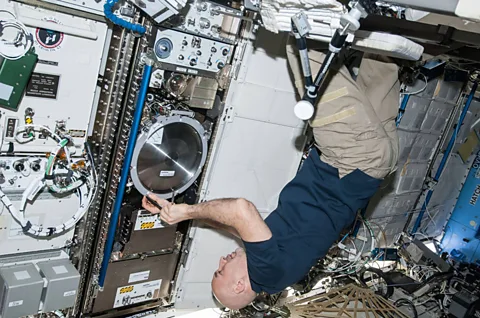
"There is an adaptation that, in many ways, feels like a transformation," European Space Agency (Esa) astronaut Luca Parmitano told me in 2019, during training for his second long-duration mission to the International Space Station (ISS). "After a few weeks your body is different to what it was on the ground – you see and you feel your body change, your legs get skinnier and your face gets round."
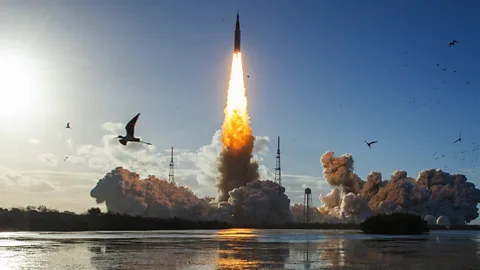
A former Italian Airforce test pilot, Parmitano has recently been selected for his third space mission as one of the four crew members of Artemis III. Due to launch in 2027, this challenging flight in Earth orbit will test out lunar landers and spacesuits for a return to the Moon. It's little surprise Parmitano was chosen – when you talk to him, you get the impression that he's found that spaceflight comes naturally.
 Nasa
Nasa"One of the reasons the human race is so successful on Earth is our capability to adapt," he said. "But to see in the arc of a few weeks [in space] physical changes happening, it really blew me away how different I felt and how much more comfortable my new body just fit the environment that I was in."
The rigours of spaceflight on the human body – from muscles to bones to blocked sinuses – are well-documented in the 70-odd years since humanity first blasted into orbit. Less well-known is the effects zero-gravity has on our brains.
In space, our bodies no longer need to overcome the force of gravity with every action or movement. As a result, the bones that support our weight and the muscles that we use to lift, carry, walk and run begin to waste away. After just a few days in space, bones lose calcium and muscles start to deteriorate, which includes changes to the heart. The reason astronauts also tend to have puffy faces is a result of liquids no longer being constrained by gravity and pooling in the upper body.
This would all be fine if astronauts spent the rest of their lives in space, but if they ever want to return to Earth in good physical shape, they need to follow a rigorous exercise regime. Typically, this includes two hours a day in the ISS gym and, even then, after just six months in space they are carried out of their returning spacecraft and placed on stretchers. It can take up to four years for their bones to return to normal.
Much less understood, however, is what has been going on in astronauts' brains. And that could be a problem.
"The brain is probably the most important of our organs," says Esa flight surgeon Alessandro Alcibiade. "If you don't bring an effective brain to space and a working brain to space that will be all worthless."
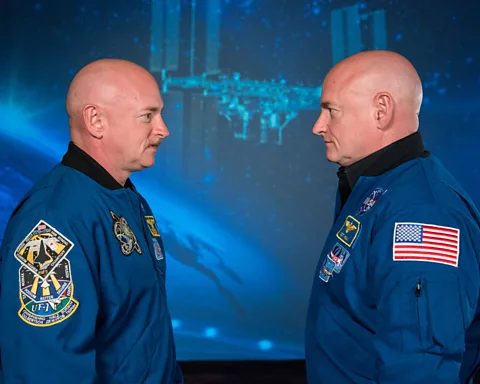
Research on the effects of spaceflight on the brain has been limited to experiments on just a few astronauts during long-duration missions. Scott Kelly, for instance, spent a year on the ISS while his astronaut twin brother, Mark, remained on Earth. In the resulting study, researchers found Scott's cognitive abilities were largely unchanged during the mission compared to Mark, but decreased for about six months after he landed.
Now, new research published in the journal Frontiers in Psychology by scientists at Birkbeck, University of London in the UK – and shared exclusively with the BBC – has pulled together results from 15 brain imaging studies involving some 377 participants. These included astronauts as well as volunteers in spaceflight simulations on Earth, such as bedrest studies.
By combining all these sets of data, the Birkbeck team believes they have identified changes that take place in the brain when its exposed to microgravity.
"It's a beautiful neuroplasticity – we found that there are both structural and functional alterations in the brain," says lead author Elisa Raffaella Ferrè, a professor of cognitive neuroscience at Birkbeck, Univeristy of London. "We have identified a cluster of brain areas that undergo changes when gravity isn't there."
 Nasa
NasaSo just as the body changes in space, the research shows the brain also adjusts physically to the absence of gravity, rewiring itself for the novel environment.
"We see changes in the parts of the brain that control movement, balance and body awareness," says Silvia Seghezzi, the paper's co-author. "We also saw alterations in the operculum – this is where all these signals meet up and can be processed in a multisensory manner."
This means that the brain has evolved to sense gravity.
"We don't perceive gravity in the same way that we perceive change in colour, in light, in temperature, in sounds," says Ferrè. "But gravity is a constant feature of the environment that our brain is receiving and processing."
"If you want to be a bit nerdy, you can think about gravity as the first signal that the developing foetus receives – so our brain is built on gravity detection," she says.
Ferrè uses the example of picking up a cup of coffee. We do it effortlessly, she explains, because our brain automatically compensates for Earth's gravity and moves our muscles accordingly.
On the face of it, this is good news for astronauts. In fact, if human brains didn't adapt in space, astronauts would encounter all sorts of difficulties, including a good deal of coffee-related injuries. The challenge comes, however, over how quickly this neurological rewiring takes place.
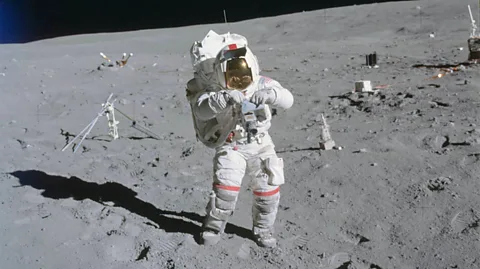
"Look at the Apollo astronauts walking on the lunar surface. The footage shows how incredibly bad they were at keeping the right posture, and that's not only because the suits were very heavy, it's because all their balance and locomotion was altered by the lack of terrestrial gravity," says Ferrè. "It doesn't mean that the brain cannot recalibrate, but it takes time and resource."
For the past 50 years since the end of the Apollo programme, none of this has really been an issue. Astronauts arrive on the ISS and are a bit clumsy for a while, bumping into the walls or moving things around with too much force, but then they adapt. When crew return to Earth, they are helped from the capsule, looked after and rehabilitated back to life in normal gravity. But what about future long-duration missions to the Moon or Mars, that Nasa and China have in their sights. For these, astronauts will need to transition between gravity and no gravity.
 Nasa
NasaOn a Mars mission, for instance, after eight months or so in space, the crew will be so well adapted to microgravity that even climbing out of their spacecraft in Martian gravity (roughly one-third of the Earth's) could present a challenge. While their muscles and bones will have be kept in shape by daily exercise, the brain that controls them may not be. The shift in gravity could be disorientating and dangerous. Without real-time communications with Earth, they will need their wits about them for the landing.
"You can have an amazing rocket, but if you're not able to pilot it, if you are not able to make the right decisions because of these sensory motor alterations, there might be trouble," says Ferrè. "We need to make sure that humans are supported and potentially facilitate the process of adaptation."
More like this:
The science fiction solution to this (see, for example, 2001: A Space Odyssey or The Martian) has usually been to build a spacecraft that incorporates a centrifuge or giant wheel to simulate microgravity.
"That would be the best solution, it would counteract bone and muscle loss and help with brain conditioning," agrees Esa's Alcibiade. "Why don't we do that? Because it will cost a lot – it all comes down to mass and mass is money when we talk space."
Ferrè agrees and is developing new techniques of using small electrical currents to stimulate the key areas of the brain that sense gravity hoping to improve flexibility.
She is confident that scientists will find a way to overcome the effects of changes in gravity but is keen to stress the positives of her initial research findings – not just for astronauts but for all mankind.
"Space flight is challenging," she says. "But it can also be a very good window for understanding our brain in a way that we cannot do here on Earth."
--
If you liked this story, sign up for The Essential List newsletter – a handpicked selection of features, videos and can't-miss news, delivered to your inbox twice a week.
