'I don't think he would've been happy': Why Anthony Bourdain biopic Tony fails to honour the chef's work

 A24
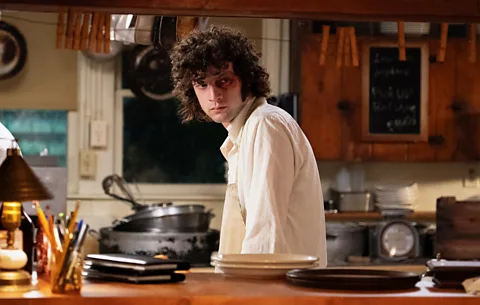
A24The new film about the US culinary titan is entertaining. But it undersells his legacy and sidelines the workers, many immigrants or people of colour, that to him were the real stars of the restaurant industry.
It's rare that a film's epigraph so succinctly sums up everything you’re about to see. But when Tony, the new film about the late great chef and food writer Anthony Bourdain, begins a quote flashes up on screen from his seminal 2000 book Kitchen Confidential – a memoir of his early days working in restaurant kitchens. "I was – to be frank – a spoiled, miserable, narcissistic, self-destructive and thoughtless young lout."
Bourdain, who died in 2018, was one of the world's most celebrated culinary figures, known for his bad-boy persona, superb food writing, and TV series like No Reservations and Parts Unknown, in which he travelled the world intimately exploring different food cultures. Matt Johnson's biopic is a solid piece of film-making, but it reflects badly on it that it can be encapsulated in a single sentence – it is, in essence, a film about the folly of Bourdain's youth. We see a delinquent "Tony", played by rising star Dominic Sessa, ineptly wielding nunchucks, sleazing on waitresses, abusing substances and getting into fights.
The crucial thing missing
But while that makes for entertaining viewing, it feels like a shallow reflection on Bourdain's work and impact. And in particular, the film misses one crucial element of Kitchen Confidential – his celebration of the workers, many of whom were immigrants or people of colour or both, who he believed were the real foundation of the restaurant industry. As the Scottish novelist Irvine Welsh observed in the foreword for a new edition of the book last year: "Bourdain knew it was always the immigrants, not the spoiled white boys who were the living, breathing embodiment of the American dream."
Rather than exploring the dynamics of modern restaurant culture, as the book does, Tony has a very narrow focus – one formative summer in 1975 when a 19-year-old Bourdain discovered his culinary passion working as a dishwasher in a seafood establishment in Cape Cod, Massachusetts. In the film, it is called The Lobster Pot, and is loosely based on Kitchen Confidential’s Dreadnaught restaurant – itself a pseudonym for the once-famous Flagship restaurant that Bourdain actually worked in. In a recent interview, Johnson explained his choice to focus on this particular episode in Bourdain's life by saying the "journey" that Bourdain goes on in the film is "universally applicable. It’s about rites of passage, a crucible, going through difficulty and making it to the other side ready to face the world."
And the film's main interest, bad behaviour aside, is a love story between Tony and Nancy (Emilia Jones) – his high-school sweetheart who later became his first wife.
Its characterisation problem
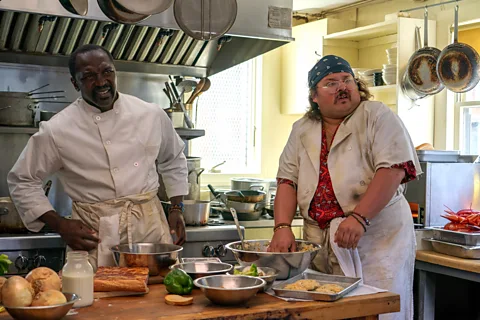
Again, this is not to decry the film completely. It evokes a good sense of mid-70s period detail, and there are compelling performances throughout from Sessa, Jones, her fellow Brit Leo Woodall as Bourdain's disreputable co-worker and Antonio Banderas as the restaurant's owner. But the latter two are both fictionalised characters, and it's glaring how many of the real-life kitchen staff from the book are sidelined in the story.
 Getty Images
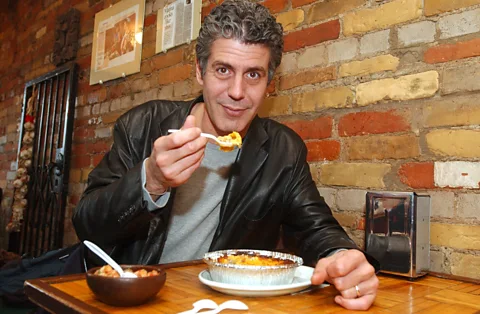
One example is black chef Tyrone – played by Nigerian-born Michael Jibrin. In reality, Tyrone was a formidable figure who showed Tony some of the harsh, macho behind-the-scenes realities of restaurants at the time. But here he is marginalised as soon as Tony is promoted from dish washer to oyster shucker.
Hannah Harley Young is a British-Iranian food presenter, creator and host of the Crazy Sexy Food podcast, who claims Bourdain as an inspiration and has interviewed Bourdain's former assistant Laurie Woolever. She believes Tyrone and other kitchen staff could have been depicted as much more pivotal characters in Tony's coming-of-age story.
"I don't think Bourdain would've been happy to be involved in a biopic of himself," she says, "but if he were I'm sure he would've wanted more character background on certain people. Everybody was somebody for Tony and everyone could sit at a table and be equal."
A lot of the cooks from Bourdain's writing about Dreadnaught in Kitchen Confidential are merged into Woodall's composite character Sal, so we lose Lydia, a Portuguese soup-maker, and Mike, a methadone dealer who mans the salad station. Meanwhile the Russian-German pasta cook Dimitri (played by Stavros Halkias) is not a mentor figure, as he is in the book, and has been made into an American.
More like this:
British-Sri Lankan beverage, food and culture writer, Ruvani de Silva, equally wonders what story the film is telling if all the immigrants and people of colour, who Bourdain championed in Kitchen Confidential and otherwise, aren't front and centre.
 A24
A24"I doubt this film will damage Bourdain's legacy as people can still read his words," she says. "But trying to super-impose a romantic narrative onto Kitchen Confidential just makes your brain jar."
Bourdain's life has been misrepresented repeatedly – from fake platitudinous quotes falsely attributed to him, to misleading memes and an all-round romanticisation of him. This film, to its credit, doesn't make him into a hero. And Sessa plays with nuance a young man seemingly trapped by his own arrogance.
But in choosing to tell the story it does, it certainly undersells the man and his mission.
Tony is out now in US cinemas and is released in UK cinemas on 14 August.
--
If you liked this story, sign up for The Essential List newsletter – a handpicked selection of features, videos and can't-miss news, delivered to your inbox twice a week.
