'There was an audible gasp': How a flash of a player's pink underwear scandalised Wimbledon

 Getty Images
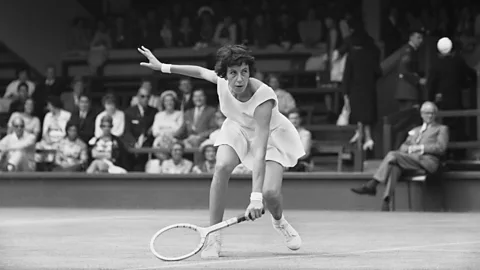
In 1962, when Brazilian player Maria Bueno wore a tennis dress lined in bright pink with matching pink knickers, it led to outrage and an even stricter dress code. It wasn't the first – or the last – outfit to raise eyebrows. But why all the fuss?
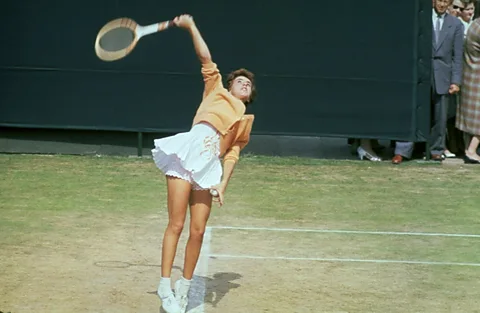
It was a summer's day in 1962. The Brazilian tennis player Maria Bueno was back at Wimbledon after time away due to injury. Returning to Centre Court, the "tennis ballerina" was wearing a white dress that seemed to be in line with the All England Club's preference for all-white attire. Until she served.
Then the truth was revealed: her dress was lined in pink – and her knickers were the same colour. As Sunita Kumar Nair, author of the new book, Ace: The Times & Style of Tennis, tells the BBC: "It caused a stir."
Years later, Bueno, who had by this time won two Wimbledon ladies' singles trophies – and would go on to win one more – recalled how "there was an audible gasp from one end of the court". However, "the people at the other end didn't know why, until I changed ends and served from there."
"Later," she said, "I wore panties that resembled the club colours [green and purple], which outraged the club committee, and they brought in the all-white clothing rule.
 Getty Images
The requirement that members dress in white dated back to the establishment of the All England Lawn Tennis and Croquet Club (AELTC) in 1877, but it was largely a matter of custom. It was Bueno's outfit – which was the work of designer Ted Tinling – that reportedly catalysed the new strict codification. As Kumar Nair writes: "Wimbledon retaliated with its 'predominantly white' rule in 1962, which meant all competitors had to wear almost all white."
'Distasteful and unbecoming'
But who exactly was scandalised by a flash of pink underwear? Tennis historian Rob Lake sheds some light: "As a conservative (big C and small c) organisation, the AELTC would have found the frilly bits of her dress… distasteful and unbecoming of a lady," he tells the BBC. "They were not really on board with the social changes outside of the club in the 1960s."
At this point in time – and until the 1980s – Lake points out, all of the committee members were men. They were "the established order, with political affiliations and connections in other elite institutions. They were certainly not willing to promote social advances that might bring disrepute."
 Alamy
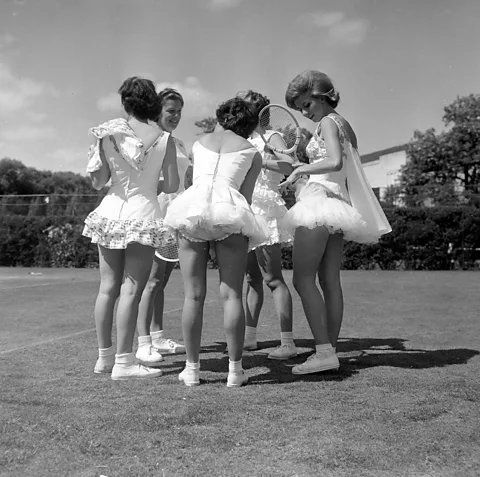
AlamyAccording to Lake, "the AELTC seemed to have a stronger view of how women should present themselves than men, or at least it seems as though women were more frequently reprimanded for their appearance."
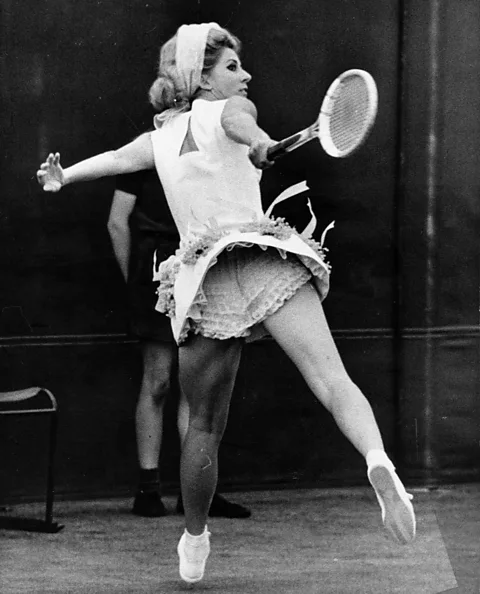
In 1967, sartorial controversy came again in the shape of Italian tennis player Lea Pericoli's short dresses, again a collaboration with Tinling. The role of Tinling – the designer otherwise known as "the Wizard of Wimbledon" – in women's tennis style was massive. He was a looming presence over the game for much of the 20th Century – as noted in Ace, "from 1940 to 1980, 75% of women who competed at Wimbledon wore his dresses".
He was "the first dedicated sport couturier", writes Kumar Nair.
 Alamy
AlamyWhite made sense as Wimbledon's colour of choice. In the late-19th-Century, when the convention was set, white was loaded with class status. As Kumar Nair writes: "Only the wealthy could afford to wear, own, and maintain it. The rest had neither the means nor the staff to have and keep separate athletic attire." For tennis historian Christopher Bowers, Wimbledon's increasing dogmatism when it comes to white originated "at the beginning, it was just the colour of tennis. Then it stuck to its white rule as a way of imposing its sense of tradition on the sport."
'Vulgarity and sin'
Bueno flashing a bit of pink wasn't the first time a female player at Wimbledon had fallen foul of the dress code, and it wasn't the first time one had done so wearing a Tinling design.
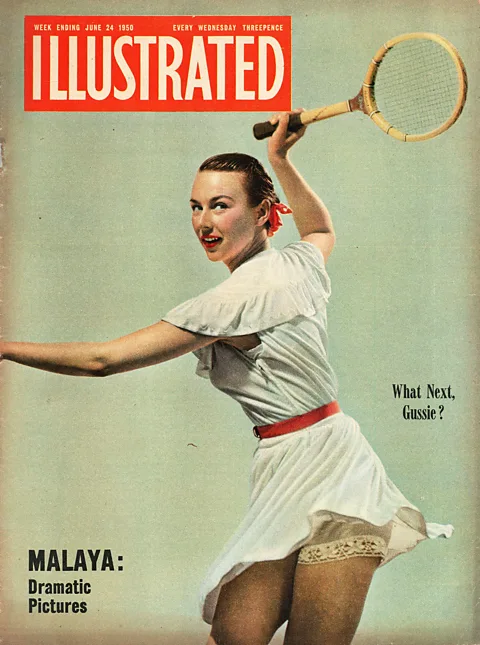
More than a decade previously in 1949, Californian player Gussie Moran – or "Gorgeous Gussie", as she was dubbed in the tabloid newspapers – had caused a stir in an earlier Tinling creation.
As Kumar Nair writes in Ace, "Gussie Moran's lace-trimmed undershorts" had "red-faced officials claiming that he had drawn attention to her 'sexual area'." While the undershorts didn't in fact at the time break any colour rules, they seem to have gone against standards of taste. The committee even accused her of bringing "vulgarity and sin into tennis".
 Alamy
AlamyBut arguably it wasn't Moran who behaved inappropriately. As Tinling said later: "The titillation was that you only saw [the panties] about once every three minutes... You had photographers, for the first time in history, lying on their backs. Everyone went wild."
How big a deal it was feels hard to grasp from the viewpoint of 2026. But Moran, as the Times once noted, "became known less for her ability on court than scandalising the prim world of Wimbledon in 1949". And Tinling, who had acted as player liaison since 1927, was subsequently expelled as a member – and not invited back for more than 30 years.
Earlier controversies
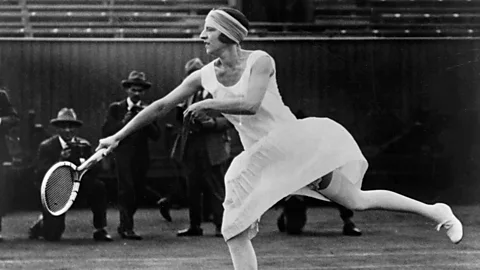
Even before Moran, female players had elicited reactions with their attire on the grass courts of SW19. Eyebrows had apparently been raised when, in 1919, French player Suzanne Lenglen, who became known as La Divine (the goddess), ditched the corsets, petticoats, full-length skirts, and broad hats, and opted for a fashionable Jean Patou short-sleeved calf-length dress minus a petticoat.
Then there was Spanish player Lili de Alvarez, who, in 1931, dared to wear an Elsa Schiaparelli-designed pair of culottes to play at Wimbledon. Given their width, it was reportedly only when she did one of her trademark leaps that it became apparent that it wasn't simply a skirt. Many commentators link her fashion choices with her lifelong commitment to the promotion of equality for women.
Then and now
When in 2014 a strict "almost entirely white" mandate for undergarments – bras, knickers, straps, lace, soles, and other accessories – was formalised at Wimbledon, it didn't take long for Serena Williams to fall foul via a pair of purple and pink undershorts. But then so did Roger Federer, thanks to a pair of Nike trainers with an orange sole that he was apparently asked to change out of.
More like this:
Over the past 20 years, says Bowers, "Wimbledon's dress code has become unbelievably strict". He thinks "the motivation is now one of branding. Wimbledon likes to think of itself as 'tennis in an English garden', and the white clothing just goes with the striped lawns, the Virginia creeper, the strawberries and cream, etc. It's all part of the brand, and the players are expected to play along."
 Getty Images
The reasons Wimbledon is keen to hang on to its traditions are to do with a sense of it being a bastion of tradition, according to Nair. "I think there's almost a fairy-tale idealism linked to Wimbledon," she says, "and, and they are very keen to retain that image that's been held for a long time."
It has its own special atmosphere that she describes in the book. "A tinge of a librarian hush in the air, the muffled pop of picnic Champagnes uncorked across the courts, the clean scent of the cut pastoral green lawns, and the pictorial gleam of competitors wearing crisp white – this is the All England Lawn Tennis and Croquet Club, ladies and gentlemen, as it was, is, and ever shall be."
--
If you liked this story, sign up for The Essential List newsletter – a handpicked selection of features, videos and can't-miss news, delivered to your inbox twice a week.
