'His life was one of fantasy': How John le Carré's spy novels were shaped by his con-man father

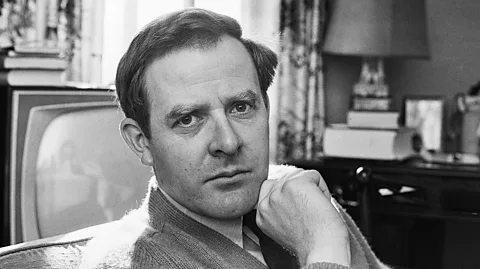 Getty Images
The author's childhood was rocked by bankruptcy and deceit. In 2008, he told the BBC that his "hectic background" trained him to be an author – and a spy.
David Cornwell was steeped in secrecy throughout his life – long before he took on the nom de plume John le Carré, long before his first novel, Call for the Dead, was published in June 1961, and long before he became one of the UK's most critically acclaimed, bestselling spy novelists. He learned deception and self-reliance from an early age, later recalling one particular childhood memory with his older brother, at the start of a day out from school.
"My father told us to wait at the end of the drive at our boarding school in Berkshire. And the reason he didn't want to present himself to the school was that he hadn't paid the bill, but we didn't know that," Le Carré told the BBC in a 2008 interview. "So we waited at the lodge at the end of the school drive with our suitcases. And he never showed up."
Let down by their father Ronnie Cornwell, a con man who was in and out of prison throughout their childhood, the boys did what they could to save face in front of their schoolmates. "We just stayed away for the whole day. We had no food. We had no money. But we wouldn't go back to school. We went back in the evening and pretended we'd had a wonderful day."
It was the first time he remembered feeling disillusioned about his father – and yet it also taught him something that was to prove useful later. "It's very interesting in espionage terms: the rendezvous collapses. You work out a cover story. You come back and dissemble."
As a child during World War Two, when other boys at his school were talking about the daring feats of their fathers, Le Carré invented a double life. "He grew up at a time when what your father did in the war was terribly important," his biographer Adam Sisman told the BBC in 2015. "He was embarrassed by his father… [who] was the most shaming of all, he was a spiv [a small-time crook who sells blackmarket goods]. He was profiteering while other boys' fathers were away fighting." To hide this, Le Carré made up stories that Ronnie was a spy.
That complicated relationship with heroics played out in the novels he wrote. His recurring protagonist, George Smiley, was the "anti-James Bond" – someone who is "bureaucratically dowdy, rarely spotted in the field… discreet to the point of self-erasure", according to The Atlantic. He "drops no one-liners, romances no tarot-card readers, roars no speedboats through the Bayou". Le Carré deliberately avoided the fast-car flashiness of Bond in Smiley, telling the BBC that he "made him tubby and physically graceless and a bad dresser".
In novels such as The Spy Who Came in from the Cold (1963), Le Carré – who died in 2020 at the age of 89 – focused on the mundane reality of espionage. It was a reality that he knew firsthand, working as a British intelligence officer for MI5 and then MI6 from 1952, after running away from boarding school and ending up in Bern.
A 'psychopath' who loved his sons
Again, his father directly shaped his career. "If I hadn't had a wildcat dad, I wouldn't have run away," he told the BBC. "If my father hadn't taken me to St Moritz to ski in 1936, Switzerland wouldn't have been imprinted on my memory as a romantic spot to go to, a kind of natural place of exile."
And this complicated relationship with his father continued throughout his life, according to Sisman. "Ronnie had no boundaries – he was in many ways a psychopath. He was a man capable of robbing old ladies of their life savings. At the same time, he clearly loved his sons."
While Le Carré's mother abandoned him at the age of five, Ronnie stuck around, albeit in a sporadic fashion. "Whenever Ronnie in later life would get in touch with David and say, 'I need bailing out, son', David would reach for his cheque book and often burst into tears," said Sisman. "So David had this peculiar love-hate thing about his father, this unresolved thing."
Le Carré recognised that Ronnie not only honed his skills in spycraft, but also shaped the books he wrote, and his ability to create fictional worlds. Coming from a respectable family in Bournemouth, Ronnie first went to prison as a young man, before being sentenced to hard labour. "From then on, he lived an extraordinarily flamboyant life," said Le Carré. Constantly reinventing himself, Ronnie "became a racehorse owner. He mixed with younger royals… [with a] chauffeur-driven Bentley and all of that."
In History
In History is a series which uses the BBC's unique audio and video archive to explore historical events that still resonate today. Sign up to the accompanying weekly newsletter.
On whether Le Carré was a writer who became a spy for a brief period, or a spy who turned his experiences into novels, he said: "I will never know… But I think actually behind both of them is the great shadow of my father and the duplicitous life that we lived as children, where we knew when we filled up the car with petrol at the local garage that it was never going to be paid for, where we pretended to live like middle-class English boys.
"We went to school. We didn't talk about our hectic background. So in a sense, we were spies." Although all of his father's family spoke with regional accents, the moment Le Carré got to private school, he adopted the speech of his fellow students. "And I started learning deportment and all the curious ways in which... people of that class communicate with each other. I never felt part of it, but I think very many creative people don't anyway feel integrated in life."
Le Carré's ability to spin fictions – and lead a double life – was in turn influenced by his father's choice to "live a criminal life, but under the guise of orthodoxy". He recalled: "My father's life was one of fantasy, he was a superb con man, and could build castles in the air, invent characters, anything. Since that gift was already an example to me, it was a natural thing to flow into writing fiction."
'Home was a very dangerous place'
His upbringing also determined the type of fiction he would write, one populated by morally conflicted characters in which no one could be trusted. "Home was a very dangerous place, as it was for George Smiley, as it is for most of my protagonists in that world," he told the BBC. "Home is where you can be found, home is where they come and arrest you, home is where the bailiffs come and turf out your toys and your clothes." That tension meant that Le Carré said he never felt safe. "Insecurity is a wonderful spark for writing."
Le Carré created his own genre of spy fiction, one in which his characters questioned themselves and the amoral methods of their agencies. It's a world away from Ian Fleming's 007. "I'm not sure that Bond is a spy," Le Carré told the BBC in a 1966 interview. "He's more some kind of international gangster… he's a man entirely out of the political context." In contrast, Le Carré's novels illuminated the Cold War ideological battleground, the political picture playing as large a role as the espionage.
More like this:
They also featured a succession of highly solitary characters, with the author describing The Spy Who came in from the Cold as "a story of loneliness". And Le Carré related to that himself, his own solitariness playing out on the page. "The condition of secrecy was a refuge for me," he said in 2008.
Although Le Carré acknowledged the scars from his unusual upbringing, he recognised the value of what had been hardwired in him from childhood. And despite the trauma of being continually disappointed by his father, Cornwell attributed much of his later success to Ronnie.
"The combination of exotic bouts of life with my father, then the hectic intermissions when he was bankrupt or at Her Majesty's Pleasure somewhere, the range and the scale of experience, in retrospect, was extremely rich. Those things contributed to the way I write, and to the sense of tension which I can never get rid of. I'm grateful for those inheritances. I often quote Graham Greene – 'the credit balance of the writer is his childhood' – and in that sense I was a millionaire."
--
For more stories and never-before-published radio scripts to your inbox, sign up to the In History newsletter, while The Essential List delivers a handpicked selection of features and insights twice a week.
