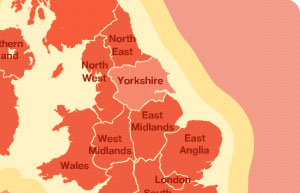
Away from the heather-filled moors and the coastline, Bradford, Hull and York have large student populations, while Sheffield and Leeds (only two hours from London) are more geared to clubbing and shopping.
More couples marry at a younger age (under 20, or between 20 and 24 years) in Yorkshire and Humberside than in other regions (along with parts of the Midlands and London). The percentage of people in their second or subsequent marriages in Yorkshire and Humberside is among the highest in the country for mid-30 to 50-year-olds. This region has one of the lowest percentages of single people across all age groups. Darren Smith, from the University of Brighton attributes this to different employment prospects. "Maps can mask some information," says Smith. "There are, for example, great contrasts between the regions that make up Yorkshire; the rural areas with more traditional family make-up and gender roles and West Yorkshire, where the views are more contemporary and the families have a very different social and economic make-up. We're now looking to see if family structures and relationships between the sexes are replicated when people move to a new region." Perhaps family dynamics are being altered by the current work culture. Families will differ according to whether they are male or female dominated. There are more non-married couples living together with children in Kingston-upon-Hull in Yorkshire and Humberside than anywhere else in the UK. This reflects a national trend towards the fastest growing type of family lifestyle. North East Lincolnshire is another area in the region that is among the UK’s top ten places for cohabiting couples with children. Yorkshire and Humberside also have a higher percentage of couples cohabiting without children than other regions of the North. Cohabiting with children is more common in the north of England than in the south, where living together without children and marriage with children are the two most common options.

|