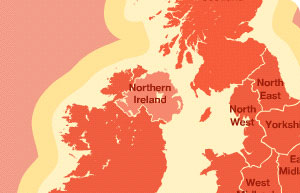
Fewer young unmarried people in Northern Ireland cohabit than their counterparts in England, Wales and Scotland. This can be attributed to religion and religious up-bringing, as well as strong family and community ties. Even though the birth rate in Northern Ireland is falling, it's still higher than in the rest of the UK. The birth rate of 14.5 per 1,000 of the population in Northern Ireland in 1997 is two per cent above England and Wales, and three per cent above Scotland for the same year. The trend, as for the rest of the UK, is to marry later in Northern Ireland. In 2002 the average age of marriage for bachelors in Northern Ireland was 29 years and the average age for spinsters was 28 years, compared to 27 and 25 years respectively in 1992. Only five per cent of couples cohabit in Northern Ireland compared with up to 14 per cent in the South of England. First marriages last longer in Northern Ireland than in the rest of the UK. More couples remain in their first marriage from age 25 to 60 and this percentage increases with age. The significant difference shows as early as the 25- to 29 year-old age group with nearly 36 per cent of this age group being in their first marriage. By ages 40 to 44 the gap has increased to 67 per cent in Northern Ireland with the nearest contenders being 10 per cent behind in Scotland. As might be expected in a country that is a bastion of marriage, and with a large percentage of the population being Catholic, the divorce rate in Northern Ireland is the lowest in the UK. However the divorce trend is still on the increase. During the 1970s there were around 500 a year. By the 1980s this figure had tripled to 1,500 a year. In 1991 the figure had reached 2,300, a number which remained stable throughout the 1990s. By 2004 the number had increased to 2,500 per year, an increase of 200 on the figure for 2003. The average duration of marriages that end in divorce in Northern Ireland is around 16 years. This compares with an average of around 11 years in the rest of the UK.

|