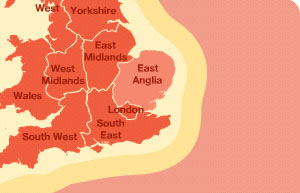
Although there's a concentration of married couple households with children in the east of England, the numbers are falling and being replaced by families made up of children with non-married parents. This national phenomenon started about 40 years ago. "Couples beginning to live together before marriage, many without the intent to marry - and some having children outside marriage, became wider scale in the seventies," says John Haskey, population expert, Oxford University. The East also has the East Anglian and Essex coastline, with its fashionable resorts, but in general it's less expensive than many other parts of the South East, so has attracted pensioner couples, lone pensioners and older divorced people. Southend-on-Sea is high in the Census 2001 league tables for separated and divorced people. There's a rich sprinkling of towns at the top of the cohabiting household league tables in the East of England: Dartford, Thurrock, Northampton, East Cambridgeshire, Harlow, to name a few. "Even though cohabiting has been a trend since the 1970s, it was felt inappropriate for the National Census to ask whether people were 'living together as a couple' before 1991," says Haskey "Norwich in East Anglia has the highest rate of cohabiting couples with children in the UK." Partners in a non-married relationship are more likely to be unfaithful than married couples, according to the results of our online Love Map survey, carried out in autumn last year. However, for both married and cohabiting men, the likelihood of being unfaithful is twice that of women in a relationship. According to the survey, which received over 46,000 responses, among non-married men in heterosexual relationships who had been unfaithful, 15 per cent said their partner had given consent and 11 per cent of women said their partner had given consent. Like most places in England, only about one third of marriages are solemnised in religious ceremonies in the East, but of all the regions here you will find the lowest number of non-traditional religions. Church of England, Roman Catholic, Methodist, Congregationalist, Baptist, United Reformed Church and Jewish are all represented but there are less than one per cent of ‘other’ religions. There are more households in the East of England with two parents working than in many other areas of the country. The online Love Map survey revealed that far more men and women who live with their partner would definitely leave if they found out their partner had sexual relations with someone else. Forty four per cent of non-married men and 49 per cent of non-married women would leave their partner compared with 23 per cent of married men and 31 per cent of married women. Most of the areas with high divorce rates are on the coast. People often move home after a divorce and many want to go somewhere they have had a good time in the past, such as a holiday destination. Or perhaps the likelihood of meeting a lonely heart in a similar situation is also a motivation for the move.

|