

- Contributed by
- actiondesksheffield
- People in story:
- Joseph Patrick gray, Mary Gray.
- Location of story:
- USA, Northern Ireland, Malta, Arnhem, Iraq, Palestine and Jordan.
- Background to story:
- Army
- Article ID:
- A5719494
- Contributed on:
- 13 September 2005
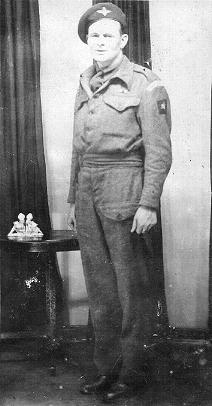
Joseph
This story was submitted to the People’s War site by Bill Ross of the ‘Action Desk — Sheffield’ Team on behalf of Mary Gray, and has been added to the site with the her permission. Mrs. Gray fully understands the site's terms and conditions.
===========================================
It was now 1 o’clock in the morning; I eventually got back home at about 4 o’clock.
I managed about 2 hours’ sleep, got up, had a bowl of porridge, got my bike ready, bumped into the old fellow in the yard, so I said to him, “I’m off now, I shan’t be under your feet any longer.” I headed off, but he ran after me and grabbed the bike and said, “You’re not taking this, it’s mine.” So I grabbed the lamp off the front and said, “Well, this is mine.” Away I went. Now I had to walk to the barn and get Heifer into town before all the buyers left. I also expected the old fellow to turn up. Anyway, I hadn’t long to wait for a sale; I finally got £8.50; robbed I suppose.
I went straight across to the pub for a Guinness and I met one of our neighbours in there. I told him my story; he talked me into getting a job, which he arranged, so I finished up on a farm again, living in full board and 12/- a week. It was great, I enjoyed the job, they were a very nice family. I was really content until Christmas. I went on Christmas Eve to a house where there were three daughters. At Christmas time, the lads took a bottle of whisky, especially if they fancied one of the daughters. I did; Maryann was her name. She was lovely, I thought. We had a good night, dancing, singing, eating and drinking. Finally, the drink ran out. We had a collection and I got the job of going into town at about midnight, to catch a barman who was hanging around waiting for such a customer. I did find one and got my order. I got to about a couple of hundred yards from the house, when two blokes stepped out in front of me. I can’t think what was said or happened, only me and one of them got tore into each other and we finished up on the road rolling locked in each other, through a thorn hedge and into a meadow a few feet below. What happened after that, I don’t know, they just disappeared, but when I got up, I could hardly walk. I thought I’d broken my ankle, but it was only sprained, so I found out later.
I couldn’t go back to my job next morning, in that state, so they put me to bed and sent for a man who was supposed to have a cure for strain. I spent a week getting back to walking, when I did, I went to my gaffer, gave him my notice, got whatever wages was lying and said goodbye. This was the 5th of January, 1937.
With the cash that I had, I hired a taxi and took the three lasses to a dance hall in Lissan, then I saw them home, wished them the best, then set off to Cookstown to join the army. I had no trouble at all (not like Chris who caught a bus through Dungannon) went on to Omagh Barracks. 7th January 1937: I’m a fully trained Irish fusilier. Three months square bashing, should have been six months. We must have been quick learners. While I was in Omagh, I won the lightweight championship. I did a lot of boxing after that and I never lost, but I won nothing big in honours, due to our sudden move after the three months stint. We got sent to Borden, a right down to earth dump; wooden huts, First World War and a right military zone, a little Sandhurst, seemed to be saluting and standing to attention all the time, if you weren’t in the guardroom. The only time I was in there was for being drunk. Our training was tense and severe, but they really toughened us up and I enjoyed it. It seemed we were set impossible tasks and it was great to get through them, though quite a few didn’t (no guts, you see). They got us into top shape, fit for anything, that’s why we got sent to Aldershot among all the top regiments, guards and such like. Even among that lot, we held our own. There wasn’t much excitement in Aldershot, just plenty of bull and drill. I once got the honour of being the best cleaned and dressed on a guard duty, which meant I didn’t have to do the guard duty, but was a runner for the Ardley room for the day. I’d rather have done the guard duty, as I stood outside the Ardley room all day and ran messages for all the brass and officers. I still managed to get to the pictures or films while we were here, as there was a garrison picture hall just a mile away, one at each end of the barracks. It cost 6d (2 ½ p). Often I attended both on the same night, I ran from one to the other hoping the other hadn’t started. Just before Christmas 1937, we all got embarkation leave. Quite a few didn’t go. I was one of them; imagine that fortnight in barracks on our own, no officers or duties, but plenty of pictures and a pint when we wished.
On the 5th of January 1938, we set sail from Southampton for Malta, on a lovely liner. All the troopships at that time were busy. What a lovely sailing, a bit rough till we got to Gibraltar, then lovely sunny weather all the way. The grub on board (we were treated as ordinary passengers) as you can imagine, three and four course meal and food we had never even tasted before. Naturally we had seconds if they were going. We got to Malta about the 11th or 12th. It looked like a dried up rock from the boat, which was, by the way, the SS California.
We unloaded onto the dock, were told to fall in, thinking our barracks were close by as there was no transport waiting for us. After we marched a mile or so, one of the officers pointed to a hill 3 miles away and said that was our barracks, “..so swing your arms and show the locals what you’re made of.” I could have told them. After that week’s eating on the boat, we weren’t fit for any force march, but we made it even though we were on our knees.
We got settled down and liked it a lot, there were still lots of bull and training but of course, that’s the army. Our social life was good though, off down to Valetta, and on weekends when we could afford it, down to the ‘Gut’ which was a street full of music bars and cafes, lovely young lasses in them all. If you liked one and she sat with you, and danced, it would cost you a sherry every time, at 1/6 (7 ½ p) each, which was a lot in those days. The girls only got 6d (2 ½ p), the rest went to the bar owner for allowing them in. My favourite was the Lucky Wheel and Mary, my sherry drinker. That was all, I’m sorry to say, and yes, I nearly did marry her. She was lovely though, Mary, my wife, once went with me to try and find her, but no luck after 37 year. I think Mary was glad, though she might have to come home on her own. She had nowt to fear, I still love her, Mary I mean.
We did the usual army training, drill guards, exercises, PT, we had plenty of time for swimming. I almost drowned learning. A chap by the name of Semple saved me. I was really on my way down for the third time; all I did was walk beyond my depth. I stood him a pint. We arrived here in January; as I said, it was now October 1938 and the Germans were taking over Sadatland, so we were in standby in case of trouble. There wasn’t, he just took it over.
As we were all ready to move, they packed us off to Palestine to defend the Jews from the Arabs. I was a lance corporal at the time. Our company was stationed in a hotel just off the docks in Italia. It was empty, we just took it over. We didn’t have waiters or servants; it was just like being in barracks. I was put in charge of the rations and seeing it was shared out fairly at meal times. All Grays in the army were called ‘Dolly’, so one day, I was sharing out a meal and there were some left overs. Someone shouted out, “Can I have some Dolly?” Don’t forget, I’m a lance jack. Who was standing at the back, but the sergeant major? He says, “Who’s this Dolly? I’ll see you in my office.” So he did and I came out without my stripe for being too familiar with the other ranks. I didn’t shed any tears for 3/- a day. We patrolled the streets similar to the Northern Ireland racket; bombs were going off in different places, land mines, raiding villages looking for anything explosive.
This went on until March 1939 and guess what, they packed us off back to Malta. Little did we know what lay in front of us; no one did. We landed back at St Andrew’s barracks, back to the usual bull.
I eventually got picked out for the motor transport, so off on driving instructions. I liked that, I passed first time. I got transferred to the Bren Gun Carriers, a tracked armoured vehicle, smaller than a tank. Joy again, off to learn carrier driving, also passed first time, what a clever boy!
At this time, we had plenty of time on our hands, off to town every chance we got, but the money was short, especially with buying sherries or showing off. I found a caretaker on a building site at nights, who was buying anything in the clothing line, or food, so I started a market. I went round the lads who were also short of cash, 2/- a shirt, 3/- a blanket etc. and I sold to this guy for 3/- and 5/-. This went on for quite a while until one night, I met the shirt man with an armful of stuff. I did my deal, got my sherry money and was on my way back to the billet through the fields, when I heard a night patrol in the distance. I daren’t let them see me because I was out of bounds, so I ran and fell down a stony bank and broke my ankle. As it happened, there was a bit of a wind that night, so I said I was covering the carrier and the wind got under the cover and pulled me off the carrier, and I went over on my ankle. I got over it but spent a month in hospital.
Come September 3rd, 1939, we went out in the country when we got the word about the war starting so they rushed us to an empty school, and it was raining cats and dogs. We never knew it to rain so heavy in Malta, we just sleep on the floor as it had been a rushed job. Now there was a war on.
With us being out in the country for those few days, we were scruffy, so they laid on a 3-ton truck to take a load to the baths. I was lucky as the truck was full. They didn’t get their bath as they had a crash. One was killed and mostly, the rest were injured. That was our first casualty of the war.
Now that war was on us, the carrier platoon wasn’t needed on Malta anyway, so we got split up and sent to different companies. The engineers and builders were hard at building bunkers all round the island. Each one could see the other, so every inch on the coast was covered from invaders, if we weren’t asleep.
I got sent to one of these, it was seven blokes to each. I was on the anti-tank gun, to blow the boats up if they came near, Unfortunately, I had to man it on the roof, as it was a long barrel. The others with bren guns and rifles could use them through the port holes. We did guard duty every night, 2 hours on, 4 hours off. We manned our posts every night from dusk till dawn, never much sleep.
Every day, four of us went on a working party while the other three looked after the post. At the beginning, we were wiring the island all around the coast, with barbed wire. Our exposed parts were torn to ribbons with old rusty wire. Almost everyone suffered running sores; desert sores we called them. I still have sores to this day. It wasn’t long before the air raids started. It was great first day or so, just watching them come in through the ‘Ack Ack’ fire. One of the biggest barrages of the war while we had ammunition. At the start, we only had three planes which were Gladiators, Faith, Hope and Charity. They put up a good show, to say they were so ancient.
We had raids almost every day, sometimes lasting all day and night. We eventually got used to them and wondered what was up if they missed a session. We used to say, “Where’s old Johnny today, or tonight?” We eventually got a few Hurricanes and Spitfires. It was great to see them in action, planes were getting shot down for a change; not so nice if they were ours of course.
The Italians and Jerries had control of the Med. by now. There were no supplies getting through, convoys of 13 to 14 ships getting sunk; odd ships were limping in now and again, which meant that we were low on everything from grub to ammo and planes. 40 Spitfires took off from a carrier well out at sea. What didn’t get shot down on the way in, got shot up on landing. We really cried when we saw it; the poor pilots did their best.
Now and then, a ship would snake in and then it was a rushed job to get it unloaded, so all drivers were required. I got the job; it got me out of that bunker at least. We had to cart the cargo out into the country for safe storage. It was mostly petrol and ammo, which was all right.
I got on the rations, there were plenty of broken cases, so we could help ourselves to an odd tin of bully or spam, anything eatable in fact. While we were on convoy duty, we pushed up at night, out in the fields, away from the bombing area, in a tent not far from an Ack Ack site. They supplied us with whatever meals were available, which was very little.
It was Christmas 1942 and the cooks had tins of steak and kidney, only the small size though. It was suggested by the medical people that a full tin each was too much, so we got ¾ of a tin. They said our stomachs wouldn’t take a full tin. I felt as if I could have eaten a lot more, but the cooks were great, what they did with the army biscuits (iron tack is what we called them) was nobody’s business. They melted them down and made some lovely pastry and cream cones, puffs, jam rolls, all just a picture to see.
At night, three of us had to guard the line of trucks because of the stealing by the Maltese and our own blokes. I suppose they could just sell anything. This night, me and a couple of others had the job; we patrolled the line of trucks a few times, and when we thought all were in bed and asleep, we decided to sit in the tent and have a game of cards. We got away from it; no one in authority came round.
========================================
Other parts to this story can be found at:
Part One: A5719331
Part Two: A5719421
Part Four: A5719656
Part Five: A5719719
Part Six: A5719791
Part Seven: A5719872
Pr-BR
© Copyright of content contributed to this Archive rests with the author. Find out how you can use this.


 Recommended story
 Story with photo