

- Contributed by
- actiondesksheffield
- People in story:
- Joseph Patrick Gray
- Location of story:
- United states, northern Ireland,Malta and Arnhem, Iraq, Palestine and Jordan.
- Background to story:
- Army
- Article ID:
- A5719331
- Contributed on:
- 13 September 2005
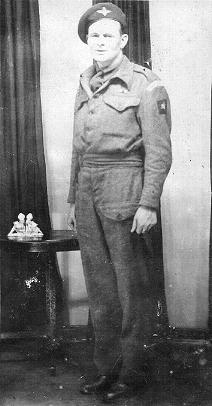
Joseph
This story was submitted to the People’s War site by Bill Ross of the ‘Action Desk — Sheffield’ Team on behalf of Mary Gray, and has been added to the site with the her permission. Mrs. Gray fully understands the site's terms and conditions.
===========================================
Preface
Although the early and final parts of this very moving story do not directly convey events of WW2, the bulk of it does so and in the sections that are accounts of the war experiences, there are reflections of the early parts, as well as forward references to the final outcome. The entire story is adequately epitomised in the Introduction that has been written by the wife of the author, and this will facilitate synchronisation of the various parts of the entire story.
Bill Ross (BBC Volunteer Story Editor).
INTRODUCTION
By
Mary Gray
This presentation was written by my husband, Joseph Patrick Gray. His journal tells his story of a big part of his life, from him being born in Philadelphia in the USA, and his youthful years. But mainly, it’s about his long army career from 1937 to1946 (+ 3 years reserve). He then lived in Northern Ireland where he joined the Royal Irish Fusiliers, aged 19.
After a period of training, he, along with the regiment, was posted to Malta, although it was still peace time. He was still there when war broke out. In total, he was in Malta for almost 6 years. The only time he got away was when Churchill announced that they wanted volunteers to start an army of airborne troops. My husband volunteered and he was sent to Egypt for rigorous training and to start parachute jumps. Then he and the rest were back to Malta — to starvation.
As no ships had got through the blockade, the soldiers and civilians alike had a bad time. There were air raids every day, over 3,000 of them in fact and they had no defence.
Well, at last, in June 1943, they were taken off Malta and boarded a ship, the first out of Malta for some time (they were still being bombed) and they landed at Port Said transit camp. He said that the first sight he saw that he’ll never forget was of piles of white bread; it wasn’t rationed either. The training was very hard but he enjoyed it. They were fully-fledged paras by now, doing 7 jumps a night. They were the first of a new battalion.
There is so much to tell in his story. I am and always will be very proud of him: what he went through, the theatres of war, Malta, Iraq, Egypt, Palestine, the Gaza Strip, Jordan, the Isle of Kos and more, but lastly, Arnhem. He landed there on the second day of the fighting, the 18th of September (his birthday) and he was captured on the last day. After a long journey by train in cattle trucks, they arrived in Czechoslovakia, to a prisoner of war camp. They were there for 18 months where they suffered starvation again, and worked in coal mines with rags on their feet. They endured this until they were liberated by the Russians.
There is another sinister story to tell in addition to this one, that being of a red tape incident that really broke his heart. When he went with the intention of laying a wreath from the Sheffield ex Paras Reunion, he was turned away at the Belgian border, purely because he was American by birth. He had a valid visa, but they would not accept it and he was escorted back to the boat, then sent back to England. All he could say was that they didn’t ask to see his passport when he jumped and fought at Arnhem and all the other places. He served 27 years in all.
My dearest husband passed away 7 years ago (in 1998) and on the wall of my home is a velvet based frame containing 10 medals from different theatres of war he was in. It will be passed on to my sons. My husband was worth a thousand of others, he was a HERO!
The Philadelphian
An Autobiographical Account Of A
WW2 POW
By Joseph P. Gray
I am Joseph P. Gray and was born in Philadelphia, Pa. in the USA, to Patrick Gray and Mary, both from Co. Derry in Northern Ireland. They met and were married in the USA.
We lived in a terrace house at 1510 Gunter Street; my father worked at the local gasworks and my mother was a housewife. What she did before her marriage, I don’t know. I had sisters, Helen and Mary who were also born in the USA. I know my mother had her hands full looking after the three of our father, and us, plus having to deal with the housework.
I can remember back to being two years of age, based upon incidences that I have been reminded of. The house had three bedrooms, bathroom, large front room and a kitchen, plus a large hallway leading to a stairway, with doorways leading off to the lounge and kitchen, and a cellar beneath. The front door was about four steps up from the pavement outside. There was a window-like entrance to the cellar from the pavement, where the coke for the boiler, that supplied hot water and central heating, was stored.
In addition to the central heating system, we had a fridge; it’s noteworthy that this was c. 1920 (it was 1953 before I was able to afford a fridge in Britain, and 1978 before we got central heating, which we can ill afford to run now in 1990).
We had plenty of relatives living close by, my father had four brothers and three sisters, all married with families. To my knowledge, my mother had three sisters; so really, we had an Irish community of our own. I remember we always had big birthdays, Christmases and Easters. Halloween was a jolly time over there, dressing up and playing tricks on each other.
We had a good playing area because as far as I can remember, our street was traffic free, so there were no worries for our mums. The main traffic and the trolley cars (or trams) were at the bottom of Gunter Street. We had a corner shop where we got our goodies. I used to fetch my dad’s Camel cigarettes, which I think cost 10 cents a pack then.
I started school before we left Philadelphia, but I don’t think I went for long because I can’t remember much about school, only that we were taught by nuns, whom I thought then were cruel, which I suppose they were at the time.
There are plenty of childhood memories that I have, but they are only ‘kid things’, which we all have. I never really found out why we left the USA at all, but I suffered a lot of illness at the time; I seem to have had everything that was going around, including having my tonsils out. Because of this, I always thought it was because of me. When I grew up, my father and I were never the closest of friends, a fact I may mention later.
We arrived in Ireland, which, as far as I know, was in 1925, so I would be about 7 years old. I seem to remember things better between 2 and 4 years, than I did after 5 years. I remember lots about the boat trip home, the cabin we had, the bunks we slept in. I remember standing at the rails and throwing a cent out into the ocean and I often wondered if anyone found it or fished it out. We sailed up the River Foyle into the city of Derry. The ship stopped well outside the city, so we entered Derry by a small tender. We arrived on the left bank, but we had to board another tender to cross over to the right, as the South Derry trams ran from that side.
Before I go any further with this, I must tell you that I have been talked (forced) into this by my wife and family, even supplying the material, but I am no Jeffrey Archer. I can’t write, I can’t spell and my memory is not so good, so if there are any wrong spellings, you will have to make the best of it, because I’m only saying this once, I’m not re-writing anything or tearing out pages, for the sake of wrong spelling, so there!
I can’t remember the journey from Derry to our destination, which was a small village in South Derry called Draperstown. The locals called it ‘The Cross’ because there were four roads going through it and they crossed in the centre of town. I can’t even remember arriving or what sort of welcome we had, I suppose I was that excited about our new surroundings. Can you imagine the difference between Philadelphia and Draperstown?
The first I remember was the next day when I went out into the street and a crowd of kids gathered around me. My Aunt Nellie, back in Philly gave me a good impression of Ireland (encouragement I suppose), about all the good things. One of them was that apples grew on trees. I’d only seen them in shops in Philly. Referring to the kids again, I was asking them where these apples were. Years later, I realised that the kids were only around me to hear me talk.
Anyway, we stayed with my father’s mum and dad; where we slept, I don’t know because it was such a small house. I don’t know how long my mum and dad stayed there, but it must have been a while because I started school in Draperstown, but I can’t remember much about school.
The reason I was left with my grandma and granddad was that my dad had bought a farm, which was about four miles up in the hills. He and my mother were trying to get it ship shape, which I often heard was a right tip, but they eventually got it into a liveable state so then I moved into my new home. Compared to Philly however, it was a wilderness.
This farm was bought from my mother’s brother Pat; it had been left to his wife by her family, the Cleary family. It is situated on a hill with two other farms, they were all called Cleary, so the locals called it ‘Cleary’s Hill’. This hill is between two rivers: The White Water and guess what, Cleary’s Burn. Often, after a rainstorm and floods, we could neither get in or out; we would have to stay at one of the nearby farms until the rivers went down. There were no bridges of course, only foot sticks as they were called.
I really enjoyed the wilderness when I was small and senseless; the wide-open spaces, as compared to Gunter Street, but even so, I had to go to school, but as I grew up, things became different.
I didn’t mention that my dad was robbed completely for this farm. It cost him over £600.00 at that time (1925). They say it was worth only £200.00, but my dad, not knowing anything about farming, fell for it, and to say it was from my uncle, my mother’s brother. They were never the best of friends afterwards.
Naturally, I had to go to school, which was about two miles away across fields and woods. There were two rivers to cross in all weathers. You can imagine the winters up there. The school was a small one in the town land of Bracke, therefore, naturally called Bracke School. We had two teachers, the head teacher Mrs Bradley and the juniors’, Miss Bradley (no relation). We stayed there until we were 14 years old, I never heard of anyone going to higher education, well, not while I was there anyway, but if anyone did, it had to be paid for.
While we were at school, my dad was working the farm with a hired hand whom he paid 2/- (2 shillings (10p) a day, getting the ground ready to plant. If it was potatoes, when we arrived home from school, we would have a scone, then put on a bag apron, fill it up with as many spuds as we could carry, and start dropping them into the drills that my mum and dad had been preparing all day until it got dark.
In the harvest time, we were never out of the fields after school. We were stucking corn, gathering up hay, up to the moss to foot, clamp or stack turf for our winter fire. When the spuds were ready, my dad and the helper would be digging all day. The spuds were laid on the ground and were waiting for us coming out of school to gather them up and store them in the pits before it got dark. Turnips had to be pulled up, de-rooted and leaves cut off and chucked into carts. This was mostly done in frosty weather and snow. After all that, we’d fetch the cows in and maybe milk them. After all this, we’d come in for a bowl of porridge.
I am now reaching school leaving age and believe me, I didn’t want to leave. I was really getting into learning and wanted to continue, but it was too late, so in September 1932, I was a man of 14 years of age, but really, still a kid, working at a man’s job on the farm. There was no machinery at all, just a spade, fork, a horse and a plough. Being only 14 years old, I would take the place of the hired man, but I didn’t get 2/- (2 shillings (10p) a day. Perhaps when a beast was sold at the fair, I’d get the two shillings, and honestly, you would think he was giving me a fortune.
The farm we lived on had belonged to Francis Cleary, the next farm belonged to Margaret Cleary and the one at the back belonged to Mick, so all Clearys. They eventually all died off, so my dad bought the lot, therefore, he ended up owning Cleary’s Hill, now Gray’s. Margaret’s farm was half as big again and the one we lived in, Francis’s was about 300 acres. Mick’s was about 100 acres and together, they cost about £400.00, but not forgetting, he paid over £600.00 for the first one. What a sucker eh? All this was about ten years after he bought from his brother in law.
My dad was no farmer to start with, that’s why he hired hands at first. They showed him everything, so he carried on in his rough and awkward way. Everyone was wrong except for him; he really was a cruel man, not only to the animal but to us, his kids. We were blamed for all the cattle going astray, breaking into crops, anything and everything that could go wrong on a farm. Our punishment wasn’t just a slap on the face, but a rod around the legs, which were always bare to the knees. This rod was like a cane; it used to wrap around the legs and leave black whip marks around both legs, visible to everyone. We always hid them the best we could from everyone, we were that ashamed, but he wasn’t.
We did have our good times playing in the summertime, wading in the river and bathing in the big holes in the rivers, playing hide and seek, gathering berries when they were ripe. This was mostly when dad was off somewhere and well out of sight. By now, I had another sister, Catherine, and a brother, Danny. I’d be about 12 when my mother died giving birth. I got to know later, but then, we were ignorant of such things, unlike today’s kids.
The day she died, a Sunday, she woke me up to go to mass at 9 o’clock, which was about 3 miles walk away, I was to go down to town, to my grandmother’s and tell her she was wanted. She gave me a bowl of tea (there were no cups then) and a scone. She just left me and told me to make my own way home when I’d finished. She knew what my mother meant when she said to fetch the doctor. There were no hospital births in those days; it was all done at the farm.
To me, my mother was that morning, as any other morning. I can even remember her dress; it was a big loose green satin one. I know why now, but I didn’t know then. It was one that came from the USA in a parcel with others. I hung around the town and spent my pennies, then I went round a few gardens that I knew had some gooseberries. ========================================
Other parts to this story can be found at:
Part Two: A5719421
Part Three: A5719494
Part Four: A5719656
Part Five: A5719719
Part Six: A5719791
Part Seven: A5719872
Pr-BR
© Copyright of content contributed to this Archive rests with the author. Find out how you can use this.


 Recommended story
 Story with photo