

- Contributed by
- actiondesksheffield
- People in story:
- Joseph Patrick Gray
- Location of story:
- USA, Northern Ireland, Malta, Arnhem, Iraq, Palestine and Jordan.
- Background to story:
- Army
- Article ID:
- A5719791
- Contributed on:
- 13 September 2005
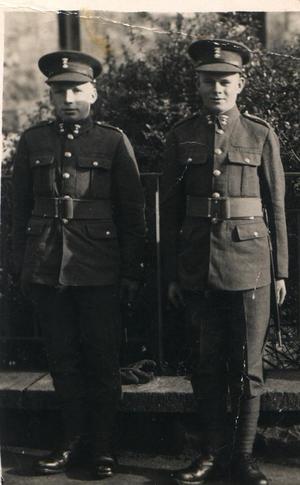
Joseph and Mr. Gormley.
This story was submitted to the People’s War site by Bill Ross of the ‘Action Desk — Sheffield’ Team on behalf of Mary Gray, and has been added to the site with the her permission. Mrs. Gray fully understands the site's terms and conditions.
===========================================
On the morning shift, we were paraded at 4.30 am, inspected and counted, then marched about 2 miles and we had snow all the time right up to mid March. The cold at that hour of the morning was unexplainable. Our breath froze on our chests, after about half an hour, our coat fronts were white and even our eyelashes froze. We couldn’t blink because it would feel like electric shocks when the eyelashes touched our cheeks. I managed to keep working; we had to otherwise our rations would be cut by half. Often, when we were on our way to or from the pit, our planes would come over and we would have to scatter. During one of these raids, it seems that the men scattered all over the place and a lot of them got to the pit on their own. The Jerries were more frightened than the prisoners, so they rushed as many of us prisoners down the shaft as they could, not for the our benefit, but more for their own. They had no name check on us, only numbers, like twenty down and twenty up. So with all the excitement of the raids, four or five of our lads managed to get back un-noticed to the camp, so when that shift came back up after eight hours, there were four men missing. The shift that was waiting to take their place knew that, so instead of 20 coming up, only 16 did, so four of the 20 going down, joined the 16 who had just come up, to make the number up to 20, for the benefit of the Jerry guard. He was no wiser, 20 in, 20 out, so he was covered. So from that day up to the end, there were 4 men short on every shift as each shift had to be made up. We all got a turn at missing a shift; we called that shift, a Churchill. Believe me, I think it would have been more comfortable to work, because when on a Churchill, we had to hide all day in case the guards tumbled to the scheme. It was for Churchill, for England.
Like all pits, even in this country, we changed our clothes before we went down; we had a shower and changed back into our best (rags) when we got back up. I enjoyed it down the pit. The Russians had all the dangerous jobs, such as at the coalface; they didn’t have to crawl on their stomachs, as in our pits. The seams were so deep, so they blasted upwards until they came to the earth or rock, or whatever came first. That is where the Ruskies worked, sending all the loose coal out to us on the main passageway and into the wagons which we had to hook onto a cable that pulled them to the lift. This cable had to be pulled down to the catch on the wagons; no easy job as the cable was on the move at all times and couldn’t be stopped, except in emergencies. Once, I pulled it down too far (I was strong), and it missed the wagon’s catch, but caught me under the chin. It lifted me up and threw me across the passage, onto the other line which I just missed with my head. I came round after a while. I’d just a few bruises but I had to keep working or starve.
Once, I was tidying up the main passage, picking up the loose coal that had fallen off the wagons. I got caught short and needed a toilet. The first to come along were the shift change hand. They were all Jerries; one of them asked me what I was doing, so I actually asked where the ‘Shisen huizen’ was, but he thought I had called him one instead. What a job I had, miming what I really meant. He finally got my meaning. A similar thing happened one night. I happened to be on a ‘Churchill’, having a game of cards, when one of the other lads rushed in, all excited and shouting, “Get me a plate,” or something. “The Jerry guards have got some fish paste for us, hurry before they move on.” They patrolled round the wire fence, which was close to our hut. He got his plate and rushed out. We were all looking forward to a fish paste sandwich, if we had any bread left. He came rushing back in saying, “Bloody fools, they only asked the time, which in German is, ‘Ish pate’” It does sound like ‘fish paste’, but when you are hungry, everything sounds like something to eat.
Life as a POW never altered much; not for the better anyway. We kept getting our mail. All the older POWs still got parcels from home. We always got cigs, when a parcel arrived for our hut. If we were at the pit when the parcel arrived, the on coming shift used to say, “There’s a fag on your bed.” The receiver always placed a fag on all the beds in the hut.
I preferred working night shift; it was warmer down the pit. All we had in the hut was two blankets and we had to lay on one of them. When it snowed, I woke up and found little lines of snow about six inches apart, where it had blown between the boards on the roof. There was no felt covering at all, only bare boards, not even overlapping. The nearest toilet was 100 yards away and in that weather, it was no mean task. I was there every two hours, so down the pit at night was home from home for me.
So that was our life as a POW, day in, day out. We did see our planes fly over, all 1,000 of them. To our right was Dresden; to our left was Leipzig, about 40 miles away. We could see the sky glow for ages after the bombings. The problem was that some of the damaged planes dropped their loads short and if any of the bombs hit the railway lines, we had to repair them the next morning, and in that cold, the frost was so severe, it was three feet into the ground. We could see the proof of that from the bomb craters. The rail tracks were so cold, they burnt our hands, but we had to keep going. The trains must get through, unfortunately, to provide the German army with the supplies they needed to fight our lads with. This went on up to the end of the war.
The first we knew about that was when a convoy of Russians came past our camp: tanks, lorries, mostly American Dodge 3 tonners. Thank God for the USA; like us, the Russians were depending on these supplies.
The Russians went straight through, they didn’t even wave to us and we were cheering them. I saw three 3 tonners go through, loaded high with loaves of bread. That was the main reason we were cheering, hoping they might throw us a few loaves, but they didn’t. It took them three days to pass through. All the heavy stuff went the first day, tanks, and guns etc. The second day, all the foot soldiers, but on the third day, it was all the civilians. It seemed that if their family followed them, they trundled in civilian transport, right down to the donkey cart, all loaded up with the spoils of war. They left nothing driveable or eatable.
When we picked ourselves up after our disappointment, we realised that our German guards had done a bunk, so we were free with nowhere to go. We were like that for a week. We raided all the stores, but there wasn’t much left. We were surprised the Russians didn’t raid them also. We were able to roam about on our own now. I got down to the village; that was our first day of freedom. We found one empty house, and guess what, it used to be a German Officer’s and it was loaded. It even had his uniform. I got a good pair of shoes, my size, and plenty of grub of all kinds. A lot of it was strange to me, but eatable.
All I thought about was to get as much together as possible, so I could give the lads a treat, back at the camp. I found a big bag, like a mattress cover, and I gathered everything eatable, even cordial. I got it onto my shoulder and went outside. There, I saw a rabbit hutch with a lovely big white rabbit. I got it out and tapped it on the back of the ears, and stuck it in the bag. I forgot to mention that I also found some dry tea. I hadn’t seen any of that since I left England.
I went down the street for a bit, and I could see Russians all over the place. They were ransacking every house and shooting anyone who got in their way. What could I do? I couldn’t run with this sack of stuff (it was heavy), so I put what I could, in my pockets and around my body, then dumped the sack, much to my regret. But I dodged them and got back to camp and had a nice cup of tea.
We waited a week before the Yanks came and got us away. They arrived in 3-ton trucks; there were about 30 in each truck. They took us to tents in the woods, just outside Prague. They ran us all around the square in Prague. I was leaning on the cab of the truck, waving the Union Jack. It was a faded old thing, but it was a great feeling. We finally got a decent meal. It was that good, I can’t remember what it was, but it was something solid at least. We hung about for a few days, then they flew us out to Brussels where we got cleaned up and rigged out with new clothes.
The sight I shall never forget was when we walked into the dining hall for our first meal. There was a table at the end of the hall, stacked high with the whitest bread loaves I had ever seen. After the German black bread, it looked so good.
We got back to England, how and where to, I just can’t remember. I was so excited at getting back home, Attercliffe would have done me. We got settled into a transit camp for a few weeks. We were well fed and clothed, and enjoyed freedom. Eventually, we got sent on leave for 12 weeks. I think the army wanted our families to build us up, rather than them doing it. I didn’t enjoy my holiday. Eight years out of Civvy Street takes some getting used to. I just spent my time in pubs, getting drunk most of the time. I was eventually sent to a camp at Shoreham where I met up with a lot of my ex-prisoner colleagues again, plus some of my fellow Irish Fusiliers. I seemed to be more at home there, than at home.
I was there quite a while, it was September, harvest time, so they sent us out to help the farmers. I got sent to Lord Ennisdale’s estate with another couple of lads. We enjoyed gathering up the crops and corn, wheat and whatever. I had a good idea what to do and how to do it. The others just followed me; they were city clickers. The foreman noticed my usefulness and asked me to go back after demob. I might have been a lord by now. I only saw the man once; we got £1.00 a day, more beer money. It was too good to last, so they sent a batch of us to the Isle of Wight, Albany Barracks (which is now the prison). I got the job of helping to lay a football pitch and digging drains. It was like digging trenches again. I had enough of that in Malta and Arnhem. One Sunday morning, it was raining so I got back into bed. I was put on a charge for sleeping in (7 days confined to barracks). This meant that I had to answer to the guardroom every couple of hours up to 10 pm. I did it for a couple of days then they sent me back to the main camp again; I suppose they thought I was going to be a handful (I wasn’t really). I’d just had an extra hour in bed on a wet Sunday morning. Some thanks for Malta and Arnhem, so with me being on punishment and only two days of it done, I took a chance at not reporting. Instead, I dressed up and reported to the guardroom on my way out for the night, and every night afterwards. They didn’t, or they forgot to send my charge sheets. Forgot, I should say; it was no big deal really.
From the Albany Barracks, on the Isle of Wight, I got a week’s holiday for Christmas 45. I palled up with a lad from Doncaster, so he and I set off. My intention had been to go to Bath to meet a lass whose address I found in the pocket of a pair of trousers I got before Arnhem. We communicated while I was a prisoner; I got a few letters. I even asked my family to send her a turkey at Christmas, which they did. If I had gone there, I’d have got a turkey dinner, but my mate talked me into carrying on to Doncaster and to call at Bath on our way back, which we didn’t. We dropped off at Sheffield and I think he went on to Doncaster and I finished up on my own.
Coming out of the Barley Corn pub one night, two nice lasses stopped and asked me if I was going home for Christmas, which I wasn’t. So they asked me to get another couple of homeless soldiers and come to their party, which they held every Christmas for us homeless folks. I promised, but I had no intention really, I was shy you see. After promising, they got me to go to the pictures. We queued for a while, so we got to know each other. There was Doreen; she did all the talking, and shy Mary. Doreen’s boyfriend Cyril was in the navy and had been to Malta, so we had something in common. I had more in common with the shy one, Mary; it was love at first sight. I kept going to the toilet (the beer you know), but they held onto my beret, to make sure I came back, but it wasn’t the beret that fetched me back. After this, I had to go to the party, so I turned up to meet them the next evening, with the other two.
We arrived and had a nice meal and a good time, well, I did, the other two, I never saw again. When the party came to an end, Mary and her pal walked all the way back to town with us and we were lost. We exchanged addresses and that’s how it took root. I think there was a letter every day; Mary still has some of them. About eight weeks after Christmas, I was demobbed and I more or less headed for Sheffield, Carrfield Road to be precise. There I was welcomed with open arms. I got my feet under the table right away, and I got a job in the sheet mills, Firth Vickers at Tinsley within a few days. All this happened after the 25th of January 46. Mary and I got married on the 16th of March 1946, which was a lovely day. I’d wanted to marry on Paddy’s Day, but that was on a Sunday. The reception was held at Lucy’s, just across the road, and we went on our honeymoon to Carrfield Road, then back to work on Monday. Mary went back to Tyzaks. My first week’s wage after our marriage was £4 — 11s — 0d (£4.55p). I took out the one shilling (5p) for my bus fare home, and gave Mary the rest. She gave me £1 — 10s back and that lasted me till the following Friday. It paid my bus fares all week, cigarettes and a couple of nights at Upper Heeley Club. It wouldn’t pay one bus fare today.
On the 7th of February, 1947, our first child, Catherine was born in the front room. I had the day off. It was all over before 10 am. She was a lovely baby; her mother did a great job. It was just like shelling peas.
=========================================
Other parts to this story can be found at:
Part One: A5719331
Part Two: A5719421
Part Three: A5719494
Part Four: A5719656
Part Five: A5719719
Part Seven: A5719872
Pr-BR
© Copyright of content contributed to this Archive rests with the author. Find out how you can use this.


 Recommended story
 Story with photo