

- Contributed by
- actiondesksheffield
- People in story:
- Joseph Gray
- Location of story:
- USA, Northern Ireland, Malta, Arnhem, Iraq, Palestine and Jordan.
- Background to story:
- Army
- Article ID:
- A5719719
- Contributed on:
- 13 September 2005
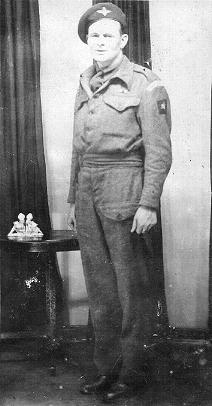
Joseph
This story was submitted to the People’s War site by Bill Ross of the ‘Action Desk — Sheffield’ Team on behalf of Mary Gray, and has been added to the site with the her permission. Mrs. Gray fully understands the site's terms and conditions.
===========================================
What a welcome we got on that day compared to the one before. There were planeloads shot, out of the air, gliders piling up everywhere, on their noses, on top of the trees in the woods, but once again, luck was with me. I got down safely, but I lost all of my kit, which was hanging from a rope around my waist. Imagine that, the rope was shot and I was unscathed. I crawled around, trying to find it; all my 48-hour rations had gone and my rifle. I did find a rifle, but the butt was smashed; every time I fired it, I had to bang the butt back into place. I wasn’t lucky enough to find anything to eat.
We were scattered all around the dropping zone but no-one seemed to know what was happening or where to go. Someone shouted, “OVER HERE!” So we headed for the woods and got formed into groups, then headed for Arnhem and the bridge. It was about 7 miles away and all the way, we didn’t have a shot fired at us. There were plenty of shells and mortars and the unlucky ones copped for them. My group got right to St. Elizabeth Hospital, which was within sight of the bridge. There we ran into our first opposition, rifle fire from the railway banking behind the hospital. We all dove for cover and we only had one casualty, Tommy Armstrong, a pal. A bullet went right through his haversack, which was packed with all sorts of ammo, grenades, mines and bullets. The bullet came out of the bottom and through the drinking mug, which was hanging on the bottom, then it went through his heel, but only through the hard flesh. He was taken to hospital but was soon back in action again.
The firing eased off, so we moved across the hospital grounds to the railway banking and could see no enemy. Where they go to, God knows, there were a few Jerries dead. I don’t know if we got them, or who. We could see right across the railway; there was a road, about 400 yards away and coming down that road was a full company of Jerries. They had their 2 scouts out in front of them. That was my first shot at the enemy. I fired at the first scout and he fell. I couldn’t fire again because I had to bang my rifle butt back on, remember? But I managed to get the other scout as he ran forward to help his mate. I fired and he fell on top of him, so I did do a little bit towards winning, but there was the company of Jerries at the back. I shouted to our officer in charge, but he said, “Hold your fire.” We realised then that he was yellow and didn’t want to give our position away, actually - his position. He could have opened up because we got hunted out as tanks were coming up behind us. A broken rifle was no match against a tank, neither was a good one.
So we were on our way back; we did see the bridge though, plenty didn’t. We retreated about a mile to a farm and dug in, which was easy, as it was sandy. It seemed as if we were going to be OK for a bit. Now on this farm there were some chicks, yes, big Rhode Island Reds. By the way, the farm had been shelled and wrecked; the coal shed was on fire and there was a lovely big smouldering heap of coal. What a lovely fire on which to roast a chicken. I’d been to the house and found a saucepan, a lovely big one. I caught and plucked a chicken. All the vegetables you could want were in the gardens. I got the saucepan onto the fire when someone came and picked me to go on patrol. The Bren gunner, a sergeant and myself were sent out to find out where Jerry might be. We’d gone quite a bit before we made contact at the end of this village green. We were hidden in a hedgerow, when over the top came a tank with a whole company of Jerries. I was in good view, so I asked for the Bren gun. All I could do was get a good burst in, then run, hoping to get as many as possible. I got them in my sights, ready to press and spray. I pressed and nothing happened, and they were getting closer, so I asked the sergeant for his Sten gun (which was only a toy at the best of times). Guess what, that didn’t work either, so I grabbed my own rifle and let go right into the middle of them, so surely, I must have got one of them. They were closer now, so it was run for our lives time. I jumped a wire netting fence; I swear it was 12 feet high. I ran all the way back to, our positions. Jerry had sneaked up on them, so we were off into retreat again. The chicken was still on the fire and I wondered since, did somebody find it before it boiled away.
The reason the guns didn’t work when asked to do so: I mentioned the sand earlier; we were ordered out without having time to dust down our weapons. The Bren gun was covered with sand, the Sten had an earwig right across the firing pin, but my busted rifle worked once again, so that’s another notch on my butt. That’s 3 to my credit now and I’m afraid, that was it.
It was getting dark now, so we kept going back until we came to the area around the church and Kate Horst’s house. I had attached myself to the Bren Gunner as he had lost his mate and my rifle was useless. He was from Dublin too, and belonged to my old regiment. We dug in at the bottom of Kate Horst’s garden. There were some apple trees, so we helped ourselves. The thing is, everyone else around the area did likewise, so they didn’t last long. I had no rations, as I’d said, but my gunner shared what he had with me, so we were soon without. I lost all trace of time, just stuck in the trench. The both of us fired an odd shot in the Jerries’ direction to let them know we were still there. The trouble was that they answered it. There was plenty of mortar fire from them too, we had none of course.
We were once having a mashing (brew) and Dennis, my mate, lit the little gadget we had and I was reaching to the top of the trench for his knapsack, to get the tea mixture, and Dennis said, “OK, I can reach it.” He did, and a lump of shrapnel hit him on his right arm. If I’d reached up, it would have got me in the head or a bit below, so I would have been a head case. He had to go for First Aid which was in Kate’s house, which was packed with the wounded and dying. All around the outside of the house were bodies.
Dennis stayed in that night, so I was on my own. I had to stay with the gun; there was nowhere to go anyway. He got back the next morning with a very bad arm.
All this time, we hadn’t seen an officer anywhere. Where they operated from, I don’t know. A couple of days before the end, we were asked to gather in the church leaving someone to mind the guns, so Dennis got the job and I went to the church to get a low down on the state of things. We did get a bit of warm stew, about a ladle each.
It was Major Lonsdale who addressed us; all he could tell us was what we already knew, that we’d had it. But we did have a slight chance if the Yanks could get through, which they didn’t. We hung on for another couple of days. Finally, the word came through that we were getting out. We were ordered to head to the river as there were boats laid on to get us across. As we were nearest the river, we were the last to be told, so the line to the river reached almost back to our trench. This would be about 10 pm and the line moved about 10 paces every hour, which meant dawn was on us before we got near to the river. By then, there were no boats left; Jerry had seen to that when daylight broke out.
They say 2,000 got out, 2,000 were killed and as many were wounded, so at least 4,000 of us were taken prisoner. We were all spread along the river (The Rhine) not knowing what to do. Some tried to swim, some did, some drowned and some were swept away, as the current was very strong. I tried to swim, but it was too strong for me. Jerry was still firing at us, spraying the river. It was awful to see so many drop dead especially when it was supposed to be all over. They were falling so fast, I couldn’t see myself making it, so I kept picking out objects on the bank, such as a daisy, a stone, a match and saying to myself, “Shall I reach that daisy, that stone, that match?” and I did. Luck was with me again. Jerry rounded us up and marched us into Arnhem, to a yard where they’d got all the rest of the airborne stragglers.
On our way back there, we were marched through a wood and through an avenue of tanks. The crews all sat on them jeering at us whilst smoking our cigarettes and eating our chocolate, making sure we saw them as they flashed Capstan, Woodbines and Cadbury’s. All these and our rations were dropped in their area.
After an hour or so, they lined us up again, no food or anything. They marched us right across Holland (I think) to a railway siding where there was a line of cattle wagons, but they did give us a loaf to share between 8 of us, before they loaded us onto the wagons. There were 48 in ours, the others too. I suppose half of us could sit if the others stood, so we took it in turns. It was a long journey: Cologne, Frankfurt and other places. We eventually arrived at a POW transit camp where all POW’s are checked through and allotted a camp. All particulars are taken, all valuables, money and details of next of kin. The Red Cross reps were there, seeing fair play was in order. All money and valuables were supposed to be returned after the war, but I never heard from anyone who received anything back. We stayed the night there and I got the job, with half a dozen others, to go to the cookhouse and collect our rations, which comprised a container of their soup, which was really milky. There was coloured water with a few potatoes in the bottom and a bit of something green floating on top. As I stood outside the cookhouse waiting, I saw in a patch outside, some Brussels sprout stalks, if you can imagine a Brussels stalk. It is about 3 feet long, no sprouts, just the stalk. I whipped it up and stuck it under my jacket and got away with it. What a feed I got off that stalk. I had helpers of course, and they had no idea what it was, but they enjoyed it, and so did I. I still like my cabbage stalks.
Next morning, we set off again on another part of the journey, to a camp with POW’s, some from the beginning of the war. I ran into some of my Irish Fusiliers mates. They were captured on the Greek Islands, one of the islands we had left in September 43; what a small world.
While we were in this camp, we got a Red Cross parcel between two. My mate was a chap called Kent from London, also a para. He was one of the young ones who joined us when we arrived back in England. I was in charge of the parcel, we shared it out the best we could. The idea of the Red Cross was that we got one of these weekly and this was our first. It turned out to be our last too, but it was great while it lasted. It contained about 50 cigs, tinned meat, biscuits (which were the army hard tack again, so I softened them with milk), dried fruit, jam, sugar and a 7lb bully beef tin, empty of course. I cut it in half and put the mixed batter in one half and used the other half as a lid. There was a fire in the hut; stacks of red hot ashes, so I stuck it in the hot ashes and left it an hour or so, thinking I had wasted all that good stuff. I lifted it out of the ashes and left it to cool. As we still had plenty of the parcel left, we decided to leave the cake or whatever it would turn out to be, until later. As it happened, we were on the move the next day, to another camp. We went part of the way by truck and marched the rest. It was a long march by the way, through snow. It was well into October by now. While we were in the truck, we decided to open the bully tin, expecting the worst. It turned out to be the most gorgeous cake I’ve ever had. The smell was rich and fruity and the taste was out of this world. Everyone in the truck was amazed at the strong rich smell, but that was all they got. The both of us just scoffed it; sorry I didn’t save the recipe.
We eventually arrived at our camp, which turned out to be our last and final one. As far as camps go, it was the usual wooden huts, well wired in a guarded camp area. There were wooden bunks, one up and one down, two blankets each. I was on top, as all the longer prisoners had the bottom bunks. Some of them had been there for four years, but they had been living pretty good, as they had been getting regular Red Cross parcels and some from home, but the Red Cross was a thing of the past now. The excuse was that the trucks couldn’t get through because of the fighting and the bombing. These trucks were called the ‘White Ladies”. We kept hearing rumours that the White Ladies had been sighted, but we never saw them, somebody did, but not prisoners I’ll bet.
We got rigged out with our prison uniforms, comprising old trousers, shirt and heavy overcoat with a big coloured patch on the back to denote we were POW’s. Our camp was Kolumbus, near Bruix, Czechoslovakia. If we were workers, we got the eighth of a loaf, a brown round loaf that weighed about 2lbs (almost 1 Kg). I should say that it was of a very heavy substance; more like concrete that flour or wheat. I’d say that I couldn’t eat it without toasting it, which we did by sticking slices on the outside of the stove in the middle of the hut. We queued up to get a place on the stove. We had some cheese too, which I could never eat; it stank. It looked like a thick candle without a wick. Once a week or so, we would get a piece of German sausage, about an inch, I did like that. Once a day, we got a bowl of stew (shilly). It looked like milky water with bits of veg and potatoes, if you were lucky.
I worked down the coal pit. It was 900 feet down and it took ages to get to the coalface, but that time didn’t count. Our 8-hour shift started when we reached the coalface, so it took 12 hours to do an 8-hour shift.
==================================
Other parts to this story can be found at:
Part One: A5719331
Part Two: A5719421
Part Three: A5719494
Part Four: A5719656
Part Six: A5719791
Part Seven: A5719872
Pr-BR
© Copyright of content contributed to this Archive rests with the author. Find out how you can use this.


 Recommended story
 Story with photo