

- Contributed by
- actiondesksheffield
- People in story:
- Joseph Patrick Gray
- Location of story:
- USA, Northern Ireland, Malta, Arnhem, Iraq, Palestine and Jordan.
- Background to story:
- Army
- Article ID:
- A5719656
- Contributed on:
- 13 September 2005
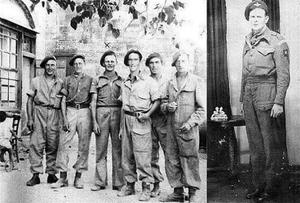
Joseph in Malta
This story was submitted to the People’s War site by Bill Ross of the ‘Action Desk — Sheffield’ Team on behalf of Mary Gray, and has been added to the site with the her permission. Mrs. Gray fully understands the site's terms and conditions.
===========================================
I was one of the first batch to go on convoy duty that morning. It was still dark when we set off to get the truck ready. Mine was a 3-ton Ford V8, which was easily started, shoved into gear, let the clutch out and it wouldn’t start to move. I got out to see if there was a stone under the wheels. There was no stone, it was worse than that; there were no wheels. The truck was jacked up and all five wheels were gone including the spare. Oh why did I have to be on guard last night? We were under suspicion; they couldn’t prove anything and they searched all our kit, expecting to find money for the sale I suppose. The wheels would fetch about £40.00 at the time, a lot of money in those days. As it happened, I had about £25.00 and I was only drawing 5/- a week, so I had to be sharp. We were in tents, so I scraped a hole in the ground beside my bed and stood in it as they inspected my kit. How I happened to have the £25.00: one morning, down from breakfast, I saw this wad. I thought it was someone’s love letters, but it was a wad of £1.00 notes. I ran all the way to the toilets before I checked it out. One of the lads saw me pick it up, so he followed me and was knocking on the door, so I peeled off a few and handed them to him. I counted it and I had £126.00. Afterwards, he told me I’d given him £26.00. I said that he was lucky because he had more than me.
The next day, I was in town and I went to the Post Office to send £50.00 home. I turned yellow with worry, in case there would be an enquiry, what with so much black marketing going on. I looked across the road and saw a pub with a beer bottle on the counter, which was also a rare sight. So that was that. I got four nights out and enjoyed it, and so did a lot of my friends; I had plenty of them. Anyway, we got away with losing the wheels, they were that busy trying to prove that we stole them; they forgot to charge us with neglect of duty.
After the ships were unloaded, they kept me on the trucks. A 15 cwt (hundredweight, approx 50 kg) truck this time, but it was filled with rocks and stones. We stood by ready to mend the runways after all the raids. I helped to fill a lot of holes and had some close shaves doing so. When the raids died down, we would refuel the planes.
After a spell on that job, they decided to form the carrier platoon again. Not long after this, they asked for volunteers for the Paras. I think everyone did; they had even asked for submarine crews, but it was serious this time, it was June 1943 now. We’d had over 3,000 raids.
Before I leave Malta, I have to tell you about when I was a bad boy: before I went on the convoy duty, I went absent off parade and got drunk and was locked up overnight. That led to eight days confined to barracks and having to answer roll call every few hours when not on duty. I refused this and got 168 hours detention, more or less locked up all the time with lots of tasks to do at night, such as cleaning mucky rusty pans, containers etc. I also refused this, so it was 3 days of bread and water. By God, they were three long days. After that, I was made a soldier, but believe me, I really did this just to experience it all. I wouldn’t like to do it again.
So, we boarded a ship, the first one out of Malta for ages, and off to be a Red devil, but we didn’t expect to get there as Jerry was still flying about of course. You know, we made it; we landed at Port Said transit camp. We soon got to the dining hall, don’t forget, we didn’t know what a dining hall was for. It was about 18 months since we had had a chance to use a knife and fork. When I walked into that hall, I saw a sight I shall never forget, a counter at the end, piled up with white bread and it wasn’t rationed.
When I joined up, I had one ambition: to sail down the Suez Canal on a troop ship. That didn’t happen, but I went down the side of it in a train for a few miles, before crossing over into Palestine. Our training camp was an aerodrome, just a few miles from Nazareth. We did our training under R.A.F. instructors, a great crowd of lads. I enjoyed every minute, I always liked new experiences and this certainly was one.
After about a fortnight, we were fully fledged Paras. We were the first of a new battalion, the 11th A company. It took quite a while to form as new batches kept coming in and had to be trained, but we had to be toughened up for what lay ahead. At least, I know that now, but not then. Again, I enjoyed it all; I liked doing the impossible, which it seemed at the time. We did one march, my toughest ever. We set off from Iraq at about 8 pm and marched across Jordan into Palestine, across the River Jordan, at 2 pm the next day. After marching all night with full kit and guns, my feet were like balloons.
We did a drop on the shores of Lake Galilee one night. The pilot said that we could brag about dropping from 100 feet as our limit was 350 feet and the lake was over 200 feet below sea level. We had a corporal killed that night; his chute didn’t open, mine always did. A few of us once did a demonstration jump at Gaza Strip for a crowd of stuffed shirt. We just dropped and gathered up our chutes and went back into the plane. They didn’t offer us a drink. I remember I was scared to death flying back, as we had no chute. I gathered mine around my feet. If it had been necessary, I could have jumped with it in my arms. We had great faith in our chutes and never liked flying without one.
Towards the end of 1943, we did a drop on one of the Greek Islands, Kos. We flew from Palestine to Cyprus, had a few hours rest, then dropped over Kos at about 2 am, it was a lovely clear night, almost daylight. I expected it to be a very rocky place. Coming down, I could see big grey mounds dotted all around the place. I tugged and towed at my lines to dodge them, and I did. I landed beside one and guess what, they were big piles of straw. I would love to go back and jump again, what a dream landing it would have been. We were there for 10 day and we met no enemy, only air raids again, and guess what; all our containers with all our rations in them, landed in the sea, so we were back to starvation again. It was Malta all over again. I caught a stray chicken one day, lit a fire and boiled it, but there were lots of mouths to feed, but it was tasty. I was noseying around the hedges watching the Italians who were supposed to be defending the place, but were taking the same air raids and bombings as we were from Jerry. My foot hit something hard; it was like a box full of rations that one of them must have hidden for the black-market. It was great: tins of meat, soups, biscuits, and chocolate, what a feast we had. Some of the tins of meat we couldn’t stomach, so we sold them to the locals for fags. When the 10 days were up, we were relieved by the Durham Light Infantry. One of them was killed the first day by a bomb. We saw them bury him. From where we were, it was right on the skyline and it was very touching. The bugler was playing ‘the last post’ at dusk. Luckily, we had no casualties.
My own battalion, the Royal Irish Fusiliers, got off Malta a few weeks after we left, they also came to Palestine to get their stamina built up after the Malta siege. They got the job of defending one of the other islands. After a couple of weeks, they were all taken over by the ferries that were taking prisoners, so I made a good move by joining the paras, otherwise I’d have been with them. It worked out that they were captured about 12 months before I was, but during that 12 months, I got back to England and home on leave, which was the first time I had been home since I joined up.
After coming off the island of Kos, I went back to Palestine. It’s not difficult to imagine our grubby state after being on the island for 10 days, laid in trenches, no baths, no change of clothes, no shaves, hardly anything to eat. It was like getting off Malta all over again.
After a few days’ rest, we were on leave again for a week; plenty of wine (women but no song) and grub. I’d seen quite a bit of the Biblical side of Palestine, but I’d never been to Jerusalem, so I intended to go while on this leave. I queued up at the bus station, waited ages, but there was no bus, so I nipped across to the nearest pub. Anyway, I couldn’t have saved Him. He’d already arisen from the dead and was probably the cause of all this present trouble. After our little holiday, we were back at the wheel with more stiff training, until mid December 43. We got the wonderful news that we were on our way back to England, and down to Port Said again, only we were going the right way this time.
We boarded a troop ship, what a difference from the one we left England in during 1937. It was crammed full, we slept on the decks, hammocks or any space available. The allies had control of the Med. now, so there was no worry going back until we got near to Gibraltar. There was a big sea battle taking place on the route we were taking, so we had to be diverted around the Azores, which was a long way round, so instead of landing in Southampton, we docked in Liverpool on the 5th of January, 44. I’d sailed out of Southampton on the 5th of January 1938, six year to the day.
With all the docking at Liverpool, we were very lucky we didn’t capsize, as I think everyone on the boat was on the dockside. It really was frightening, but it all worked out OK. The battalions all went their own way, we the 11th Para battalion, left from Lime street Station and headed for Leicester, to a place called Charlton. From there, I went on that holiday, the first since I’d joined. I set off to go home to N.I., frightened, not knowing what to expect. They didn’t know I was coming, so it would be a shock to them also. I arrived at about 8 pm, in the middle of January, so you can imagine the pitch black night out in the hill of ‘Corick’, a couple of miles from Draperstown, Co Derry.
The paraffin lamp was lit, but there wasn’t much light; the half door was shut, so I knocked on it. I had to wait a bit because nobody knocks on doors over there, they just walk in. Eventually, a lass came to the door and stood a while. All she could see was my brass buttons shining. She shouted at the top of her voice, “IT’S JOSEPH!” Then there was a mad rush and I said, “Can I come in?” I don’t remember what the answer was.
The lass that met me at the door was my youngest sister, Catherine. She was about 10 when I left, but 17 now. You can probably imagine the crowd of strangers I’d walked into. I recognised my two eldest sisters, Helen and Mary, my father and step mother, but don’t forget, they had a second family, 3 boys and 3 girls. They were: Johnny, Patrick and Peter, and Winnie, Sally and Anna. I think that was all of them; oh, not quite, there was Jessie and Nellie, a couple they had adopted, as if they didn’t have enough kids of their own.
I just walked in, dumped what kit I had on the floor and got the best chair in the house offered to me. What happened after that, I can’t remember. I just explained my journey, how long leave I had and everybody just sat about looking at me. What went through their minds I don’t know; mine was just blank. I had no conversation in me at all. I just spoke when I was spoken to; it was a completely different world from the one I’d come from after 7 years.
They all hugged me, naturally, but I can’t remember my dad even getting off his chair. I think he was lost at what to do, so he did nothing, but it hurt. It was because of him that I left, and it was because of him that I’d never gone back until now. I shouldn’t have gone even now, but I knew there were big things ahead for me, so this was probably my last chance of seeing them all, and them of me.
I was at a loss, so the pubs came to my aid; I spent all my time in them. When I arrived home at night, they would all be in bed. I stayed in bed until opening time next day. Nothing was too much for them to do for me, but I wasn’t used to being cuddled. I suppose I should have settled down and tried to accept it all, but I just couldn’t. It’s all right saying so now, but the wildness has all left me now. I’ve Mary (the girl I later married) to thank for that really. She was a lovely innocent girl, and she treated me as I needed to be treated. Anyway, more about that later.
My leave was coming to an end. I was gradually getting used to my surroundings, there were plenty of parties for me. The old fellow and I had a few chats and I drained a bottle of whisky. I eventually had him in tears; he did have feelings of guilt, I could see that.
The town people got a dance organised in the Town Hall for me and another chap who was also home at the time. He was in the Royal Irish Fusiliers, but he didn’t join the Paras. The dance was OK, everyone was a stranger to me, but they presented us with supper at the vicar’s house, plus a ten-pound note each. That was a decent sum in those days. It was a sad day when I left; everyone was in tears, myself included and the old fellow. He came with me to Magherfelt, to the train. We had a good talk on the bus, on the way to the train. He made me promise to come back home after the war was over. He offered me the Corick Farm. I often wondered if I had gone back, would he have kept his word? I didn’t go back and had no intentions of doing so, but at that time, I didn’t know what I was going to do. I was just going to get shot I suppose. The battalion re-formed at Melton Mowbray and there we stayed until the final day. We had plenty of standby scares, one South of France, one Belgium and one North Holland. It seemed that our troops were advancing too fast for us to get there. That is why they dropped us so far in front at Arnhem on the 17th of September 1944. I dropped on the second day, the 18th of September, which was my 26th birthday.
=======================================
Other parts to this story can be found at:
Part One: A5719331
Part Two: A5719421
Part Three: A5719494
Part Five: A5719719
Part Six: A5719791
Part Seven: A5719872
Pr-BR
© Copyright of content contributed to this Archive rests with the author. Find out how you can use this.


 Recommended story
 Story with photo