Summary
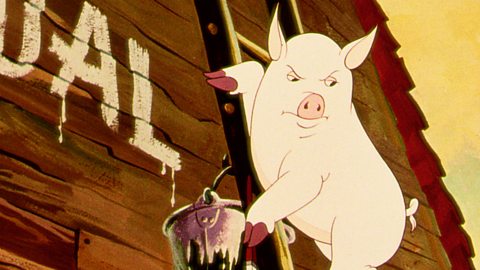
Animal Farm was written by George Orwell and published in 1945. This novel is an A story or poem which has a hidden (usually political) meaning. – even though it is set on a farm and stars a cast of farm animals, it reflects the events of the Russian revolution of 1917. The animals are all clever representations of Russian politicians, voters and workers. Orwell used the novel to make his opinions on Russian leaders heard.
Title: Both a simple description of the setting of the novel, and a nod to the revolution that leads to Manor Farm being renamed ‘Animal Farm’, foregrounding the animals.
Narrative Perspective: Animal Farm is told from a A third person narrator is not a character in the story. They see the events from the outside and tell the story using third person pronouns, like 'him', 'her' and 'they'.Able to observe everything; a narrator who knows the thoughts and actions of all the characters.Narrative is another word for story. perspective, where the story is related by a voice from outside the characters who can access everyone’s thoughts and feelings, and who describes the action without taking part.
Setting: An English farm in the first half of the twentieth century.
Themes: Class, equality, power, corruption, control, Propaganda is when words, images or films are used to try and make people think a certain way., Where characters focus on how things should be rather than how they actually are and Dealing with things sensibly and realistically., unity and division, the power of language, A system of government where the state has total control over public and private life, often using propaganda, censorship, and repression to maintain power. and A ruler with total power over a country, who has generally come into power through force. Dictators usually rule in a cruel and brutal way., Where characters pretend to have high morals or beliefs that their actual actions contradict.
Characters in George Orwell's Animal Farm
The characters in Animal Farm can be split into three groups – the humans, the pigs and the other animals.
The humans are the villains, thoughtless and neglectful. The pigs are scheming, clever and forceful and replace the humans as villains. The other farmyard animals are trusting, passive and hardworking – they are the heroic victims of the novel.
Each group represents a different element of the An uprising led by the Bolshevik party under Lenin. The revolutionaries were committed to the ideas of Karl Marx and believed that the working classes should liberate themselves from the economic and political control of the ruling classes. in 1917.
Old Major
Old Major is Mr Jones' prize boar. He gathers all the animals together in the big barn to make a speech. He tells the animals that mankind and Mr Jones are the 'enemy', it is their fault that the animals' lives are miserable. He points out how cruel the men are to the animals – consuming without producing. He says that one day a rebellion will come – the animals will overthrow mankind and live in harmony.
Old Major is very intelligent, well-respected, an excellent speaker and an inspiration to the animals. He ends his speech by teaching the animals a song called ‘Beasts of England’. It is about a time when animals are free and humans are overthrown. He dies shortly after giving his speech and the other pigs take what they learnt from him and create 'Animalism', a set of rules for animals to live by.
Old Major is partly based on Karl Marx, the philosopher who created Marxist theory to criticise the ways rich people exploited poor people. He is also partly represents Vladimir Lenin, a prominent figure in the 1917 Revolution who helped establish a form of The ideas of Karl Marx who supported a system of rule where industries were run by the government for the good of the people.in Russia.
| How is Old Major Like this? | Evidence | Analysis |
|---|---|---|
| Well-respected | ||
| Every other animal is willing to go out of their way to hear Old Major's speech. | “[Old Major] was so highly regarded on the farm that everyone was quite ready to lose an hour's sleep in order to hear what he had to say.” | It is clear that the others respect Old Major. So much so that they will even lose some sleep to hear his thoughts. Rest time must have been very precious during Mr Jones' rule. |
| Good speaker | ||
| During his speech, Old Major uses a range of linguistic techniques as part of his Artful persuasive speaking.to persuade and inspire the other animals. | “Why then do we continue in this miserable condition? Because nearly the whole of the produce of our labour is stolen from us by human beings. There, comrades, is the answer to all our problems.” | Old Major persuades the animals that he is right by using emotive words like ‘miserable’ to pull on the animals' heartstrings. He also uses questions and inclusive Words that replace nouns, ie he, she, it, they. like ‘comrades’ and ‘our’ to involve them in his ideas. |
| Intelligent | ||
| Old Major has lived a long time and learned many lessons from his experiences. | “I have had a long life, I have had much time for thought as I lay alone in my stall, and I think I may say that I understand the nature of life on this earth as well as any animal now living.” | Old Major has had a long time to consider the ‘nature of life’. During this time he has learned so much that he is confident that he understands it ‘as well as any animal now living.’ |
Napoleon
Napoleon is a threatening and ‘fierce looking’ Berkshire boar. He is one of the three pigs that take Old Major's ideas and turn them into ‘Animalism’ - a system of thought that encourages the animals to rebel. He is not a gifted speaker but is known for getting his own way. He also manages to get the support of the sheep – he encourages them to chant ‘four legs good, two legs bad’ during debates, preventing others making their points.
He takes two litters of puppies from their mothers and brings them up himself. Once they have grown up, he uses them to take control of the farm. After he has done this, he and the other pigs start to break the ‘Seven Commandments’ that the animals agreed to live by. He eventually becomes as much of a as Mr Jones ever was, and exploits the other animals.
Napoleon is based on Joseph Stalin, who took over as ruler after Lenin’s death and subverted the ideals of the revolution. The Soviet Union soon became a land of fear and starvation where millions died. Stalin controlled the media and violently oppressed anyone who disagreed with him.
| How is Napoleon Like this? | Evidence | Analysis |
|---|---|---|
| Threatening | ||
| The way Napoleon makes his point during meetings carries threat. | “He said very quietly that the windmill was nonsense and that he advised nobody to vote for it, and promptly sat down again.” | The sense of threat in the way Napoleon speaks ‘very quietly’, is sinister and menacing, there is a hint that he is planning something and he does not need to raise his voice. |
| Hypocritical | ||
| Napoleon often contradicts himself or ‘Animalism’ in the messages he puts out through Squealer. | “Napoleon announced that there would be work on Sunday afternoons as well. This work was strictly voluntary, but any animal that absented himself from it would have his rations reduced by half.” | Napoleon uses the word ‘voluntary’, yet the fact that it will result in reduced rations means that there is no choice for the animals – he is contradicting himself. |
| Tyrannical | ||
| Napoleon abuses his power to the point where he even kills some animals. | “The dogs promptly tore their throats out, and in a terrible voice Napoleon demanded whether any other animal had anything to confess.” | Napoleon has become a tyrant. He is capable of having his ‘comrades’ put to death to protect his position. When he ‘demands’ to know of more confessions we can imagine the other animals cowering in fear. |
Snowball
Snowball is one of the key pigs who take the teachings of Old Major and turn them into a way of thinking called ‘Animalism’. He is an intelligent and animated pig. He comes up with new ideas and cares about the working animals. His plans and ideas revolve around providing education and better conditions on the farm. He is also a brave fighter, organising the animals during ‘The Battle of the Cowshed’.
Napoleon does not like Snowball's ideas and so has him chased off the farm by his guard dogs. We do not see Snowball after this incident. He is used by Napoleon as a Irrationally putting the blame for something on a group or individual. – anything that goes wrong on the farm is blamed on him. Napoleon also convinces the animals that Snowball was never brave during the battle and was actually on Mr Jones' side.
Snowball represents Leon Trotsky, a political theorist and leader in the Red Army who was actively involved in the 1917 Revolution. In the wake of Lenin’s death, with no clear successor identified to lead, Stalin moved to discredit Trotsky and put himself in power; Trosky was forced into exile and later assassinated.
| How is Snowball Like this? | Evidence | Analysis |
|---|---|---|
| Brave | ||
| Snowball shows his bravery during the ‘Battle of the Cowshed’, being wounded while helping to chase Mr Jones off the farm. | “He himself dashed straight for Jones. Jones saw him coming, raised his gun, and fired. The pellets scored bloody streaks along Snowball's back…” | ‘He himself’ emphasises that Snowball worked alone with no thought for his own safety, running straight for Jones and receiving injuries in the process. |
| Good Speaker | ||
| Snowball shows his strong public speaking skills when addressing the animals. | “Snowball's eloquence had carried them away. In glowing sentences he painted a picture of Animal Farm as it might be when sordid labour was lifted from the animals' backs.” | The imagery of sentences ‘glowing’ gives the impression that his words are beautiful and shining, while the metaphor used to show he ‘painted a picture’ suggests that he is an artist with words. |
| Caring | ||
| Snowball's idea for a windmill shows he puts the other animals first. | “Snowball conjured up pictures of fantastic machines which would do their work for them whilst they grazed at ease in the fields or improved their minds with reading and conversation.” | Snowball wants the other animals to be ‘at ease’, relaxed and happy. He also values their education, preferring that they ‘improved their minds.’ He shows genuine concern for the animals' well-being. |
Boxer
Boxer, a large horse, is a A heroic character who makes an error of judgement that leads to his downfall., a good and mostly admirable character with one flaw that leads to his downfall – in Boxer’s case, his trusting nature and inability to think for himself. He is a hard worker, strong, loyal and caring. He also fights bravely against the humans. Unfortunately, he is too trusting; the pigs take advantage of this and work him until he collapses. Then, when he is no longer useful to them, they sell him to the horse slaughterer so that they can buy more whisky.
Whenever something goes wrong, Boxer blames himself and vows to work even harder. His favourite sayings are ‘Napoleon is always right’ and ‘I will work harder’. He is the strongest animal and could easily fight off the pigs and dogs. He never does though, as he is too used to taking orders.
Boxer represents the hardworking, uneducated peasants of Russia, who were exploited first by the Tsarist monarchy and then by the revolutionaries who had once claimed they would make their lives better.
| How is Boxer Like this? | Evidence | Analysis |
|---|---|---|
| Trusting | ||
| Boxer shows that he is trusting in his unwavering loyalty to the pigs. | “Napoleon is always right.” | Boxer believes everything that Napoleon tells him. The language of his A statement that is frequently repeated. is sure and simple and reflects Boxer’s pure Innocent or lacking experience.. He is the strongest animal on the farm but does nothing when conditions get worse, believing that working harder will fix anything. |
| Great worker | ||
| Boxer’s efforts to make the windmill show he is a great worker. | “To see him toiling up the slope inch by inch, his breath coming fast, the tips of his hoofs clawing at the ground, and his great sides matted with sweat, filled everyone with admiration.” | This description of Boxer is very emotive and inspirational. It shows how hard he works. The image of him dragging huge rocks whilst dripping with sweat shows his great strength. He never complains or lacks motivation. |
| Limited intelligence | ||
| Boxer is uneducated and struggles to express himself and his thoughts. | “He set his ears back, shook his forelock several times and tried to marshal his thoughts; but in the end he could not think of anything to say.” | Unfortunately, Boxer, like a lot of the other animals, except the pigs, lacks an education. Orwell uses Boxer to show that without the benefit of learning, he cannot express himself and so he will never be able to speak out against the pigs. |
Mr Jones
Mr Jones is the owner of Manor Farm. He neglects the animals, spends most of his time drinking and reading the newspaper and not feeding them. He is taken by surprise by the animals when they fight back against him and his men, so much so that he is thrown off the farm.
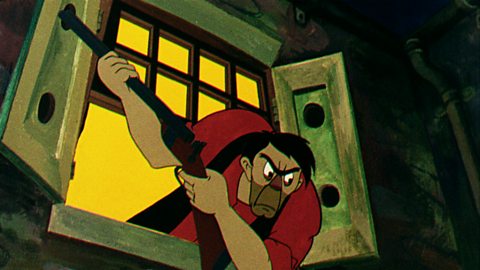
He tries twice to take back the farm but both attempts fail. He ends up dying in a home for alcoholics. He represents Tsar Nicholas II, the rich monarch of Russia who was entirely unconcerned for the wellbeing of his subjects.
| How is Mr Jones Like this? | Evidence | Analysis |
|---|---|---|
| Neglectful and uncaring | ||
| Mr Jones fails to look after the animals properly, putting himself before them. | “[Mr Jones], of the Manor Farm, had locked the hen-houses for the night but was too drunk to remember to shut the popholes.” | This shows that Mr Jones was ‘too drunk’ to remember to shut all the doors. By leaving the ‘popholes’ open, the chickens would get very cold, so this shows his lack of care about their wellbeing. |
| Cruel | ||
| Old Major speaks of Mr Jones’ cruelty in his speech – drowning the dogs when they get too old. | “As for the dogs, when they grow old and toothless, Jones ties a brick round their necks and drowns them in the nearest pond.” | Here, Old Major is saying that when the dogs are ‘old and toothless’. Mr Jones should be looking after them but instead he ‘drowns them in the nearest pond’ as soon as they are no longer of use to him. The image of him tying a ‘brick round their necks’ demonstrates his cruelty and brutality. Even an animal as loyal as a dog is seen by Jones as merely a resource to exploit and then discard when it used up. |
Squealer
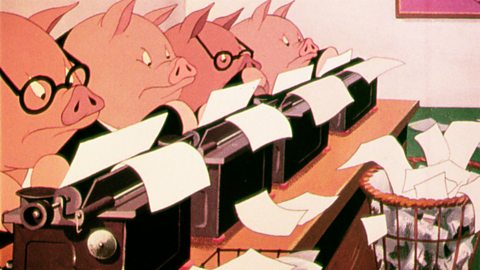
Squealer is another of the three most important pigs. Like Snowball, he is clever and a good speaker and he is excellent at persuading the other animals. He ends up being Napoleon's spokesperson – he delivers his orders, explains his choices and tells lies to support Napoleon.
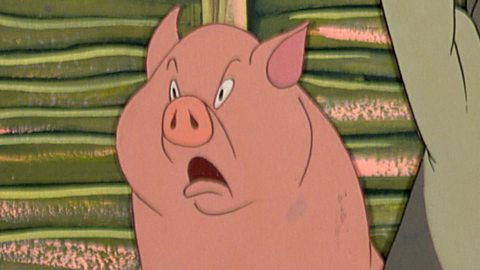
He delivers Propaganda is when words, images or films are used to try and make people think a certain way. to the other animals. It is also hinted that he reports back to Napoleon about what the other animals say, acting as an informant. Squealer represents the state news and media, which Stalin controlled in order to manipulate the information received by the public.
| How is Squealer Like this? | Evidence | Analysis |
|---|---|---|
| Persuasive | ||
| Orwell suggests that Squealer is persuasive through the description of his appearance and actions. | “The others said of Squealer that he could turn black into white.” | This description suggests that Squealer is capable of persuading anyone of anything, a skill Napoleon puts to good use. |
| Deceptive | ||
| Squealer is deceptive when he explains to the other animals why Napoleon changed his mind about the windmill. On one hand Squealer supports Napoleon’s plans to build the windmill but criticises the same suggestion from Snowball. | “‘Suppose you had decided to follow Snowball with his moonshine of windmills - Snowball, who, as we now know, was no better than a criminal?’” | Squealer describes the idea of a windmill as ‘moonshine’ – a A metaphor is a word or a phrase used for dramatic effect, to describe something as if it were something else. that suggests the idea was fantasy. However Napoleon still decides to build one. Describing Snowball as a ‘criminal’ is also deceptive as the animals still remember when he fought bravely at the Battle of the Cowshed – yet Squealer sneakily uses the inclusive pronoun ‘we’ to imply that the animals are now all united in thinking Snowball was a traitor. |
Benjamin
Benjamin is an old and The tendency to expect the worst to happen, or to believe that situations and people are more likely to end badly than well. donkey. No one on the farm knows exactly how old he is but it is hinted that he has been around for a very long time. He is never enthusiastic when things go well for the animals; likewise, he is never surprised or upset when things go wrong. He often gives vague answers.
Some might say that he is a realist; others might be critical of the way he seems aware of what is going on but says nothing to draw attention to the injustice and corruption he notices.
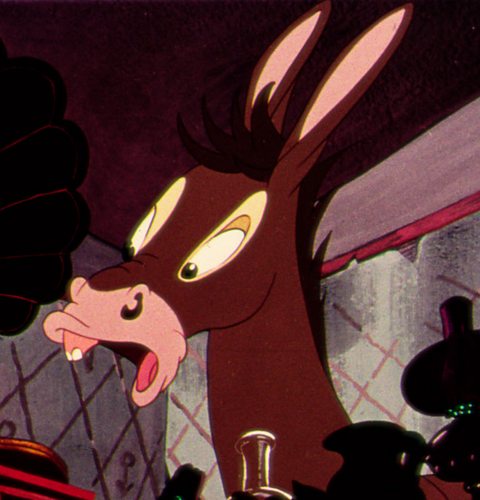
He is close friends with Boxer and plans to spend his retirement with him. He calls all the other animals to help when Boxer is being taken away by the horse slaughterer, but his one attempt to take action is too late to save his friend.
Benjamin represents those who understood the terrible actions taken by Stalin’s oppressive regime but did not speak up against them.
| How is Benjamin Like this? | Evidence | Analysis |
|---|---|---|
| Vague | ||
| Benjamin is often vague with the other animals. For example, when they ask if he is happier now Mr Jones has gone he doesn’t give a straight answer. | “‘Donkeys live a long time. None of you has ever seen a dead donkey.’” | It is suggested that Benjamin has seen rebellions come and go in the past and he knows that the happiness the animals feel after the Rebellion will be short-lived. His comment that they have never ‘seen a dead donkey’ is a hint that he has seen similar events in the past, meaning he views the revolution with scepticism and is not as excited as the others. |
| Pessimistic | ||
| Benjamin’s responses are often negative, he doesn’t share in the enthusiasm of the other animals even in their victories. | “He said, life would go on as it always had gone on - that is, badly.” | Benjamin’s suggestion that life ‘always’ goes on ‘badly’ reveals that he has a pessimistic view on life. He does not see the Rebellion, the windmill or victories in battle as being positive things – he sees them as struggles that never end or achieve good. |
| Realistic | ||
| In the end, it turns out that Benjamin was right to be so negative about the Rebellion. Although conditions seemed better initially, they soon went back to ‘normal’. Benjamin was not overly negative, just realistic. | “Only old Benjamin professed to remember every detail of his long life and to know that things never had been, nor ever could be much better or much worse – hunger, hardship, and disappointment being, so he said, the unalterable law of life.” | By this point in the novel it becomes clear that Benjamin was avoiding idealism and being realistic when he was negative about the Rebellion. This explains his attitude toward the changes on the farm and why he is never as enthusiastic as the other animals. |
Minor characters
Clover – the mother figure of the farm. A kind and caring horse who sees the faults in Napoleon’s rule but like Boxer, lacks the words to express herself. She represents the female working class of Russia.
The dogs – there are good dogs: Bluebell, Jessie and Pitcher, and there are Napoleon's dogs that he uses to police the farm. They represent the secret organisations of the police.
The hens – they bravely protest about their eggs being taken, and suffer for failing to comply. They represent workers in Ukraine who died trying to resist the Soviet Union’s five-year plans.
Mollie – a horse that is happy to be ruled by humans. Mainly concerned with pretty things and small comforts, she represents the middle classes of Russia.
Moses – Jones' pet raven, who represents the Church by telling the animals of Sugarcandy Mountain, a wonderful place where they will go after they die.
The young pigs – they speak out against Napoleon and are executed as a result.
The sheep – they interrupt debate on the farm with chants of “four legs good, two legs bad”. They play a crucial role in Napoleon's rise to power and represent unthinking citizens who blindly obey in a A system of government where the state has total control over public and private life, often using propaganda, censorship, and repression to maintain power. regime.
Mr Pilkington – an ‘easy going’ gentleman farmer who spends most of his time hunting. He represents the Allies of World War Two, particularly the UK.
Mr Frederick – a tough farmer who fights to get what he wants. He and his neighbouring farm are a representation of Hitler’s Germany.
Mr Whymper – a lawyer that the pigs hire, who grows rich through working with them. He represents the capitalists who gained wealth by doing business with the Soviet Union.
Test yourself
Further study
Listen in full to Animal Farm by George Orwell. audio
The landmark allegory about hypocrisy and corruption of power.
The Real George Orwell. collection
A journey exploring the man Eric Blair and the writer George Orwell.

Animal Farm by George Orwell. collection
A selection of programmes about George Orwell's classic Animal Farm.
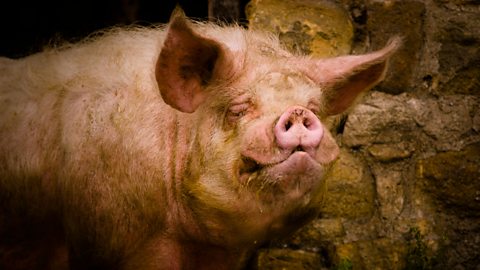
In Context: Animal Farm (part one) video
Andy Kershaw explores how the allegorical novel Animal Farm reflects the events leading up to Stalin seizing power in Russia.
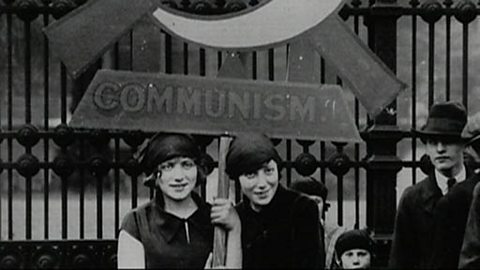
In Context: Animal Farm (part two) video
An analysis of how and why the workers' paradise represented in George Orwell's Animal Farm became a brutal dictatorship.
In Context: Animal Farm (part three) video
An analysis of George Orwell's Animal Farm as a representation of the corruption of the revolution by its leaders and of the rise and fall of Stalinism.
More on Animal Farm
Find out more by working through a topic
- count3 of 5
- count5 of 5
- count1 of 5