Themes in Animal Farm
Animal Farm is a A text that tries to teach a lesson. text – Orwell aims to teach the reader a number of lessons on:
- class
- equality and inequality
- power, control and corruption
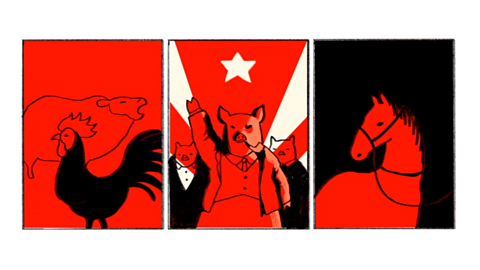
These themes are explored through the events and characters in the novel, and are an A story or poem which has a hidden (usually political) meaning. for the An uprising led by the Bolshevik party under Lenin. The revolutionaries were committed to the ideas of Karl Marx and believed that the working classes should liberate themselves from the economic and political control of the ruling classes. and the years that followed it.
The animals' unhappiness represents class struggle. This leads to the Rebellion, which offers some equality. Then the pigs' actions allow inequality back on the farm.
The theme of power and control is explored throughout the novel and is highlighted by the characters' relationships on the farm.
The themes are political and explore what happened within Russian society in 1917 onwards. Orwell originally subtitled the novel 'a fairy story' suggesting he intended it as a A type of story with animals as characters. It teaches the reader a lesson..
It is important to remember that, even though the novel is based on events that took place in 1917, its themes are still relevant today.
Class
Before the Revolution of 1917, Tsar Nicholas II ruled Russia. The ruling classes had money and power, whilst most of the population were poor, exploited peasant workers or from the working class. These people lived in terrible conditions and what they farmed was taken from them, leaving them to face starvation and poverty.
The Revolution that came in 1917 sought to overthrow the Tsar and change the balance of society to give power back to the working class. The plot of Animal Farm closely parallels these events.
In Animal Farm, Orwell uses the animals to highlight the hardships of the working classes. He uses Mr Jones as a symbol for the Emperor – to highlight how lazy and neglectful the Tsar was. The animals each represent a different section of society at the time – they are a A metaphor is a word or a phrase used for dramatic effect, to describe something as if it were something else. for what happened to the people.
The animals, like the working class of Russia, had short, difficult lives, working to produce things that the ruling class would take for themselves. The Rebellion on the farm seeks to change this, but the revolutionary pigs soon adopt the ways of the ruling class that they sought to abolish.
How is the theme of class shown in the novel?
In Animal Farm, Orwell explores class through:
- the hardships of the animals during Mr Jones’ rule
- the exploitation of the animals by Mr Jones
- the exploitation of the animals by the pigs after they take control
| How is class shown? | Evidence | Analysis |
|---|---|---|
| Hardships of the animals | ||
| During Old Major's speech, he describes the difficulties the animals face including being fed only enough food to survive, being worked until their 'last breath' and then slaughtered with 'hideous cruelty'. | “‘No animal in England knows the meaning of happiness or leisure after he is a year old. No animal in England is free. The life of an animal is misery and slavery: that is the plain truth.’” | The contrast of the lack of 'happiness' and 'leisure' and abundance of 'misery' and 'slavery' in an animal's life helps to emphasise the hardships of the animals. |
| Exploitation of the animals by Mr Jones | ||
| In his speech, Old Major says that the animals' produce is sold by Mr Jones and only he profits. | “‘…how many of those eggs have ever hatched into chickens? The rest have all gone to market to bring in money for Jones and his men.’” | Old Major uses a A question asked in order to create a dramatic effect or to make a point, rather than to get an answer. to get the hens to consider how Mr Jones has exploited them and how he has sold their eggs for his own profit. |
| Exploitation of the animals by the pigs | ||
| The pigs take any extra apples and milk for themselves, rather than share them out with the other animals. | “‘It is for your sake that we drink that milk and eat those apples. Do you know what would happen if we pigs failed in our duty? Jones would come back!’” | Squealer emphasises the word 'your' to try and suggest that the pigs eat the food for the other animals’ benefit. The pigs exploit the others by threatening the return of Jones. |
Equality and inequality
In Animal Farm, Orwell uses the animals and their actions to make the reader think about equality and inequality. Before 1917, the majority of Russian people suffered from great inequality – they had far less money and food than the ruling classes.
Likewise, before the Rebellion in Animal Farm, Mr Jones takes everything that the animals have away from them. After the Rebellion, the animals are free from the A way of governing or ruling that is oppressive and cruel to the people. of Mr Jones and seek to establish equality amongst themselves.
One of the Commandments is 'All animals are equal'. However, this equality is short-lived and the pigs begin to bend the rules until inequality returns to the farm.
How is the theme of equality and inequality shown in the novel?
In Animal Farm, Orwell explores equality and inequality through:
- the inequality between the animals and mankind
- the equality that the animals seek to establish after the Rebellion
- the inequality that begins again after the pigs take control
| How is equality and inequality shown? | Evidence | Analysis |
|---|---|---|
| Animals and mankind | ||
| During Old Major's speech he talks about how 'no animal is free' and that life for them is 'one of slavery' and that 'man is the only creature who consumes without producing'. | “‘Man serves the interest of no creature except himself.’” | This short and blunt sentence shows Old Major's opinion about the inequality between men and animals. |
| The Rebellion | ||
| After the Rebellion, the animals agree on Seven Commandments that they will now live by – to make sure everything is fair and equal. | “All animals are equal.” | A simple sentence but hugely effective. There is no room for argument or debate here – the intention of the animals is very clear. |
| The pigs taking control | ||
| When the pigs take control they move into the farmhouse and sleep in beds – creating inequality between themselves and the other animals. | “‘You would not rob us of our repose, would you, comrades? You would not have us too tired to carry out our duties? Surely none of you wishes to see Jones back?’” | Squealer argues here that without 'repose' the pigs can't carry out their work and so Mr Jones will return. Squealer uses The pronouns in English (I, you, he, she, it, we, they, me, him, her, us, and them) showing contrasts of person, gender, number, and case. to create a difference and distance between the pigs and the other animals. |
Power and control
Power and control are among the most important themes in Animal Farm. Orwell explores political power – Mr Jones owns the farm and the animals, and uses his men and whips to keep them under control and maintain his power.
Orwell shows that the animals have the power to challenge Mr Jones' control and take over the farm – using power in a positive way. He then explores how the pigs use Artful persuasive speaking. and Propaganda is when words, images or films are used to try and make people think a certain way. to establish themselves in power and take control of the farm. It is interesting that the working animals, especially Boxer the horse, have great physical power but they don’t use it to break free from the control of the pigs.
Old Major is partly based on Karl Marx and Vladimir Lenin. Karl Marx was a German philosopher who lived during the 19th-century. His ideas formed the basis of A classless society where all property is owned publicly. – his ideas are collectively known as ‘The ideas of Karl Marx who supported a system of rule where industries were run by the government for the good of the people.’, like ‘Animalism’ in the novel. He developed theories on how power structures in society keep people under control. Vladimir Lenin was a Russian revolutionary who established a form of ‘Marxism’ in Russia in the early 20th-century. After Lenin’s death, rivalries between his potential successors led to violence, and the political leadership grew more and more corrupt until the country was in the grip of a , suffering starvation, fear and exploitation just as they had under the previous regime.
Orwell explores the idea of power leading to corruption. Many of the characters in the novel are eventually corrupted by the power they have, particularly the pigs, as they manipulate their position of leadership to exploit other animals.
How is the theme of power and control shown in the novel?
In Animal Farm, Orwell explores power and control through:
- Mr Jones exploiting his power and treating the animals badly
- the Rebellion and how the animals use their power to take over the farm
- the pigs and how they cleverly control the other animals
| How is power and control shown? | Evidence | Analysis |
|---|---|---|
| Mr Jones | ||
| Old Major teaches the animals a song called ‘Beasts of England’ in response to Mr Jones treating them badly. The song is about animals overthrowing man and being free. | “‘Bit and spur shall rust forever, Cruel whips no more shall crack.’” | The animals sing about the devices Mr Jones uses to keep his power. The 'bit and spur' and 'whips' are used to cruelly keep the animals under control. |
| The Rebellion | ||
| The animals fight back against the men and take control of the farm. | “…this sudden uprising of creatures whom they were used to thrashing and maltreating just as they chose, frightened them almost out of their wits.” | The animals surprise the men with their 'sudden' change in behaviour – it frightens the men to see the animals using their power. |
| The pigs taking control | ||
| The pigs take charge and begin to control the other animals. Napoleon uses Squealer and the dogs to stop the animals' questions about the windmill. | “Squealer spoke so persuasively, and the three dogs who happened to be with him growled so threateningly, that they accepted his explanation without further questions.” | Between Squealer being so ‘persuasive’ and the dogs so ‘threatening’ the pigs control the animals by preventing them questioning their decisions. |
Test your knowledge of the themes in Animal Farm
Further study
Listen in full to Animal Farm by George Orwell. audio
The landmark allegory about hypocrisy and corruption of power.
The Real George Orwell. collection
A journey exploring the man Eric Blair and the writer George Orwell.

Animal Farm by George Orwell. collection
A selection of programmes about George Orwell's classic Animal Farm.
In Context: Animal Farm (part one) video
Andy Kershaw explores how the allegorical novel Animal Farm reflects the events leading up to Stalin seizing power in Russia.
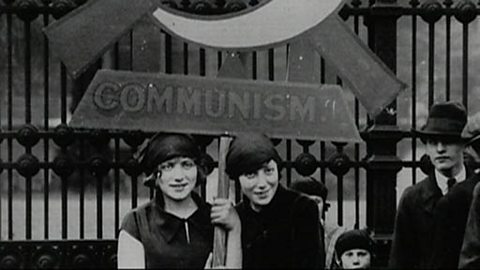
In Context: Animal Farm (part two) video
An analysis of how and why the workers' paradise represented in George Orwell's Animal Farm became a brutal dictatorship.
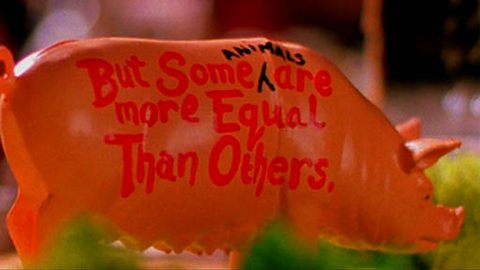
In Context: Animal Farm (part three) video
An analysis of George Orwell's Animal Farm as a representation of the corruption of the revolution by its leaders and of the rise and fall of Stalinism.
More on Animal Farm
Find out more by working through a topic
- count5 of 5
- count1 of 5
- count2 of 5