Example questions
Use these questions to hone your knowledge of Animal Farm, and to practise using your notes and analysis in organised paragraphs that focus on how particular characters, themes or ideas are shown in the novel. There is an example answer in the following section to demonstrate how you can do this.
- How does Orwell explore the themes of power and control in Animal Farm?
- To what extent is Napoleon presented as an effective leader in Animal Farm?
- In what ways do language and communication matter in Animal Farm?
- In what ways is Where characters focus on how things should be rather than how they actually are a negative force for the characters in Animal Farm?
- Examine how far Snowball is presented as a positive character in Animal Farm.
- How does Orwell present equality and inequality in Animal Farm?
- To what extent are the animals responsible for what happens to them in Animal Farm?
Example answer
Below is a demonstration of how to use your revision material to answer an example essay question. The answer below is not a full essay, but only an extract of a longer answer showing some of the points that could be made.
Q: How does Orwell present equality and inequality in Animal Farm?
A: George Orwell was passionately against totalitarianism, a form of government in which those in charge seek to control every aspect of the lives and actions of their citizens. He identified as a Democratic Socialist, and shared many of the ideals that the Marxists of the 1917 Russian revolution also believed. At the heart of his beliefs was the idea that everyone in a society should be free and equal, with equal rights, and he was so appalled by the corruption of the ideals of the Russian Revolution that he wrote Animal Farm to criticise those involved. His belief in equality was a driving force behind the novel and forms a major theme throughout – the injustice of how the animals are treated by the humans is what drives the animal rebellion in the first place. The animals’ attempts to get equality for all end up with them being oppressed by other animals in place of humans, and this shows Orwell’s belief that achieving true equality was a huge struggle and meant authority had to be challenged constantly to avoid inequality creeping back in.
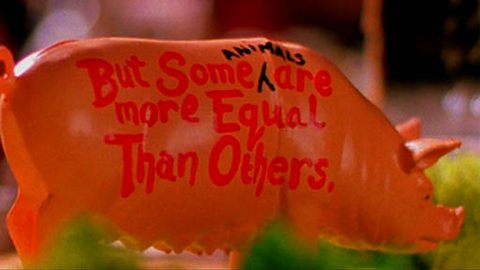
There are three main stages in the book in relation to equality and inequality – the way Manor Farm is run by Mr Jones at the start, the animals’ revolution, and the way the pigs slowly take over and become just as cruel and oppressive as Jones ever was. The ideals of the revolution are summed up in the Commandment “All animals are equal”, yet by the end this has been amended with the addition “But some are more equal than others”. This is obviously nonsensical because it is the opposite of what ‘equal’ truly means, but the animals aren’t able to challenge it. This is due to many factors: their lack of education; sometimes their lack of memory; the propaganda Napoleon uses against them through Squealer; fear of being punished, such as having their rations reduced or taken away; and possibly even a continuing belief that if they just work harder and do as they’re told, things will get better. The third person narrative perspective makes it easier to see the various different reasons that different animals behave the way they do and fail to challenge what is going on. The sheep, for example, are simple-minded and repeat whatever they’re told as if it is the truth – they won’t challenge anything even if they notice inequality. Boxer is such a hard worker and so devoted to the ideals of the revolution that he feels the answer is always to work harder; he also lacks the mental capacity to question the leaders. The pigs’ superior intelligence makes it easier for them to exploit others to enrich themselves; they have no interest in things being equal if inequality means more for them. Orwell shows that creating and maintaining equality is difficult, especially since the animals themselves are all so different, and that differences across the species can help to breed inequality.
This essay could go on to make the following points, backed up by evidence from the novel and analysis/interpretation of that evidence:
- Explaining the inequality that exists between the animals and Mr Jones – Mr Jones spends his time drinking whilst the animals go unfed. He is the only one who profits from their hard work and when he can no longer make money from them, they are brutally killed. Old Major’s speech sums up much of this, and should be quoted and analysed.
- Examining the fact that when the animals chase Mr Jones away, there is a chance for equality after the rebellion – ‘All animals are equal’ is one of the Commandments the animals decide on. There are hints that this sort of equality might be hard to establish – the animals aren’t sure whether to include the rats in their comradeship and the pigs clearly have a better quality of life than the other animals, even under the rule of Mr Jones.
- Analysing how and why the chance for equality is lost when the pigs come to power – they start to change the rules, they take more food and enjoy more leisure time until life on the farm is filled with just as much inequality as before the rebellion.
Further study
Listen in full to Animal Farm by George Orwell. audio
The landmark allegory about hypocrisy and corruption of power.
The Real George Orwell. collection
A journey exploring the man Eric Blair and the writer George Orwell.

Animal Farm by George Orwell. collection
A selection of programmes about George Orwell's classic Animal Farm.
In Context: Animal Farm (part one) video
Andy Kershaw explores how the allegorical novel Animal Farm reflects the events leading up to Stalin seizing power in Russia.
In Context: Animal Farm (part two) video
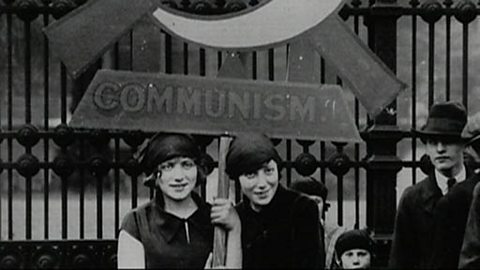
An analysis of how and why the workers' paradise represented in George Orwell's Animal Farm became a brutal dictatorship.
In Context: Animal Farm (part three) video
An analysis of George Orwell's Animal Farm as a representation of the corruption of the revolution by its leaders and of the rise and fall of Stalinism.
More on Animal Farm
Find out more by working through a topic
- count1 of 5
- count2 of 5
- count3 of 5