| 13 November 2014 |

| |
| BBC Homepage | | |
| |||
| Contact Us | | |
RemembranceYou are in: Manchester > History > Remembrance > Memories of the Somme 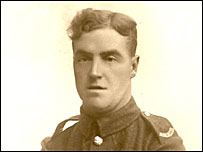 Pte. Andrews: survived the Somme Memories of the Somme1st July, 1916: the bloodiest day in British military history. Here, Manchester Pal Albert Andrews recalls the horrors of life in the trenches on the Somme in his memoirs written while convalescing for shell shock and a bullet to the shoulder. Albert William Andrews served with the 19th Battalion Manchester Regiment (90th Brigade, 30th Division) until December 1915, then 21st Brigade from September 1916 to August. He fought in France from November 1915–1917. 1st July 1916: The Battle of the SommeI will here tell what I carried. Rifle and bayonet with a pair of wire cutters attached. Contents of pack – two days rations, oil-sheet, cardigan, jacket, mess tin and a shovel fastened on my back. Haversack, containing one day’s iron rations and two Mills bombs. Pouches, 150 rounds of ammunition, two extra bandoliers containing 60 rounds each, over each shoulder, and a bag of ten bombs. 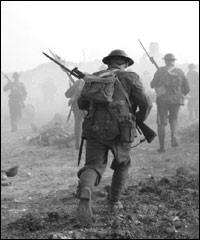 The Battle of the Somme, 1916 Our Colonel came down the trench and asked did we know what time Zero Hour was, meaning the time we attacked. "No sir," was the reply. "Well, it's 7.30. Anyone got a watch? It is 6.13. Put your watches right and don’t forget – be ready." A mist was on at this time, but it cleared away about 6.45. Then a rum ration was issued. I received less this time than I had ever received. The order came down: "Half an hour to go; Quarter of an hour to go; Ten minutes to go; Three minutes to go…" I lit a cigarette, and up the ladder I went. You waited until the others got up in line, each company forming a wave, a battalion therefore forming four waves about 250 men in line, about one yard apart. BayonetWell, at 7.30am, on a beautiful sunny morning, off we started, about 50 yards between each wave. I had not gone many yards, when whizz! – I was carrying my rifle by the sling on my shoulder – it felt as if someone had pulled at the top of my bayonet, which of course carrying it in this position was at the side of my head. But I took no notice, it taking us all our time to keep going – we were at a quick march. I, like nearly every other fellow, smoking. 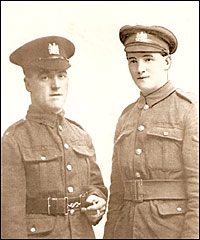 Brothers in arms: Andrew and Tom No Man’s Land was one mass of shell holes, and the soil all loose. We had 400 yards of this to go to the first German trench. Fritz let us have it with shrapnel, machine guns and rifle. As we travelled along our lads kept falling – killed or wounded. About half way across, the second wave catches up with the first to fill these gaps up. About 100 yards from the German trench, our officer turned and said 'Up a bit on the left' then pitched forward. That was the last order he ever gave. As we got nearer, dozens of Germans were running through us towards our lines with their hands up. Others stopped there, throwing bombs, firing machine guns and rifles, but they will fire no more. I jumped into the German trench – what was left of it – just past a dugout door. In the doorway there was a big barrel. As soon as I jumped in, a German jumped from behind this barrel. I was already on guard, and had my bayonet on his chest. He was trembling, looking half mad, with his hands above his head, saying something I did not understand. All I could make out was that he did not want me to kill him. It was here I noticed my bayonet was broken. I couldn’t have stuck him.
Of course, I had ‘one up the chimney’ as we called it, the bullet being in the breech. I pointed to his belt and bayonet. He took these off, his hat, water bottle, emptied his pockets, offering them all to me. Just then, one of my mates was coming up the trench. "Get out of the way, Andy -l eave him to me. I’ll give him one to himself." - meaning he would throw a bomb at him. I said "Come here." He was on his knees in front of me now fairly pleading. I said 'He's an old man.' He looked sixty. 'Take no prisoners'I pointed my thumb towards our lines, never taking my bayonet off his chest. He jumped up and with his hands above his head ran out of the trench towards our lines, calling out all the time. He was trembling from head to foot, frightened to death. I honestly believe he could have done me as I jumped into the trench if he had not been so afraid. This was the only German I ever let off and I have never regretted it because I believe he could have done me quite easily. 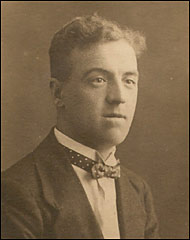 In civvies: worked for the Daily Herald Well, we both bombed the dugout and turned round to go along the trench, when three Germans came running towards us their, hands up. We would be about 20 yards away. We both fired, two fell, my mate saying as he fired: 'That’s for my brother in the Dardenelles!' and he fired a second, the other fell, and he said “That’s for my winter in the trenches!" We walked up to them. One moved. My mate kicked him and pushed his bayonet in him. That finished him. Of course, all this occurred in about five minutes, it taking a good deal longer to tell than do. And there were other instances, but I am just telling of what I was actually in. This kind of thing was going on all along the line, no Germans being spared. Wounded were killed by us all, we having been told: ‘Take no prisoners.’
last updated: 05/11/2008 at 09:26 SEE ALSOYou are in: Manchester > History > Remembrance > Memories of the Somme  |
| | About the BBC | Help | Terms of Use | Privacy & Cookies Policy |