Applicable context
- Robert Cedric Sherriff was born in 1896 to a middle class family who lived in a village close to London. He had a comfortable life and a good education, attending Kingston Grammar School before beginning work as an insurance clerk in 1914. On 4th August of that same year, Britain declared war on Germany in what would become known as ‘The Great War’ or World War One because of its massive scale and terrible loss of life across Europe and beyond. A sense of duty, patriotism and love for one’s country was a key feature in the kind of education Sheriff received, and there were huge rounds of Propaganda is when words, images or films are used to try and make people think a certain way. aimed at encouraging young men all over Britain to sign up for the war effort.
- Like countless other young men around him, Sherriff volunteered for the army as a new recruit in 1915 and was sent to France, where his leadership skills saw him promoted to the rank of captain. In 1917 he almost died, suffering severe injuries in a now famously terrible battle near the town of Passchendaele in southern Belgium. He spent over a month in hospital before returning to the front.
- It has become a widely accepted part of history that World War One was badly planned by generals and politicians back home in the safety of London – the phrase ‘lions led by donkeys’ was often used to suggest this. Some contend the massive loss of life on the front line is proof of bad decisions and disregard for human lives, while others suggest it is very difficult to judge without knowing exactly why certain decisions were made. Either way, Sheriff suggests in the play that the intentions of the Colonel and others like him were less concerned with the welfare of the men they commanded and more focused on “winning” at any cost. By the end of World War One, millions of soldiers had died and many millions more were wounded or even maimed for life.
- Sherriff had not originally intended to be a writer; he wrote his first play hoping to raise funds for his village rowing club. When he wrote Journey’s End, his eighth play, many theatres were resistant to taking it, complaining that people didn’t want to be reminded about the war and that there was no ‘leading lady’ character to look nice for the audience. However, it resonated with audiences all over the world and became a great success. It was first performed in 1928, 10 years after the end of World War One; its first audiences would have either fought in the war themselves or lost someone close during the fighting. Since then, it has been adapted for film twice, and continues to be a favoured production for all-male theatre companies.
Themes in Journey's End
Sheriff uses World War One as a setting for the play, allowing him to explore a variety of themes. The main themes in Journey’s End are:
- The horror of war
- Courage and cowardice
- Social groupings, sometimes used to measure people's place in society.
- Community and comradeship
Before 1914, Britain lay at the heart of the huge and prosperous British Empire; it was a much more confident and powerful nation than it would be just four years later in 1918.
In 1914 it would never have occurred to most ordinary people to question the morality of war or the ability of the country’s leaders. But, after the war was over, plays such as Journey’s End and many anti-war poems (such as the works of Wilfred Owen and Siegfried Sassoon) shook this unquestioning confidence. Sheriff’s own experiences at war mean he can offer insights into what it was really like to live, fight and die with other men in such physically and psychologically horrible conditions. His exploration of these experiences through the themes of the play helps the audience understand them and creates a clear anti-war message.
The central theme of Journey’s End – how men deal with sudden horror, maiming and death – made audiences question aspects of war, and the play soon became internationally popular. It explores courage and cowardice and how humans cope in the face of death.
We see this when Osborne gives advice to Raleigh:
You must always think of it… as romantic. It helps.
Osborne himself reads Alice in Wonderland, a childhood book, for comfort. Stanhope depends on drinking alcohol for courage. The men in general try to keep their sense of humour while Private Mason finds diversion in complaining about the food:
Smells like liver, sir, but it 'asn’t got that smooth, wet look that liver’s got.
But Hibbert shows us what focusing on death can do. He breaks down in hysterics.
The idea of heroism is explored through Raleigh’s boyish patriotic myth of the 'hero' as a knight in shining armour and the way he worships Stanhope.
The desperate way Stanhope “clutches Raleigh’s wrist and tears the letter from his hand”, a letter which could reveal the truth about his drinking, Stanhope’s real fear.
Trotter’s bravery makes the audience question our perception of just what a 'hero' is.
By juxtaposing the upper class officers with working class soldiers like Trotter and Mason, the dramatist shows how war brought every one of differing social classes together. Trotter’s bravery suggests he is as much a 'hero' as any of the officers.
What soldiers do to pass the time under the stress of trench life is also a major theme, inviting the audience to understand just how this tense, prolonged waiting was an untold horror, and creating a subtle anti-war message.
As for the generals, their decisions and behaviour persuades the audience to question those at the top of society and in power.
Community and comradeship under extreme stress permeate the play.
There’s Stanhope’s encouragement of Hibbert:
Shall we go on together?
And even the idea of an "enemy" is brought into question as we’re reminded by Raleigh that Germans are ordinary people, highlighting the theme of the idiocy of war:
The Germans are really quite decent, aren’t they? I mean, outside the newspapers?
As for dramatic effects, here are three to look out for:
Verisimilitude
This is naturalistic drama, when the setting is made to mimic real life. It’s created in the first act, when the stage directions note the gloominess of the dug-out but add that there are “a few tattered magazine pictures pinned to the wall of girls in flimsy costumes.”
Dramatic irony
This is when the audience learn something interesting from one character that another character doesn’t know about. It happens when Hibbert complains to Stanhope of his “neuralgia”. The audience are already half aware of what Stanhope’s response will be.
Contrast
Sherriff uses this to guide the audience’s response to characters and actions, like when the tall, slim Stanhope first appears with chubby, red-faced Trotter. The contrast of appearance emphasises the heroic physical attributes of Stanhope.
The horror and futility of war
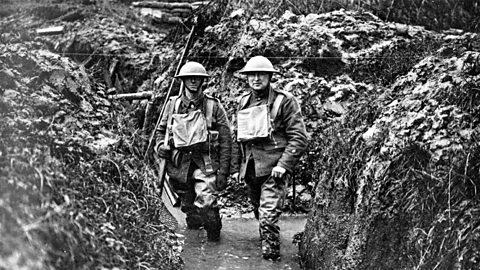
Journey’s End focuses on life in the trenches. Stage directions show little comfort. The sounds of war permeate. The constant references to rats, cold and damp and so on all highlight how difficult life was for men, who discuss the comfort of their homes and gardens. This is combined with the feeling of constant boredom and waiting. Young, able and – in many cases – highly educated men suffer these conditions. The overall effect is to make the audience question the wisdom of wasting their potential in this ‘No Man’s Land’.
It is sometimes easy to think that soldiers in wars are always fighting battles. But the play shows that for most of the time it’s a matter of waiting. What soldiers do to fill the hours under such horrendous stress is a major theme. Sherriff wanted his audiences to understand just how this tense prolonged waiting was an untold horror of war. This helps create a subtle anti-war message.
One of Sherriff's skills is to construct a tense plot, whilst also showing the boredom of trench life. The humour and friendly banter between the officers is Two things placed side by side to highlight their differences. with talk of battle and fear. This reminds us that they are on the front line, and also has the effect of showing us that these are human beings.
We see the men being concerned about what is for breakfast, discussing gardening and sports, and feeling nervous and scared before going into battle. This removes the glamour and heroism often associated with fighting for one’s country in the Propaganda is when words, images or films are used to try and make people think a certain way. of the time. It also undermines the Showing extreme patriotism in an aggressive or warlike way, often combined with hostility toward other countries. works of poets like Jessie Pope.
The youth of the men is also emphasised, to reinforce the waste of young lives. Note how the word “boy” is repeated in the stage directions as Raleigh is dying, and how the A simile is a word or phrase used to make a comparison for dramatic effect, using 'like' or 'as'.“like a child” is used to describe how the Sergeant Major carries him. All of the young, enthusiastic, able men are dead by the end of the play – reminding the audience, then and now, of the great losses in war.
Courage and cowardice
Journey’s End is at heart about how men deal with almost certain death, constant fear, sudden and intense horror, attack and maiming.
The play touched the hearts and minds of audiences watching only a decade after the war had been fought. The men all deal with the horrors of war differently and Sheriff uses each character to show the various things soldiers did to cope.
We are immediately made aware of Stanhope’s drinking problem in the opening dialogue between Osborne and Hardy, who asks if Stanhope is “drinking like a fish as usual?” It becomes clear throughout the play that Stanhope is a brave soldier and a courageous leader. However, he uses alcohol to give him ‘Dutch courage’ – a term believed to have originated in a much earlier war because of soldiers’ reliance on Dutch gin to prepare them for the horrors of battle.
Stanhope himself admits that after “that awful affair on Vimy Ridge … There were only two ways of breaking the strain. One was pretending I was ill – and going home; the other was this.”
The stage directions tell us he “holds up his glass” as he says this. Is Sheriff suggesting that remaining courageous in the face of unbelievable fear and horror always comes at a cost?
Raleigh’s boyish patriotic myth of the hero as some kind of knight in shining armour – and his “hero-worship” of Stanhope – introduces us to the concept of heroism.
Supporting the war effort and fighting for one’s country was glorified by propaganda and poets such as Jesse Pope, who painted a romantic picture of the heroes doing their duty for England. This led to soldiers and officers being pressurised to live up to the expectation of heroism.
We see that Stanhope’s real fear is that his reputation back home as a 'hero' will be ruined if anyone finds out about his alcoholism.
This is shown in the desperate way he "clutches Raleigh’s wrist and tears the letter from his hand" – a letter which could reveal the truth about his drinking to his girlfriend, Madge.
His really heroic acts – like volunteering for the raid – are juxtaposed with his alcoholism to show the cost of true bravery.
Juxtaposed with Stanhope’s brave attitude to his duty is Hibbert, who decides to attempt what Stanhope says is the other alternative to “break the strain”. Hibbert chooses “pretending to be ill”. His situation shows us what focusing on death can do to the nerves and health.
Stanhope however refuses to believe Hibbert and talks him round to staying, at one stage threatening him with execution for desertion. Stanhope’s opinions of Hibbert range from “artful little swine” to “repulsive little mind”.
It is never made clear if Hibbert is just a coward or if he has a real mental illness, but his fear is shown through his dialogue and the stage directions. Here Sherriff uses verbs such as “quivering” and “trembling”, as well as “timidly” to describe him.
Osborne bravely accepts his fate when told he is to join the raid. But his advice to naïve Raleigh to “Think of it all as - as romantic. It helps” suggests he too realises Raleigh would do well to continue glorifying the war, as the reality can be too much to bear.
Osborne himself seems to use similar tactics when he reads a childhood book – Alice in Wonderland – for comfort and escapism while waiting for the raid to start. In showing the tactics men employ to stay strong and courageous, Sheriff subtly conveys the fear they try not to show.
Sherriff also uses contrasts in physical descriptions to build up the audience’s perception of heroic characters. For example, when the tall and slim Stanhope first appears on set he is with chubby red-faced Trotter.
This emphasises the heroic physical attributes of Stanhope and helps us to understand the boyish love Raleigh has for him.
Hibbert’s desire to leave and his pretence of illness is contrasted with the heroic perseverance of Stanhope who has “never had a rest” according to Osborne.
However, Sherriff also uses these contrasts to show how the men suffer to stay brave – the contrast of Trotter’s addiction to food with Stanhope’s addiction to alcohol is used to show how everyone uses crutches to deal with the horrors of war. They may choose different things to help them cope, but in the end everyone finds their own way of “breaking the strain”.
Stanhope – like Sherriff himself – has been awarded a Military Cross for bravery and so has received the official hero’s reward. The Colonel promises Raleigh an MC for taking part in the raid. The fact that he dies in battle a short while later shows the futility of such medals.
While the deaths of men like Raleigh and Osborne are clearly shown as futile in one way, it’s also clear that them doing what they thought was their duty – voluntarily in Osborne’s case because of his age – was heroic. Their superiors may have orchestrated the battles and riots, but it was the brave officers who put their lives in danger and died.
Trotter portrays another version of a hero. He is a working class officer who copes with the strain by eating too much and talking of down to earth pleasures such as his garden. Despite his lower class status, he is made second in command after the death of Osborne. This shows Stanhope’s trust in his ability and loyalty.
The last we see of Trotter is when he “disappears into the dark” as the battle commences. Then Stanhope receives a message from him in the closing scene, summoning him to “come at once”. We assume that he is killed. Trotter may not be the conventional ex-public school pupil that we have come to understand as heroic, but his bravery helps us to question our own perception of just what a hero is.
Social class
When Sherriff was writing Journey’s End, the social order in Britain was very different to nowadays.
By Two things placed side by side to highlight their differences. the public school educated upper class officers with working class soldiers like Trotter and Mason, Sherriff wanted to show how war brought everyone together and that there were brave and dutiful men from all levels of society.
The portrayal of the Colonel – and unseen superiors – suggests that Sherriff wants us to question the decisions and behaviour of the rich, A special right, advantage, or immunity available only to a particular person or group. men in charge of the war effort. While Sherriff does not mock them outright, he does give his audiences reasons to doubt those in power.
The Colonel is supposed to lead but is noticeable by his absence, appearing on stage for only a short time despite his importance in the action of the play. He quickly suggests who should go on the raid, understatedly describing the matter as “a damn nuisance” but “necessary”. This seems to trivialise the fact that he is sending men to their death.
Afterwards – on receiving scant information from the German soldier captured during the raid that kills Osborne – the Colonel seems triumphant. He declares, “It’s a feather in our cap, Stanhope.” In this way he shows ambition but no humanity; he comes across as unfeeling and uncaring towards the men who have died because of his orders, thinking only of how good this will make him look to his superior officers. Stanhope’s sarcastic tone when he says “Still it’ll be awfully nice if the brigadier’s pleased” shows that he too is bitterly angered by the Colonel’s dismissive attitude.
Community and comradeship
The relationships between the men in the A shelter for soldiers in the trenches, made by digging a hole in the ground and covering it with a roof. point to a sense of trust and community that seems to help them cope with the horrors of trench life.
Even though Stanhope’s dislike of Hibbert is clear, he still encourages him. This conveys to the audience the importance of "getting on together". Stanhope says, "Shall we go on together? We know how we both feel now. Shall we see if we can stick it together?"
The Artful persuasive speaking. he uses here in convincing Hibbert that he is a part of a close team is what persuades Hibbert to carry on. Suggesting that Hibbert is not doing his duty for the other men in the company, and convincing him that they must “stick together” is what changes his mind.
Even the idea of an ‘enemy’ is brought into question as we are reminded by Raleigh that Germans are just ordinary people. He says, "The Germans are really quite decent, aren’t they? I mean, outside the newspapers?"
The audience reflects that German soldiers too were mostly naïve and enthusiastic young men, like the characters in the play. This is reinforced when we see the fear of the German soldier, called a “boy” in the stage directions and described as “sobbing bitterly”.
The men are shown in a claustrophobic setting, stuck together day and night in cramped surroundings. As so much of the time is spent waiting, we see them getting to know each other well.
The businesslike use of formal surnames – normal in public schools and the army – is something the audience are forced to think about at the end of the play. When Raleigh is dying he calls Stanhope "Dennis". Stanhope replies – to the audience’s surprise – with "Jimmy". While there is a hierarchy in the army, Sherriff shows that these men were – underneath it all – friends and comrades.
Test yourself
Further study
World War One: The global conflict that defined a century. collection
The First World War was the first truly global conflict – the battle raged not just in the trenches of the Western Front but in Africa, the Middle East and Asia.
World War One. collection
A collection of programmes relating to World War One

Bitesize: World War One
A collection of articles covering World War One as part of Key Stage 3 History (Environment and Society).
More on Journey's End
Find out more by working through a topic
- count5 of 5

- count1 of 5

- count2 of 5


