Example questions
Use these questions to hone your knowledge of Journey’s End, and to practise using your notes and analysis in organised paragraphs that focus on how particular themes or ideas are shown in the play. There is an example answer in the following section to demonstrate how you can do this.
- How does Sheriff use the character of Raleigh in Journey’s End?
- To what extent is Stanhope presented as heroic in Journey’s End?
- To what extent does Sheriff present the war as futile in Journey’s End?
- How does Sheriff present comrade relationships in Journey’s End?
- In what ways do the men cope with suffering during the course of Journey’s End?
- How does Sheriff present Social groupings, sometimes used to measure people's place in society. in Journey’s End?
- What dramatic methods does Sheriff use to show life in the trenches in Journey’s End?
Example answer
Below is a demonstration of how to use the material in this section to answer an example essay question. The answer below is not a full essay, but only an extract of a longer answer showing some of the points that could be made.
Q: To what extent is Stanhope presented as heroic in Journey’s End?
A: Dennis Stanhope can certainly be considered the protagonist of Sheriff’s 1928 realist drama Journey’s End. Early in the play, he is discussed by other characters well before appearing himself; at the end, he is the last living character to leave the stage and face his almost certain death. As Captain of the unit, he has the responsibility of leading the men as well as the task of answering to – and obeying the orders of – the Colonel, whether he wishes to or not. Sheriff himself volunteered for the army as a new recruit in 1915 and was sent to France, where his leadership skills saw him promoted to the rank of captain, so it can be assumed that he wrote the character at least partly from a place of personal experience. Stanhope has many positive qualities as a leader – he is empathetic, brave, a skilled persuasive speaker, hardworking and dutiful; Osborne states he’s “never had a rest” during the three years he has been in the trenches. However, he is also reliant on alcohol to cope with the strains and pressures of living in constant danger, and his disillusionment with life sometimes give way to a bad temper. Stanhope is not perfect, yet the question of whether or not he is heroic is clear not only from his positive characteristics but from his flaws. A tragic hero always has a fatal flaw, and there is no doubt that Stanhope and the other men are living in a tragedy waiting to happen. The stress of that wait is what causes his alcoholism and provides the flaw that ironically proves him to be ultimately be heroic.
Raleigh appears in the first scene; alongside being a main character and a kind of symbol of youth and innocence throughout the play, Sheriff also uses him as a device through which Stanhope can be portrayed more clearly. The fact the two characters have a previous relationship allows for several aspects of Stanhope’s character to be introduced or heightened. For one thing, the revelation that they were at school together works to remind the audience that despite his leadership responsibilities, reputation and experience, Stanhope is still young himself – only 21, and described in the stage directions as “still a boy”. This shows how the pressure of the front has already ruined his hope, innocence and future, letting Sheriff guide the audience towards believing the war to be a waste of human life and potential. Furthermore, Raleigh’s idealistic impression of Stanhope as a kind of hero figure lets the audience both understand more about Stanhope’s qualities but also see how far he has fallen. Osborne understands this when he hears how Raleigh speaks about Stanhope and tries to hint at the change in him now, but Raleigh cannot comprehend how his former hero could be anything but heroic still. While the audience can see Stanhope’s flaws and are already aware of his drinking from the opening scene, Raleigh’s unshakeable belief in Stanhope as a noble and admirable man gives a stronger sense that Stanhope is heroic – not only because Raleigh makes it clear he was admirable before the war, but because the audience quickly understands that Stanhope’s weaknesses are a product of his unstinting service under constant threat of death. The fact his circumstances are so terrible but he continues to endure creates admiration in the audience, and strongly hints at Stanhope’s heroic qualities.
This essay could go on to make the following points, backed up by evidence from the play and analysis/interpretation of that evidence:
- Mentions of Stanhope’s bravery, from his medal to his consistent failure to shirk duty, make him seem heroic; the fact he relies on alcohol to achieve the confidence to do this is a character flaw but one that reflects the personality of a classic tragic hero in literature, as well as emphasising the stressful and dangerous situation in which the men live every day.
- Stanhope’s skill as a leader is highlighted in how he deals with Hibbert, who is presented in contrast to the other men as a fairly dishonourable and dislikable character. Stanhope is smart enough to anticipate Hibbert’s behaviour; he is firm and direct but also treats Hibbert with some understanding and patience, and uses persuasive language skills like repetition to manage Hibbert’s doubts. Hibbert’s lack of personal honour offsets the harsh edge Stanhope has in threatening to shoot him for desertion; the overall effect supports the idea of Stanhope as heroic.
- The men like and admire him already, suggesting he is kind to and good with people, but Raleigh’s death scene most clearly shows Stanhope’s humanity and compassion – he carries him into the dugout and puts him in his bed (described in stage directions with the simile“like a child”) rather than leaving him outside to suffer; he chooses to stay with Raleigh when asked, and uses his first name to comfort him, seeking a light when he asks for one. This poignant scene shows Stanhope as heroic – he cannot save Raleigh but he tries his best to make his final moments peaceful and comfortable.
Further study
World War One: The global conflict that defined a century. collection
The First World War was the first truly global conflict – the battle raged not just in the trenches of the Western Front but in Africa, the Middle East and Asia.
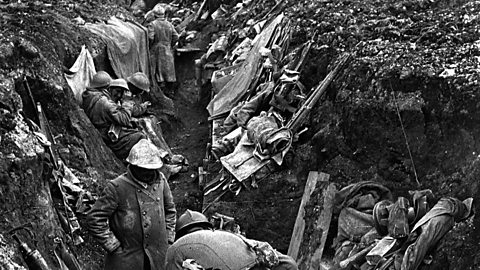
World War One. collection
A collection of programmes relating to World War One

Bitesize: World War One
A collection of articles covering World War One as part of Key Stage 3 History (Environment and Society).
More on Journey's End
Find out more by working through a topic
- count1 of 5

- count2 of 5

- count3 of 5


