The plot of Journey's End
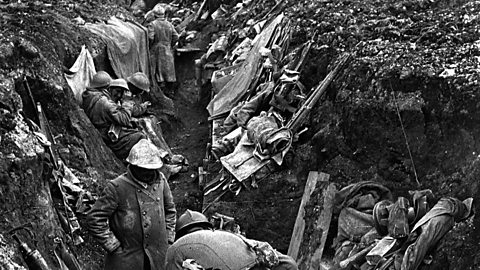
Journey’s End is set in the vicious trench warfare of World War One. The action begins on the evening of Monday 18 March 1918 and continues over three days. It was written and first performed in 1928.
Summary:Journey’s End examines the relationships between men of different ages, classes and temperaments as they endure the stress of waiting for combat in their trench during World War One. Instructed by their ambitious colonel, a man who remains mostly remote from danger himself, the men prepare for a hugely risky daylight raid on the enemy and await an anticipated attack by the Germans. The play highlights how horribly life in the trenches could affect and change people as they tried to cope with the never-ending pressure and danger. It also suggests how terrible and pointless the war was in wasting so many young men’s lives.
Title: Taken from a line Sherriff read in an unnamed book: “It was late in the evening when we came at last to our journey's end”. He had considered calling the play Suspense or Waiting, to give a sense of awaiting something dreadful; Journey’s End implies that a long and difficult experience is inevitably going to finish, conveying the weariness of the soldiers and the deadly fate that will await most or all of them.
Setting: A dugout on the frontlines of World War One in St Quentin, France in 1918, the final year of the war.
Themes: Heroism, the futility of war, courage and cowardice, community and comradeship, Social groupings, sometimes used to measure people's place in society., power and obedience, trauma and coping mechanisms, responsibility and leadership, anticipation and uncertainty.
Characters in Journey's End
The small cast of characters seen in Journey’s End are exclusively male, reflecting the conditions in the trenches at the front. The different ages, ranks, experiences and attitudes of the men convey their individuality, but at the end they are all equally doomed by their participation in the war.
Captain Dennis Stanhope

Brave
There is no doubt that Captain Dennis Stanhope is a brave soldier.
His bravery has gained him the Military Cross (a medal awarded to officers for gallantry). We're also told that he survived one of the war’s fiercest encounters – the Battle of Vimy Ridge – thus building up a hero image in the audience’s mind.
We forget while reading the script that he is only 21 years old – he is described in the stage directions as “no more than a boy”. He is therefore in a very responsible position at a young age.
We find out from Osborne that Stanhope has been “commanding this company for more than a year” and that “He’s never had a rest” in the three years he has been in the trenches.
This conveys the pressure he has been under and explains how he has changed from the boy Raleigh knew at school.
Flawed
Despite his heroism, Stanhope is a flawed character. This is a feature of a conventional A heroic character who makes an error of judgement that leads to his downfall.. He has not returned home in three years, partly because he does not want his girlfriend and family to see that life in the trenches has turned him into an alcoholic.
Stanhope is furious that Lieutenant Raleigh has found a way to join his unit, mostly because he is worried that Raleigh will tell his sister Madge – Stanhope’s girlfriend – about his addiction.
We are given further clues about his dark side when he threatens to shoot Lieutenant Hibbert – whom he sees as a "coward" – for trying to avoid the battle by pretending to be ill. This scene allows Sherriff an opportunity to show a harshness in Stanhope’s nature, but also to develop useful insights into the effects of war on men.
Stanhope’s reputation as a heroic leader is only possible because of his drinking. He himself admits that “without being doped with whiskey - I’d go mad with fright”.
A good leader
Despite his flaws, Stanhope is presented as a natural leader. This is apparent through the respect the men have for him, and the mature and reasoned way he deals with the issues facing his company.
Osborne’s character speaks highly of him in the opening scene. He defends Stanhope against the sneering opinion of Hardy when he states, “He’s a long way the best company commander we’ve got.”
The way Stanhope deals with the fearful Hibbert shows his leadership skills. He is straightforward and assertive: “You are going to stay here and do your job.” But he softens his tone later to, “Stay here, old chap – and see it through.”
Despite coming across as cold and harsh in this scene, Stanhope uses a variety of The linguistic techniques used as part of persuasive speaking or writing. (language techniques used to influence someone) such as repetition and Show understanding of how someone else feels. to persuade Hibbert to stay. Even with his own problems, he is able to manage his team in a crisis.
Compassionate
When faced with the Colonel’s insensitivity towards the end of the play, Stanhope makes clear his disdain for his commanding officers – separated as they are from the dreadful reality the men are facing.
He adopts a sarcastic tone after the death of Osborne: “Still it’ll be awfully nice if the brigadier’s pleased.” This shows his resentment at the lack of concern shown for the death of his men. Here we see that – unlike his superiors – he is compassionate enough to feel for his lost comrades.
In the closing scenes of the play, we again see Stanhope’s intense humanity as he comforts the dying Raleigh. The stage directions tell us that he lays Raleigh on Osborne’s bed. This is significant because of the close relationship Stanhope had with Osborne.
In a final act of Understanding and appreciation of the pain and suffering of others. and kindness, Stanhope remains with Raleigh who – as his life ebbs away – asks “Can you stay for a bit?”
Lieutenant Osborne

Loyal
Osborne is Stanhope’s second in command. His loyalty – despite Stanhope’s flaws – remains throughout.
He makes it clear to the audience that Stanhope is an exceptional soldier.
When Hardy is gossiping about Stanhope, Osborne states "I love that fellow. I'd go to hell with him."
While he recognises Stanhope’s flaws, Osborne understands that dealing with the horrors of war have made him the way he is. Because of this, he refuses to criticise Stanhope.
Respected
Osborne’s respected place in the company is shown in how Stanhope and the others call him by the nickname"Uncle". We find out that he has been a schoolmaster and the other men – including Stanhope – look up to him.
After his death, Stanhope shows a softer side when he A heartfelt expression of sorrow, usually in verse or song. that Osborne was “The one man I could trust - my best friend - the one man I could talk to as man to man - who understood everything”. This is high praise coming from a commanding officer as heroic as Stanhope.
Likable
In the opening scene of the play Osborne is contrasted favourably with Hardy. For example, Osborne’s humour is less rude so we come to like him immediately.
He is kind and friendly to everyone he meets.
The fact that he has played rugby for England – but only mentions it to Raleigh in passing and asks him not to “breeze it about” – shows he is a humble man.
He is concerned for those around him, saying to Stanhope: “Now come and lie down. You’ve had a hard day of it.” He is the most popular officer with all the other men and is much lamented by Stanhope when he dies.
Brave
Given Osborne’s age, he wouldn't have been recruited to the war effort – he would have volunteered. This 1928 audience would have been aware of this and it would increase their respect for him, as it showed his bravery in giving his life for his country.
We know he is terrified at the thought of being part of the raid. We see him reading from Alice's Adventures in Wonderland – he comforts himself with this childhood book and uses it as a distraction from the horrors of the war.
He accepts his fate with a simple, understated “Oh” when he is told he will be involved, and right up to the end – despite his fear – he does his duty bravely.
Second Lieutenant James Raleigh

Naïve
In the first few scenes Raleigh is a symbol of the Innocent or lacking experience. believer in the kind of glorious war put forward by recruitment Propaganda is when words, images or films are used to try and make people think a certain way..
When he is told he will be taking part in the raid, the stage directions inform us that Raleigh speaks “excitedly”.
His final line in Act Two, Scene Two is “I say!”, with an enthusiastic exclamation mark. This shows how flattered he is to be chosen.
As a family and school friend of Stanhope’s, Raleigh glorifies his commanding officer as a hero figure. He doesn’t recognise that Stanhope is a broken man because of his war experiences.
Raleigh quickly realises the realities of war after Osborne dies in the raid, and he will not take part in the celebratory meal as a consequence.
Raleigh’s death scene is one of the most poignant in the play because he started out so naïve and innocent about what war is truly like.
Enthusiastic
Raleigh is initially presented as boyish, exuberant and eager to please. He is described as “healthy looking”, in contrast to the pale figure of Stanhope.
He is young and his enthusiasm seems to prove Osborne’s theory that “a youngster straight from school” is “the kind that do best”. They have youth and energy and are not yet worn out by the horrors of the battlefield.
Raleigh is keen to take part in the raid – describing the prospect as “most frightfully exciting” – despite the more experienced officers knowing how dangerous it is. Sherriff uses Raleigh’s character to illustrate what war did to eager young men.
Raleigh is fatally wounded in the final battle. When he is being comforted by Stanhope, he asks for a light as “it’s so frightfully dark and cold”. This seems to foreshadow his own death. Sheriff uses Raleigh’s demise to show how spirited young men with so much potential were wasted in war.
Second Lieutenant Trotter

Dutiful
Trotter’s bravery and sense of duty is shown when Stanhope promotes him to second-in-command after Osborne is killed.
His promotion comes despite the fact that he is not a public school boy from a privileged background like the others are. He accepts the role dutifully and says: “I won’t let you down.”
Food, chatter and jokes help to keep his nerves intact and horror at bay. His obsession with food shows – just as with Stanhope’s addiction to alcohol – that every man found his own way of coping with the daily reality of war.
Underneath all the cheer, Trotter too has feelings he keeps hidden. He reveals this when he says to Stanhope, “Always the same, am I? Little you know”. Despite this he keeps going.
At the end it is he who is on the battlefield calling for Stanhope’s assistance.
Likeable
Trotter presents a humorous contrast to Stanhope when they first appear on stage together. He is described as "short and fat" compared with the hero-like physique of Stanhope who is "tall, slimly built but broad-shouldered".
Trotter’s first line shows him as cheerful and friendly when he talks about food, the exclamation marks emphasising his easy conversational tone, “Ha! Give me apricots every time! I ‘ate pineapple chunks; too bloomin’ sickly for me!”
Even when Stanhope has lost all patience with Hibbert and his bawdy stories and calls him a “Little worm”, Trotter defends him by saying “I reckon ’e only wanted to keep cheerful.”
His The words said by a character in a story or play. is cheerful, no matter what the circumstances – for example his responses of “Righto, skipper.” He manages to stay friends with everyone without argument for the duration of the play.
Second Lieutenant Hibbert

Frightened
Hibbert is described as “a small, slightly built man” in Sherriff’s stage directions.
This – perhaps stereotypical – description seems to Hint at something that will happen later and have greater significance. that he will be weak and cowardly as a soldier.
His lack of strength in the face of the horrors of war leads Stanhope to threaten to shoot him for desertion if he leaves.
Hibbert’s hysterics in front of Stanhope show him as desperate to escape the trenches.
He claims to have neuralgia – sudden attacks of severe sharp shooting facial pain – hoping that this will grant him a medical reprieve from fighting.
While his claim may be viewed by some of the men as cowardice, it is certainly genuine – and understandable – fear that makes him act this way.
Unpleasant
Hibbert is presented as quite a dislikeable character. Stanhope describes him as a "Little worm" with a “repulsive little mind". He doesn’t easily fit in with the men.
He tries to be sociable by joking. But his crude postcards of women and references to them as “tarts” – especially while getting drunk after the deaths of other men – create an unfavourable impression.
While Trotter tries to defend him, the audience feel little sympathy for Hibbert as throughout the play he fails to do his duty as the other men do.
Even at the end we see him taking as long as possible – “wasting as much time as [he] can” according to Stanhope – to go up and help fight the attack that kills Raleigh.
Other characters
The Colonel
The Colonel’s short time on stage highlights how little time senior army officers spent on the front line. We feel that he is relatively safe and removed from the horror, but that he too has to follow orders from above and keep a stiff upper lip.
The Colonel acts in control, suggesting who Stanhope should send on the raid. But he lacks sensitivity, speaking as if he views war as a game: "It’s all a damn nuisance; but, after all – it’s necessary."
Sherriff’s use of A literary technique where something is deliberately described as less important, serious or significant than it really is, often to create emphasis or irony. in choosing the phrase “a damn nuisance” to describe something which is killing many men, suggests how trivial the whole thing is to the Colonel.
When the young German soldier is captured, the Colonel interviews him roughly and shows no humanity, scornfully taking away his treasured letters from home. This lack of care and compassion shows him in contrast to the respected “hero”, Stanhope.
Hardy
Hardy is the first character we see in the play. He is an officer from another company about to be relieved by Stanhope.
Hardy offers our first insight into Stanhope: "How is the dear young boy? Drinking like a fish, as usual … [he] really is a sort of freak … He didn’t go home on his last leave, did he?" This allows us to form an opinion of Stanhope before we meet him.
Despite Hardy’s criticism of Stanhope, contrasts are drawn between them showing Stanhope as the better officer of the two. For example, Hardy is messy and disorganised while Stanhope has high standards and likes the dugout to be kept clean and tidy.
Mason
Mason is Stanhope’s batman – this is the term for an army officer’s servant. He is presented as less well educated than the officers. His station in life is emphasised by his working class dialect; he talks about " ’ot tea” and “sambridges".
Mason is hard working and keen to serve his officers. He is put in his place by Stanhope but is resilient and humorous, offering light relief and a sense of normality against which the madness of the war seems even more apparent and sad.
In the end, Mason proves brave and dutiful when he asks to join the others at the front. Sherriff juxtaposes his character here with the reluctant time-wasting Hibbert in order to emphasise Mason’s courage.
Test yourself
Further study
World War One: The global conflict that defined a century. collection
The First World War was the first truly global conflict – the battle raged not just in the trenches of the Western Front but in Africa, the Middle East and Asia.
World War One. collection
A collection of programmes relating to World War One

Bitesize: World War One
A collection of articles covering World War One as part of Key Stage 3 History (Environment and Society).
More on Journey's End
Find out more by working through a topic
- count3 of 5

- count5 of 5

- count1 of 5


