| 13 November 2014 |

| |
| BBC Homepage | | |
| |||
| Contact Us | | |
Credit CrunchYou are in: Tees > Credit Crunch > Changing with the times Changing with the timesBy BBC Tees' Martin Forster Whether it's a ewe with her newborn lambs finding shelter from a vindictive wind behind a drystone wall, or a twisted sapling clinging to a cliff face, everything in the Pennines tells you that survival here depends on adapting to the environment. 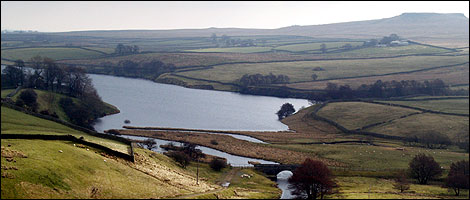 The view across Baldersdale from Balderhead. For a business trying to stay alive in this beautiful, but merciless environment, the message is just the same. You adapt, or you die. 
Beneath the dam at Balderhead Reservoir, where the wind can blow the spray over the top like an imitation, inland breakwater against the evening sky, lies the old farmhouse at Blackton Grange. The old stones bask in upland beauty in the summer and bear the excesses of the English weather in the winter. Marking the mid-point of the Pennine Way, the building had served for years as a Youth Hostel, providing shelter, warmth and a welcome bed for the night to walkers traversing this area of outstanding natural beauty. But in 2001, foot and mouth disease spread south from Tyneside. The surrounding farms became the front-line in a war between man and nature, the Pennine Way was closed, the walkers stopped coming. After the crisis was over and the countryside breathed again, says manager Jan Arger, the traffic past Blackton Grange Youth Hostel never recovered. "Once that link had kind of stopped, it's very difficult to re-establish. People found other places to walk, other things to do. People still walk in the area and still walk the Pennine Way, but it was, I guess, the impetus that was required to make the YHA (Youth Hostels' Association) think, 'Okay, we'll look very closely at this centre.'" A new startBlackton Grange, like many other Youth Hostels following the foot and mouth outbreak, was no longer viewed as sustainable. The Youth Hostels' Association put it up for sale and it was bought by a company that provides corporate getaways and management training.
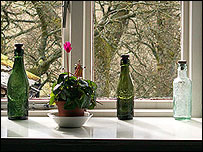 The facility has had to adapt. "They're used to 5-star, en-suite accommodation in very swanky hotels," said Jan, "so when they drive over our road across the dam and they look down the valley at our farm ... they're usually not really too impressed, but once they're here they actually enjoy it and they quite often bring their family back, because they've had such a good time." But with the centre only completing its refurbishment and reaching full occupancy in early 2008, by the time it was ready to put its new business model into practice, that oh-so-important environment was already beginning to change. Riding the changeIf nothing else positive comes out of 2009, it will sort the strong business models from the weak. As billionaire investor Warren Buffet said, "It's only when the tide goes out that you discover who isn't wearing swimming trunks." Blackton Grange is already discovering that something introduced almost as an afterthought has provided the breadth of market that may well see the business through this recession, as corporate clients cut management training breaks from their budgets. 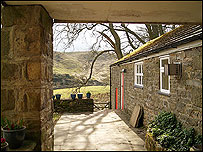 Blackton Grange porch. "The centre was bought with the intention of running it as a management training centre, which we do function as ... but we do have a split-persona," Jan explained. "Although the YHA sold us on, we're still affiliated to the YHA . We're part of their 'Escape To' programme ... where a large user group takes over the whole hostel at weekends and school holidays." This sideline, introduced to make use of down-time, has seen Blackton Grange play host to birthdays, murder mystery weekends, musicians from across Europe, Hari Krishna retreats and even a group who, inexplicably, spent the whole weekend wearing bear masks. As the pound weakens and more of us look for an alternative to expensive foreign travel, this side of the business has flourished. Late March saw the centre fully booked at weekends right up until the end of June. The same economic factors that caused the core corporate client base to cut back, have caused this sideline business to boom. It's 2009. Who could have predicted that Britain's great banking institutions, of all things, would be turning to part or full nationalisation to survive? But for all the uncertainty, here in the high reaches of Teesdale, far away from the screaming city traders, this breadth of business model could well be what keeps Blackton Grange clinging to the cliff face to weather the storm.
last updated: 03/04/2009 at 16:07 SEE ALSO
You are in: Tees > Credit Crunch > Changing with the times |
| | About the BBC | Help | Terms of Use | Privacy & Cookies Policy |