

Wednesday 24 Sep 2014
Programme Information
Network TV BBC Week 48: Monday 30 November 2009
BBC ONE Monday 30 November 2009
Rip Off Britain Ep 1/5


Angela Rippon, Jennie Bond and Gloria Hunniford team up to help the nation in its battle against Rip Off Britain, in a new, five-part series for BBC One Daytime.
At a time when every penny counts, the series investigates the sharp practices by some of the biggest names on the High Street – exposing the hidden costs and the deals that really are too good to be true.
Every day this week, the team digs into the facts to show consumers what they need to do to fight back. They tackle a different area each day, including finance and banking, travel, utilities, shopping and housing.
Rip Off Britain also features a new nationwide survey, investigations into how companies don't always give consumers the best deals and information aimed at helping people make informed choices about their finances.
CI2
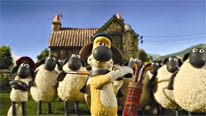
Shaun The Sheep and his farmyard pals are set for some more hair-raising animated adventures this week, as the Emmy-winning series, made by the Academy Award-winning Aardman Animations, continues.
In Monday's show, the farmer comes across his old golf clubs and decides to knock a few balls around, instantly putting his back out in the process. Shaun takes the opportunity to learn how to play, while Bitzer is forced to tend to his injured master inside the house.
The farmer gets ready for a date in Tuesday's episode and wants to look his best, so it's time to dust off his prized hairpiece. Shaun can't resist trying the wig on but loses it while showing off to the flock. The race is on as Shaun and Bitzer try to return the wig in time for the farmer's big night.
On Wednesday, the sheep discover a set of bagpipes on the rubbish dump which they immediately misidentify as a sick emu. They set about trying to nurse it back to health before releasing it back into the wild.
Timmy accidentally eats a tomato grown with "Miracle-Grow" fertilizer, in Thursday's episode, and expands to become the King Kong of sheep. Shaun must keep the giant toddler out of sight while trying to figure out how to return him to normal size.
Finally, on Friday, while preparing for bed, the farmer manages to lock himself out of the house and is stuck outside in his pyjamas. He decides to spend the night in the barn but his incessant snoring drives the flock mad. Shaun concocts a plan to return him to his bed without waking him up.
VT
Phil advises Max that it's in his best interests to pay back the £13k he owes, in tonight's first visit of the week to Walford. He says he'll be waiting in the Vic.
Ronnie, meanwhile, bursts into Roxy's bedroom to announce her return home, but discovers her in bed with Dr Al.
Phil is played by Steve McFadden, Max by Jake Wood, Ronnie by Samantha Womack, Dr Al by Adam Croasdell and Roxy by Rita Simons.
JM3
Life – Creatures Of The Deep Ep 8/10

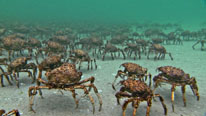
Marine invertebrates are in the Life spotlight this week as the series from the BBC's Natural History Unit, narrated by David Attenborough, continues.
Marine invertebrates are extraordinarily diverse, outnumbering fish by 10 to one and ranging from some of the most primitive creatures to some of the most intelligent.
Many of them make a nightly migration to shallower water. For the first time, a huge number of six-foot long carnivorous Humboldt squid are filmed hunting co-operatively to attack a shoal of fish.
Conditions under the ice in Antarctica's Ross Sea are similar to the deep ocean. The sea bed is carpeted with thousands of sea stars, sea urchins and huge nemertean worms. Seen in tracking time-lapse for the first time, they swarm across the sea bed to feed on a dead seal pup carcass.
Off the coast of Australia, giant spider crabs emerge from the deep to congregate in vast numbers in the shallows to moult. Once they've moulted they are soft-bodied – ideal for mating – but it is also a time when they are vulnerable to attack from sting rays.
A large male giant Australian cuttlefish attracts and mates with a female and then guards her from his rivals. If another large male challenges him, he flashes colours and stripes that pulse along his side. However, devious smaller males can change colour to look like a female and hold their tentacles just like a female who wants to mate. In this disguise, they slowly swim towards the female and, right under the larger male's nose, quickly mate with her.
In the warm but nutrient-poor seas of the tropics, microscopic coral polyps multiply and grow, creating the largest living structures in the world that harbour a quarter of all marine life. And yet coral reefs are built by the tiniest of creatures, occupying less than half of one per cent of the ocean's floor.
Tonight's diary section, Sink Or Swim, reveals the depths the Life team went to film under the Antarctic ice and to create their own coral reef.
Life is simulcast on the BBC HD channel – the BBC's High Definition channel, available through Freesat, Sky and Virgin Media.
BR/LS2
BBC TWO Monday 30 November 2009
After a spot of duck versus caterpillar racing in the shop, and telling a customer that she and Gary have two little boys with two little toys, named Cliff and Richard, Miranda realises she needs to be a bit reckless and wild, as the semi-autobiographical writing of comedy actress Miranda Hart continues.
She's young, free and happily single, after all, so why not book a spontaneous short break to Thailand? That's the Thailand down the road, in the shape of her local hotel, Hamilton Lodge – the definite perks being no travel, no language barrier and, most importantly, no sand/towel/lolly/wasp scenarios to deal with.
After 26 hours at the hotel Miranda has done everything – she's had six baths; eaten every room service meal; pressed every pair of trousers she owns; mistakenly ordered an overly familiar escort; and reached verbal diarrhoea levels with the young porter. Her trip away reaches an even weirder level when she's mistaken for the hotel's visiting seminar leader.
When Gary works out where Miranda actually is he turns up at her room. A regally drunk Miranda suggests that to prove the ease of their friendship they should just sleep together, before promptly passing out.
On returning from her spontaneous holiday, Miranda defends her choice of location to her disapproving friends and mother – what's not wild about getting drunk, ordering an escort, making new friends, running a seminar and jumping out of a window?
Miranda is played by Miranda Hart, Gary by Tom Ellis and the young porter by Luke Pasquilino.
RD4
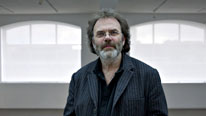
Charles Saatchi's nationwide search to discover the next generation of artistic talent continues and his six chosen artists are commissioned to produce large-scale pieces of public art for the seafront in Hastings. They have only two weeks to try to make artworks which must appeal to the locals.
For these avant-garde, contemporary artists, this poses a considerable challenge, but this is precisely what Saatchi wants. The idea behind this commission is to force them to create big, bold and accessible work that will appeal to a non-art-world audience. Up to now, they've only ever created small work for an arty audience, but to make a mark in the art world they'll have to prove they can create pieces with scale and ambition, which will make an impact on a wide audience.
As the artists conceive and start creating their works, they receive advice and critique from controversial Turner Prize-winning artist Martin Creed and art writer Matthew Collings. Creed – who made the famous piece The Lights Going On And Off – advises them to keep it simple and make sure their work stands out from the environment around them. The worst thing they could do is create pieces that the public didn't even know was art. Collings fears that their work could be boring and commit the ultimate art crime of being worse than the empty space that was there before it; something, he feels, which bad contemporary art is often guilty of.
When their work is finally constructed on the seafront in Hastings, the artists come face to face with the public and find out exactly what they think of their creations. And what does Saatchi think of their work? He's very impressed with most of the pieces, particularly given the short time and limited budget available to them. But one of the works doesn't impress at all and comes in for significant criticism. He deems the others so good he'd be happy to exhibit them in his gallery. Praise indeed!
School Of Saatchi is part of the Modern Beauty Season, a range of programmes coming to BBC Two and BBC Four which look at the concept of beauty in modern art.
KA
BBC FOUR Monday 30 November 2009
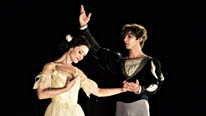
Anne-Marie Duff stars as Margot Fonteyn in Margot, the final drama in BBC Four's Women We Loved season.
Margot tells the story of the prima ballerina assoluta's dancing partnership and complex relationship with Russian dancer Rudolf Nureyev, forged towards the end of her career.
The partnership propelled them into the stratosphere of international stardom, creating a kind of celebrity that had never existed before and securing their place in the hearts of audiences and the history of ballet.
Viewers meet Fonteyn aged 40 in a dark prison cell, having been caught up in her husband, Tito's, attempt to overthrow the Panamanian government. Despite her surroundings she remains elegantly poised but behind this façade is a woman painfully aware of the future.
Along with knowledge of her diplomat husband's infidelities, Margot senses mounting pressure from the Royal Ballet to consider retirement. But, in 1962, everything changes when Margot is introduced to the young Russian émigré Rudolf Nureyev, and they begin a professional partnership that would captivate the world for years to come.
As Margot's private life collapses, her passionate performances with Nureyev turn her into a worldwide celebrity. With tensions mounting at home, and the strain beginning to affect her marriage, Margot's relationship with Nureyev grows stronger and the divide between her public and private life more pronounced – will she be forced to choose between her career and her husband?
Anne-Marie Duff is Margot Fonteyn, Michiel Huisman is Rudolf Nureyev, Con O'Neill is Tito, Penelope Wilton is Margot's mother, BQ, Sir Derek Jacobi is choreographer Frederick Ashton and Lindsay Duncan is Ninette de Valois, founder of The Royal Ballet.
LH2
Programme information
Network TV
Network TV – Days
Key
- New

- Live event/outside broadcast

- Interactive programme
- High Definition programme
BBC iD
BBC iDBBC navigation
BBC links

BBC © 2014The BBC is not responsible for the content of external sites. Read more.
This page is best viewed in an up-to-date web browser with style sheets (CSS) enabled. While you will be able to view the content of this page in your current browser, you will not be able to get the full visual experience. Please consider upgrading your browser software or enabling style sheets (CSS) if you are able to do so.
