

Wednesday 29 Oct 2014
Programme Information
Network Radio BBC Week 45: Sunday 8 November 2009
BBC RADIO 1 Sunday 8 November 2009

Sunday 8 November sees the return of the BBC's flagship event for teens – BBC Switch Live. Taking place at London's Hammersmith Apollo, it features performances from some of the biggest music stars in the teen world – including Black Eyed Peas, The Saturdays, N-Dubz, Alexandra Burke and Pixie Lott.
Switch DJs Nick Grimshaw and Annie Mac race back from the event to the BBC Radio 1 studios for a special, five-hour BBC Switch Live extravaganza, from 7pm. They are joined by Switch Live performers JLS and fellow Switch presenters – The 5:19 Show's Tom Deacon and The Surgery presenter Aled Haydn-Jones.
Nick and Annie bring listeners exclusive, live tracks from the event as well as interviews with the acts themselves and winners from the BBC Switch Live awards, announced at the event. Tom will be dishing the dirt and sharing backstage gossip while Aled shall be asking his celebrity friends for their top advice tips for teens.
Producer/Megan Carver
BBC Radio 1 Publicity
BBC RADIO 2 Sunday 8 November 2009
REMEMBRANCE SUNDAY 2009
Good Morning Sunday

On Remembrance Sunday, Aled Jones says Good Morning Sunday to Sir Ranulph Fiennes, whose father was killed in action in the Second World War, before Sir Ranulph was born.
Grammy Award-winning guitarist and singer-songwriter Mark Knopfler talks about a song he has written for his Uncle Freddie, a piper of the First Battalion, Tyneside Scottish, the Black Watch, Royal Highland Regiment, who carried his pipes into action and was killed with them at Ficheux, near Arras, in May 1940, aged just 20. Entitled Piper To The Ends, it is the closing track on his fifth studio album.
Aled is also joined by author and former RAF pilot John Nichol, who has served around the world and was shot down and held captive during the first Gulf War.
Presenter/Aled Jones, Producer/Hilary Robinson
BBC Radio 2 Publicity
Brian D'Arcy introduces some favourite hymns for Remembrance Sunday to commemorate and honour all those who have lost their lives in conflicts around the world. Through reflection, music and prayer, he pays tribute to those who have sacrificed their lives in current and past wars.
This week's featured choir is the Trinity Boys' Choir, directed by David Swinson, with organist David Thorne. Hymns featured include O Valiant Hearts, O God Our Help In Ages Past and O Love That Wilt Not Let Me Go.
Presenter/Brian D'Arcy, Producer/Janet McLarty
BBC Radio 2 Publicity
BBC RADIO 3 Sunday 8 November 2009
Michael Berkeley's guest today is the Deputy Leader of the Liberal Democrats Dr Vincent Cable.
Music is integral to Vince's life. His first wife, who died in 2001, was an accomplished musician and teacher, and two of their three children have inherited their mother's talent.
Vince himself loves all kinds of musical activity, from opera to ballroom dancing. His choices include several great singers – Luciano Pavarotti, the German bass Gottlob, Nicolai Gedda and Angela Gheorghiu.
Presenter/Michael Berkeley
BBC Radio 3 Publicity
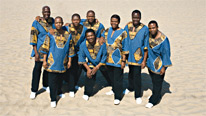
Hailed by Nelson Mandela as "South Africa's cultural ambassadors", multi Grammy Award-winning, a cappella vocal group Ladysmith Black Mambazo are in the UK until late November on one of their longest-ever UK tours.
The Choir this week seizes the opportunity to hear them in concert, with Aled Jones presenting music from their show at the Hall For Cornwall, Truro.
Presenter/Aled Jones, Producer/Dominic Jewel
BBC Radio 3 Publicity
As Russians fight off the Nazis in the savage 1942 siege of Leningrad, three teenagers are thrown together in a war-torn apartment block. Having lost everything from their pasts, they forge a triangular relationship that binds them together, and a new hope that keeps them alive – the promise of a better future. The drama charts the rise and fall of their hopes for each other and themselves, and of the cost of this promise to them all.
Ruth Wilson (who recently appeared as Stella in the Donmar Warehouse production of A Streetcar Named Desire), Harry Lloyd and Russell Tovey star in this adapatation by Nick Dear, originally written for the Tricycle Theatre's production of the play in 2002.
The Promise is part of BBC Radio 3's 1989 Season, which features an array of programmes marking the 20th anniversary of the fall of the Berlin Wall, one of the most potent symbols of the Cold War.
Producer/Sasha Yevtushenko
BBC Radio 3 Publicity
Twenty years after the fall of the Berlin Wall, Dariusz Rosiak and David Vaughan investigate the idea that oppression spurs the imagination and that censorship can be a muse. They look specifically at Poland and the Czech Republic, presenting cultural portraits of two famous centres of artistic activity, Warsaw and Prague.
David Vaughan, who was the editor of Radio Prague for many years, meets artists who were active in the Communist era, such as author Ivan Klima, whose work was banned, and young novelist Petra Hulova.
In Warsaw, Dariusz Rosiak, one of Poland's best-known radio journalists, talks to Agnieszka Holland, one of Poland's most prominent film makers who made To Kill A Priest, a film about the 1984 murder of Polish priest Father Popieluszko by the secret police.
These two portraits of the cultural ecology of Warsaw and Prague reveal how artists in Eastern Europe are, after struggling with totalitarianism, now grappling with the challenges of freedom.
The Muse Of Censorship is part of BBC Radio 3's 1989 Season, which features an array of programmes marking the 20th anniversary of the fall of the Berlin Wall, one of the most potent symbols of the Cold War.
Presenters/Dariusz Rosiak and David Vaughan, Producer/Julian May
BBC Radio 3 Publicity
Berlin may not be as beautiful as Paris; it may not have the brash allure of Rome; or even London's muscularity; but no one can think of the 20th century without thinking of Germany's capital. It was on the front line between two of the most powerful ideologies of modern times – Communism and Capitalism. It was Hitler's stage when he seized power in 1933. And it now stands poised between a resurgent Russia in the East and a Europe forging a new identity in the West.
Actors Henry Goodman and Liz Shepherd read prose and poems to evoke the city's history, with a rich array of music, including Strauss, Mendelssohn, Schoenberg and Bach.
Words And Music is part of BBC Radio 3's 1989 Season, which features an array of programmes marking the 20th anniversary of the fall of the Berlin Wall, one of the most potent symbols of the Cold War.
Readers/Henry Goodman and Liz Shepherd, Producer/Zahid Warley
BBC Radio 3 Publicity
BBC RADIO 4 Sunday 8 November 2009
Living World Ep 1/5

John Walters is a naturalist, a writer, a photographer, a painter, a radio enthusiast and a talented observer of wildlife.
John takes Lionel Kelleway onto Dartmoor to find the last of the season's grasshoppers and crickets.
Most people think that grasshoppers and crickets are the sound of the summer. But John reveals that their behaviour changes and becomes much more visual in the last of the summer rays.
And the great surprise is finishing the programme on John's allotment where, under his shed, he finds the greatest cricket in Europe, the giant green bush cricket.
Presenter/John Walters, Producer/Andrew Dawes
BBC Radio 4 Publicity
REMEMBRANCE SUNDAY 2009
Ceremony Of Remembrance From The Cenotaph
In the year when the UK said farewell to its last First World War veteran, Harry Patch, and the 70th anniversary of the beginning of the Second World War is marked, Nicholas Witchell sets the scene in London's Whitehall for the solemn ceremony when the nation remembers the sacrifice made by so many in the First and Second World Wars, and in other, more recent, conflicts.
The traditional music of remembrance is played by the Massed Bands and, after the Last Post and the two-minute silence, Her Majesty the Queen lays the first wreath on behalf of the nation and Commonwealth. The Bishop of London leads a short Service of Remembrance. Then, during the March Past, veterans recall past conflicts and listeners hear from those serving in the armed forces around the globe today.
Presenter/Nicholas Witchell, Producer/Simon Vivian
BBC Radio 4 Publicity
Mark Whitaker presents the fourth series of annual 15-minute vignettes for Remembrance Sunday.
This programme is not just about how the poppy became the symbol of remembrance in Britain, it is also a deeper analysis of why it rapidly became such a strong and enduring symbol. The programme also looks at France's rather less ubiquitous flower of remembrance, the blue cornflower. Through these two floral symbols, the programme seeks an insight into the two nation's different approaches to remembering those who have died in past conflicts.
The programme visits Ypres, where the symbol of the poppy is everywhere; the nearby battlefield where Canadian John McCrea penned one of the best-known poppy poems, In Flanders Field; and listeners are taken inside the British Legion's poppy factory in Richmond.
The programme then goes to Verdun, scene of the longest and most devastating battle in French history, to visit the awe-inspiring ossuary – where the bones of thousands of French and German soldiers lie together.
Professor Jay Winter gives his penetrating insights into different traditions of remembrance. Listeners hear from a French farmer, near the Somme, who has painstakingly researched, for decades, the course of the war across the plateau he now farms and where he still regularly uncovers remnants of the Great War.
Presenter/Mark Whitaker, Producer/Mike Hally
BBC Radio 4 Publicity
REMEMBRANCE SUNDAY 2009
The Two Minute Silence
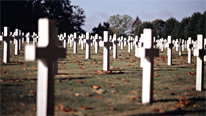
Every Remembrance Day, during the two-minute silence, Clare Jenkins's mother remembers her father, Clare's grandfather, who was wounded during the early days of the First World War on the Mons Retreat from Belgium.
Meanwhile, Bill Stewardson thinks of a far more recent conflict, the one taking place in Iraq. His 21-year-old son, Alex Green, was killed by a sniper in Basra two years ago.
In this programme, Clare Jenkins talks to her mother, to Bill Stewardson and to others about their personal reasons for respecting the two-minute silence.
The programme includes Billy Stanger from Orkney who has played The Last Post at Remembrance Day services in Kirkwall for the past 57 years; Dave "Charley" Brown, a veteran of both the Falklands conflict and the Northern Ireland Troubles, who now works for the South Atlantic Medals Association which helps Falklands veterans and their families; and David Cotterrell, professor of fine art at Sheffield Hallam University and official war artist for the British troops in Afghanistan, who has marked the two-minute silence both in Camp Bastion and, inadvertently, at Sheffield railway station, on his return from the front line.
It may be 90 years since King George V decreed: "All locomotion should cease, so that, in perfect stillness, the thoughts of everyone may be concentrated on reverent remembrance of the glorious dead." However, the silence still resonates with millions, not just in Britain but around the world.
Presenter and Producer/Clare Jenkins
BBC Radio 4 Publicity
Adventures In Poetry Ep 1/6
Adventures In Poetry returns with a new series of six programmes. Each programme, presented by Peggy Reynolds, focuses on a single poem and tries to view it from as many different perspectives as possible.
The series begins with Adlestrop by Edward Thomas.
Adlestrop is made up of only 16 short and simple lines, yet it evokes far more than just the mood of a single moment and has been much loved by many for almost 100 years. The poem captures the moment when a train stops unexpectedly at a small Cotswold station on a summer's day.
Thomas only worked as a poet for short time before he was killed at Arras in 1917. Perhaps the poem is known, in part, because of the modesty of Thomas's output and because his life was so tragically cut short by war. However, it also evokes the lost world of the English countryside and a human mood that was swept away.
The station at Adlestrop has gone too, though the railway line is still there and Peggy Reynolds is joined on a bridge over the tracks by Jonathan Davidson, railway buff and poet, and by Anne Harvey, who has long loved and studied the poem and champions Edward Thomas.
Natalie Seddon of Oxford University and Andy Clements of the British Trust for Ornithology discuss Thomas's lines in the light of what is known about bird-song.
Subsequent programmes in the series focus on: Robert Frost's Mending Wall; Robert Browning's My Last Duchess; John Keats's On First Looking Into Chapman's Homer; Philip Larkin's An Arundel Tomb; and Anna Bradstreet's To My Dear And Loving Husband.
Presenter/Peggy Reynolds, Producer/Tim Dee
BBC Radio 4 Publicity
BBC RADIO 5 LIVE Sunday 8 November 2009
5 Live Sport
Colin Murray presents an afternoon of live sport, plus the latest sports news.
From 1pm, there's live Formula 1 commentary of the final race of the season, the Abu Dhabi Grand Prix, with David Croft, Anthony Davidson and Holly Samos. There are also regular updates from Dundee United versus Rangers in the Scottish Premier League.
At 2.30pm, there are updates from the day's rugby union Premiership matches and reports from cycling's Track World Cup at Manchester Velodrome and the New York Marathon.
From 4pm, there's live Premier League commentary as Birmingham take on Manchester City at St Andrews.
Presenter/Colin Murray, Producer/Graham McMillan
BBC Radio 5 Live Publicity
BBC RADIO 5 LIVE SPORTS EXTRA
Sunday 8 November 2009
Football
Uninterrupted Premier League commentary of Wigan Athletic versus Fulham comes, live, from the DW Stadium.
Producer/Jen McAllister
BBC Radio 5 Live Sports Extra Publicity
NFL American Football
Arlo White presents commentary of the New York Giants versus the San Diego Chargers, live, from the Giants Stadium.
Arlo is joined by regular contributors NFL journalist Neil Reynolds and Greg Brady, plus regular updates from around the NFL.
Presenter/Arlo White
BBC Radio 5 Live Sports Extra Publicity
BBC 6 MUSIC Sunday 8 November 2009
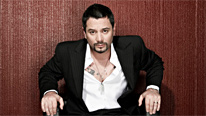
Huey Morgan meets Blur lead guitarist and acclaimed solo artist Graham Coxon to talk about his seventh solo release, the primarily acoustic and blues-influenced The Spinning Top.
It's been a hectic year for Coxon as Blur spectacularly re-formed, accompanied by much media hype, performing at Glastonbury, T In The Park, Oxegen and London's Hyde Park.
Huey talks to Coxon about guitars, the Blur reunion, the inspiration behind his latest solo release and his upcoming tour dates.
Presenter/Huey Morgan, Producer/Becky Maxted
BBC 6 Music Publicity
Stuart Maconie hosts a very special event, recorded at the BBC's Radio Theatre, which sees the UK première of radio musical The Seduction Of Ingmar Bergman, written by Sparks.
Originally commissioned by the Swedish National Public radio, Sveriges Radio, Ron and Russell Mael wrote and produced an original radio musical called The Seduction Of Ingmar Bergman, a musical fantasy based on internationally acclaimed film director Ingmar Bergman. Stuart presents this first UK playback to an audience of the musical followed by a Q&A with the Sparks brothers.
Presenter/Stuart Maconie, Producer/Henry Lopez Real
BBC 6 Music Publicity
Bob Dylan chooses questions as his theme.
The chosen tracks include: Who Do You Love? by Bo Diddley; Who's That Lady? by The Isley Brothers; Marvin Gaye's What's Going On?; and What Is This Thing Called Love? by Billie Holiday.
Presenter/Bob Dylan, Producer/Frank Wilson
BBC 6 Music Publicity
Programme information
Network Radio
Network Radio – Days
Key
- New
- Live event/outside broadcast

- Interactive programme

- Picture available
BBC iD
BBC iDBBC navigation
BBC links

BBC © 2014The BBC is not responsible for the content of external sites. Read more.
This page is best viewed in an up-to-date web browser with style sheets (CSS) enabled. While you will be able to view the content of this page in your current browser, you will not be able to get the full visual experience. Please consider upgrading your browser software or enabling style sheets (CSS) if you are able to do so.
