

Wednesday 24 Sep 2014
Programme Information
Network Radio BBC Week 45: Monday 9 November 2009
BBC RADIO 1 Monday 9 November 2009
The fourth in a 10-part series exploring the music and pop cultural moments that defined the first decade of the new millennium – seen through the eyes of BBC Radio 1 – is presented by Huw Stephens. The year 2003 saw The White Stripes break into the mainstream and The Libertines become the big indie darlings. Former Libertines drummer Gary Powell contributes to the programme.
Huw also talks to Frankie Poullain, former bassist of The Darkness, the cliché-laden rock band who debuted in 2003 becoming hugely successful before crashing and burning in the course of making two albums.
Huw delves into the online revolution of MySpace and the emergence of future pop superstar Dizzee Rascal from the underground grime scene.
Presenter/Huw Stephens, Producers/Alice Lloyd and Louise Kattenhorn
BBC Radio 1 Publicity
BBC RADIO 2 Monday 9 November 2009
As part of BBC Radio 2's Great British Songbook, Ken Bruce is joined this week by English songwriter and record producer Guy Chambers, who is perhaps most well known for his music collaborations on the solo projects of former Take That star Robbie Williams. Guy will be picking his Tracks Of My Years and has chosen songs composed solely by British songwriters including The Beatles, Kate Bush and Led Zeppelin.
There's also PopMaster, the Love Song and the Album Of The Week.
Presenter/Ken Bruce, Producer/Gary Bones
BBC Radio 2 Publicity
The Jeremy Vine Show

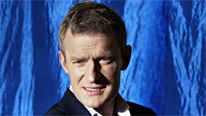
To celebrate 20 years since the fall of the Berlin Wall, Jeremy Vine broadcasts his show live from the German capital and talks to people who experienced life behind the wall about their memories of the day it fell.
Presenter/Jeremy Vine, Producer/Chris Walsh-Heron
BBC Radio 2 Publicity
In the fourth episode of the series which celebrates the centenary of clarinet virtuoso and bandleader Benny Goodman, American singer/songwriter and musician Curtis Stigers looks at Benny's career following his huge success at Carnegie Hall in January 1938, when trouble was brewing between Benny and his star drummer Gene Krupa.
Johnny Mercer entered the picture as lyricist on the big Goodman hit, And Then Angels Sing, and became a regular on Goodman's Camel Caravan radio show. Star trumpeter Harry James departed to start his own band while his wife, Louise Tobin, became Benny's new girl singer.
BBC Radio 2 celebrates the birth centenary of lyricist Johnny Mercer later on this week with Friday Night Is Mercer Night.
Presenter/Curtis Stigers, Producer/Graham Pass
BBC Radio 2 Publicity
BBC RADIO 3 Monday 9 November 2009
Composer Of The Week – Satie Ep 1/4

He's the writer of one of the most famous piano pieces ever written; yet away from the famous Gymnopédie, Erik Satie still divides opinion like no other composer. For some, Satie is a surreal, neglected genius – as the composer of piano works with titles like Desiccated Embryos and Three Pieces In The Shape Of A Pear – not to mention the infamous Vexations, designed to be repeated 840 times in succession. For others, he's just a show off who covered up his ineptitude with a series of bad jokes.
Donald Macleod examines Satie's roots on the sleepy Normandy coast, through his apprenticeship in the boozy dives of Montmartre (where he met Claude Debussy, one of his closest friends), his tempestuous, poverty riddled affair with the artist Suzanne Valadon, and his decision to go back to music school at the tender age of 39.
By the end of his life, Satie, the one-time renegade, had become the toast of the musical establishment, working with legends like Pablo Picasso, Jean Cocteau and director René Clair.
Presenter/Donald Macleod, Producer/Steven Rajam
BBC Radio 3 Publicity
1989 SEASON
Night Waves
Night Waves hosts a live debate from Berlin on the 20th anniversary of the fall of Berlin Wall. Philip Dodd and a roundtable of writers, journalists and artists discuss whether the loss of the Wall has left a gaping hole in German intellectual life.
The Berlin Wall divided Germany, divided families and divided East and West Europe. The collapse of the Communist State with its Stasi apparatus and the reunification of Germany were momentous events.
But, arguably, the Wall's demolition also removed a central focus for Germany's thinkers. It acted as the lynchpin for a whole host of powerful books, films, articles and plays grappling with what it meant to be German – in both East and West – and the 20 years since have not thrown up an equally powerful pre-occupation to understand the nation.
Philip Dodd's guests live in Berlin include Dresden-born novelist Ingo Schulze, who made his name writing about eastern Germany in the aftermath of the Wall's destruction, and the historian of Germany Karen Leeder.
Presenter/Philip Dodd, Producer/Zahid Warley
BBC Radio 3 Publicity
1989 SEASON
The Essay – The World Turned Upside Down Ep 1/5
Passports, garden chairs, cars or contraceptives. Five essayists from former Warsaw Pact nations reflect on the changing use and meaning of an apparently banal object – an object that unlocks a wider story about how daily life in their country was transformed by the dramatic events of 1989.
In this week's series of The Essay, contributors from Hungary, East Germany and three other former communist countries remember 1989 and the changes that a year of revolutions brought about – changes to the economy, the media and all aspects of public and private life. Comparing life under and after Communism, each essayist chooses an object which encapsulates change.
In Monday's programme, Hungarian journalist Valeria Toth measures out her life in passports. The multiple passports of communist Hungary, included red for travel to Warsaw Pact nations, blue for travel outside the Soviet bloc and red with a blue stamp for non-aligned Yugoslavia. Special one-way passports were used to expel troublesome citizens and passport anxiety continued into 1989, when thousands of East Germans entered Hungary and the ditch beside the border filled with discarded passports. Finally, a new era dawned in which – unthinkably – it's even possible to occasionally forget your passport.
The Essay is part of BBC Radio 3's 1989 Season, which features an array of programmes marking the 20th anniversary of the fall of the Berlin Wall, one of the most potent symbols of the Cold War.
Presenter/Valeria Toth, Producer/Julia Johnson
BBC Radio 3 Publicity
Jez Nelson and Kevin Le Gendre mark the fall of the Berlin wall 20 years ago, featuring an exclusive session recorded in the city with BBC Radio 3 New Generation Artist, trumpeter Tom Arthurs. Joining him is Philipp Gropper, saxophonist for promising young German band Hyperactive Kid, together with Swedish bassist Petter Eldh and Swiss drummer Marc Lohr.
Trumpeter, flugelhornist and composer Tom Arthurs currently splits his time between London and Berlin, a city that has become a cultural and musical hub of Europe, attracting musicians from around the world for its stylistically diverse jazz and improvised music scene.
Jazz On 3 is part of BBC Radio 3's 1989 Season, which features an array of programmes marking the 20th anniversary of the fall of the Berlin Wall, one of the most potent symbols of the Cold War.
Presenter/Jez Nelson
BBC Radio 3 Publicity
BBC RADIO 4 Monday 9 November 2009
Book Of The Week – The Magnetic North Ep 1/5
Acclaimed writer Sara Wheeler journeys to the collar of lands around the Arctic Ocean, searching for the truth behind the perceptions of this "place of greatest dignitie".
Sara completes a series of journeys to the semi-inhabited fringes of the Arctic, taking part in adventures such as herding reindeer with Lapps, smashing through the ocean on board a Russian icebreaker and following the huge Trans-Alaskan pipeline across the Arctic Circle. She examines some of the myths and legends of this sparsely populated area and how preconceptions match up to the reality.
Sara draws on a wide range of sources – explorers' diaries, oral histories of indigenous people, current writing on climate change, as well as her own observations, to explore the Arctic and what it says about the world today.
Reader/Adjoa Andoh, Producer/Eilidh McCreadie
BBC Radio 4 Publicity
Woman's Hour Drama – Our Mutual Friend Ep 1/20

Pauline Quirke, Lee Ross, Alex Jennings, Neil Stuke, Daisy Haggard and Patrick Kennedy are among the 22-strong cast of a new dramatisation of Charles Dickens's last complete novel.
Nicola Miles-Wildin, who is partially disabled and a wheelchair user, plays the part of Jenny Wren, the disabled dolls-dressmaker.
According to the terms of his father's will, John Harmon will inherit a fortune built on the collection and recycling of waste: but only if he marries Bella Wilfer, a beautiful but mercenary and wilful girl whom he has yet to meet. However, when a body floating in the Thames is identified as that of John Harmon, his inheritance passes instead to the humble Boffins, and the effects spread throughout London society.
This story features a wider social canvas than any of Dickens's other works and marks a great return to some of the truly Dickensian characters of his early fiction. The well-meaning Boffins collect a motley crew of dependents almost as soon as they inherit their fortune.
Adapted by Mike Walker, all 20 episodes of Our Mutual Friend will be available on the BBC iPlayer after broadcast until a week after the final broadcast.
Jason Watkins is Mr Boffin, Pauline Quirke is Mrs Boffin, Jamie Foreman is Rogue Riderhood, Lizzy Watts is Lizzie Hexham, Patrick Kennedy is Eugene Wreyburn, Lee Ross is Silas Wegg, Alex Jennings is Charles Dickens, Daisy Haggard is Bella Wilfer, Carl Prekopp is John Rokesmith and Neil Stuke is Bradley Headstone.
Producers/Jeremy Mortimer and Jessica Dromgoole
BBC Radio 4 Publicity
Comedian Ed Byrne asks why students are turning their backs on the union bar and heading to the High Street for a night out.
Cheap, loud and cheerful, the union bar has long been part of university culture and the focal point of student social life. The student circuit has launched many famous comedians and bands, and provided a living for others whose best days are behind them.
But from Bristol to Aberdeen, union bars have been shutting down. Unable to compete on price with pub happy hours and off-licence promotions, union officers are turning to juice bars and even gyms to make money.
Ed Byrne, stand-up comic and regular panellist on Mock The Week and Have I Got News For You, was once Vice President of the Student Union at Strathclyde University, where he studied horticulture.
In this programme, Ed heads back to Glasgow to find out what has happened to his bar. He looks back on union bar culture in his day, talks about student gigs and tries to find out why, around the UK, the student social scene has been shifting from the union to the city centre.
Presenter/Ed Byrne, Producer/Chris Ledgard
BBC Radio 4 Publicity
Carine Adler's comic play, about three sisters and their mother who gather at their family home after the death of the father, stars Sian Thomas.
Gilda is a charming, eccentric, unpredictable Romanian-Jewish septuagenarian whose larger-than-life personality towers over her three daughters.
When her husband Walter dies, Gilda returns from hospital with her three daughters. The sisters' reaction to Walter's death could not be more different.
Amy, the eldest, cries inconsolably and her claustrophobia seems to worsen, while middle-child Nathalie tries to control Gilda's life and looks everywhere for her father's will. The youngest, Clarissa, gets stoned, writing awful poetry to be read at the funeral.
Gilda plays each daughter off against one another, telling them individually that they are her favourites, bestowing a special present to each one.
Lies and secrets collide when it transpires that Amy has to face the fact that Walter may not have been her biological father. The two younger siblings are keen to explore this possibility, wondering if they shouldn't get more of the inheritance if they're daddy's "real children". Gilda is having none of it, "Who cares who the father is – it's the mother who's important". In fact Gilda, idiosyncratic as ever, has plans of her own that don't involve any of the daughters.
Sian Thomas plays Gilda, Pippa Haywood is Amy, Kathryn Hunt is Natalie, Claire Bleasdale plays Clarissa and Jonathan Keeble plays both Frank and the therapist. The trumpet player is Jamie Prophet.
Producer/Pauline Harris
BBC Radio 4 Publicity
Whatever Happened To The Teapots? Ep 1/5
In the Eighties, Roger Law and Peter Fluck of Spitting Image went to Stoke-on-Trent to get some Margaret Thatcher teapots made. Now Roger Law returns to meet the craftsmen and potters who worked with him and find out what has happened to their great industry. He discovers that Stoke has a lot on its plate.
Fluck and Law's Margaret Thatcher teapots have become collectors' items, much to Roger's amusement: people pay a considerable amount of money for the privilege of pouring tea through the former Prime Minister's nose.
This programme explores what happened to the craftsmen who worked in the potteries in the Eighties. With the recent demise of Wedgwood it seems as if the industry is facing a threat to its very existence.
Roger Law is passionate about ceramics and spent time in China working with the craftsmen who perfected the art of production. Now he is returning to Staffordshire to see how British potteries can survive in the 21st century against competition from the Far East and the difficulty of global recession.
In Stoke-on-Trent and the surrounding towns, Roger meets those whose jobs are at risk and those who have found innovative ways to reinvent their industry. He examines how taste changed in the Sixties, leading to the demise of the once-popular china dinner service traditionally given as a wedding present.
Producer/Mark Rickards
BBC Radio 4 Publicity
Poet Lemn Sissay looks for the lost memories of his time in social care as a child.
Lemn was in children's homes in Lancashire from the ages of 11 to 17 and grew up as a "child of the state".
Since losing touch with his foster parents when he went into his first children's home, he has had no one in his life to remind him about his childhood.
In this programme he tracks down the people – staff, social workers and old friends, who remember him to help him fill in the gaps in his memory.
Lemn also looks for the lost social services files written about him while he was in care, and in an emotional journey tries to make sense of his past and the decisions made about him by the care system.
Presenter/Lemn Sissay, Producers/Lisa Meyer and Brian King
BBC Radio 4 Publicity
Book At Bedtime – The Glass Room Ep 1/10
Simon Mawer's story set in Czechoslovakia on the eve of the Second World War forms this week's Book At Bedtime and is read by Greta Scacchi.
High on a Czechoslovak hill, the Landauer House shines as a marvel of steel, glass and onyx. Built specially for newly weds Viktor and Liesel Landauer, a Jew married to a gentile, it is one of the wonders of modernist architecture.
But the radiant honesty and idealism of 1930 that the house seems to engender quickly tarnishes as the storm clouds of the Second World War gather. Eventually, as Nazi troops enter the country, the family, accompanied by Viktor's lover Kata and her child Marika, must flee.
Yet the family's exile does not signify the end of this spectacular building. Possession slips from hand to hand, from Czech to Nazi to Soviet and finally back to the Czechoslovak state, the crystalline perfection of the Glass Room always exerting a gravitational pull on those who know it.
It becomes a laboratory, a shelter from the storm of war and a place where the broken and the ruined find some kind of comfort until, with the collapse of Communism, the Landauers are finally drawn back to the place where their story began.
Reader/Greta Scacchi, Producer/Karen Rose
BBC Radio 4 Publicity
BBC RADIO 5 LIVE Monday 9 November 2009
5 Live Sport
Arlo White presents all the day's sport news and is joined by special guests for The Monday Night Club discussing all the latest football issues.
At 8pm there's live Premier League commentary on Liverpool versus Birmingham from Anfield. At half time Arlo is joined by Mark Clemmit for 5 Live Football League with the latest news and reaction from the Championship and Football League.
Presenter/Arlo White, Producer/Claire Ackling
BBC Radio 5 Live Publicity
BBC 6 MUSIC Monday 9 November 2009
Steve Lamacq launches the very first Metal World Cup.
To celebrate the 30th anniversary of the release of the first Iron Maiden EP, Lammo will be wading through the iron sea of metal all this week, to finally discover who rules the roost in the genre of metal, decided in the fantasy "Metal World Cup".
Presenter of BBC 6 Music's Rock Show, and lead singer of the mighty Iron Maiden, Bruce Dickinson joins Steve on Monday to discuss his guide to the runners and riders in the first round – look out for dark horses Saxon, possible favourites Metallica and Black Sabbath and, of course, Iron Maiden.
For the rest of the week, esteemed judges from the world of rock will be joining Steve to pick the winners from every match ... just how will Deep Purple get on against Girlschool? All will be revealed in Friday's show.
Presenter/Steve Lamacq, Producer/Gary Bales
BBC 6 Music Publicity
Marc Riley's first Brighton band of the week, The Miserable Rich, are given a hearty welcome back to Manchester.
The Miserable Rich, whose name derives from an experience they had playing at the wedding of two ultra-rich aristocrats in Rome, grew from a "bedroom electro-songwriter project". Cellist/pianist William Calderbank and singer/percussionist James de Malplaquet formed their string quintet intending to "produce quirky acoustic modern music". Their bar-room chamber music has been described as "pop music that could soundtrack a nursery rhyme created by Tim Burton".
Alongside The Miserable Rich, are founder members of a wider movement called the Willkommen Collective, a group of Brighton-based bands who share various members, including The Leisure Society, Sons Of Noel and Adrian And Shoreline.
Presenter/Marc Riley, Producer/Michelle Choudhry
BBC 6 Music Publicity
Gideon Coe presents Birmingham soundscapers Broadcast in concert and a 1972 session from Arthur Brown and his band Kingdom Come. Gideon has also unearthed sessions from the Go-Betweens, Decoration and German/Danish drone rockers 18th Dye from the BBC archive.
Presenter/Gideon Coe, Producer/Frank Wilson
BBC 6 Music Publicity
Journalist and broadcaster Paul Sexton, who has written about soul for more than 25 years, travels to Memphis to tell the story of The Reverend Al Green, possibly the last great soul man.
This programme was first broadcast in 2005.
Presenter/Paul Sexton, Producer/Frank Wilson
BBC 6 Music Publicity
BBC ASIAN NETWORK Monday 9 November 2009
Mary discovers that Mani doesn't know that Jodie and Kuljit have split up, in the week's first visit to Silver Street. Meanwhile, things are still awkward between Sway and Jodie. Sway later learns that Kuljit might not be coping as well as they all think.
Elsewhere, Simran has big plans for Kesar's birthday but Jaggy is worried...
Later, Jodie tells Simran that Kuljit isn't the one for her; she is about to reveal who is when they are interrupted. Will Jodie get a chance to share her secret?
Mary is played by Carole Nimmons, Jodie by Vineeta Rishi, Kuljit by Sartaj Garewal, Sway by Nicholas Bailey, Simran by Balvinder Sopal and Jaggy by Jay Kiyani.
BBC Asian Network Publicity
BBC WORLD SERVICE Monday 9 November 2009
The Crescent And The Cross Ep 1/4
The borders between Christendom and the Islamic world have shifted for over a millennium and at several key moments have erupted into war. The list of combatants from the past includes: Richard the Lionheart, Saladin, Suleiman the Magnificent, the Mahdi, Gordon of Khartoum, George Bush and Osama bin Laden.
This new four-part series, presented by Owen Bennett Jones, examines several turning points in the relationship between Christianity and Islam: covering Muslim Spain, the Crusades, the Ottoman Empire and the struggle for Africa.
It has recently become fashionable to argue that the gulf between Islam and Christianity is deep and eternal, this series assesses whether such a claim can survive the scrutiny of history.
Presenter/Owen Bennett Jones, Producer/David Edmonds
BBC World Service Publicity
Programme information
Network Radio
Network Radio – Days
Key
- New
- Live event/outside broadcast

- Interactive programme

- Picture available
BBC iD
BBC iDBBC navigation
BBC links

BBC © 2014The BBC is not responsible for the content of external sites. Read more.
This page is best viewed in an up-to-date web browser with style sheets (CSS) enabled. While you will be able to view the content of this page in your current browser, you will not be able to get the full visual experience. Please consider upgrading your browser software or enabling style sheets (CSS) if you are able to do so.
