Summary

  1. In Shetland, it's woolly dress and vest weatherpublished at 11:02 BST

    Sadaf Maruf
    Your Voice news editor

    Woman wearing beanie hat taking a selfie as she stands outside buildingImage source, Supplied

    Helen and her husband Tony live in the northeast part of Shetland, in the hamlet of Lunna.

    She got in touch with BBC Your Voice on Wednesday to say that for them it was a balmy 14C.

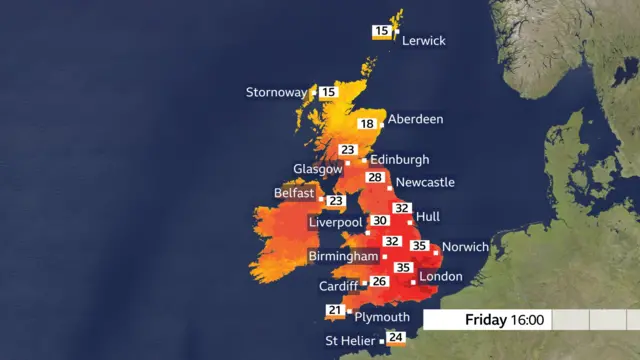
    She says there is a lot of mention on the news of how hot it is south, “but the forecast here is for a maximum of 15C”.

    Helen who works from home in the pharmaceutical industry says, “ if it got to 20C the sheep would probably lie around panting.” The couple have lived in the hamlet of Lunna for 25 years.

    She says, “I’ve put on a woolly dress and a vest on today! Even though its baking hot in the south, we prefer it here by far. Just a bit of warmth every now and then would be nice though - for us 20C is tropical.”

    Your Voice banner
  2. Red extreme heat warning extended by three hourspublished at 10:58 BST
    Breaking

    The Met Office has extended the red extreme heat warning in place by three hours until 23:59 on Thursday evening.

    The warning has also been extended south across Dorset, Hampshire and Sussex, the Met Office say.

    It has also issued another amber warning for heat for Friday, covering eastern and central England, alongside the existing red warning.

    The Met Office red extreme heat warning has been pushed slightly further southImage source, Met Office
    Image caption,

    The Met Office red extreme heat warning has been pushed slightly further south

  3. Record heat on Tuesday in Jerseypublished at 10:36 BST

    Matt Taylor
    BBC Weather

    Jersey experienced as hottest June day on record on Tuesday.

    The Jersey Met Service reported a high of 37.2C (99F) - smashing the previous record of 33.4C, which was only set last year, by a huge margin.

    It was also their second warmest day on record.

    St Aubin in Jersey earlier todayImage source, BBC Weather Watchers / Hedi
    Image caption,

    St Aubin in Jersey earlier today

  4. Early risers see a warm start to the daypublished at 10:19 BST

    It was a notably warm start this morning, although it hasn't deterred some from getting out and about.

    Here are some pictures taken by BBC Weather Watchers from across the UK.

    A line of different coloured beach huts curve along a concrete road very close to the shoreline. In front of them is a dry grass field, which is dotted with a few bushes leading towards the beach and the sea in the distanceImage source, BBC Weather Watchers / Hayley85
    Image caption,

    Beach huts basking in the sun in Pakefield, Suffolk

    Several boats ranging in different colours and sizes are moored in a harbour in Kent. The sea is still and the sky can be seen reflected in the water, with a long row of buildings seen in the backgroundImage source, BBC Weather Watchers / Steve
    Image caption,

    Boats line the water in Ramsgate, Kent

    A golden labrador type dog stands in the middle of a wheat field next to a tall hedge. Trees can be seen in the middle distance above a clear blue skyImage source, BBC Weather Watchers / Philbert Nut
    Image caption,

    Clear skies and long walks in Pilton, Somerset

    A pier is stood on a headland jutting out to sea in Wales. In the distance a large cliff rises above several houses along the coastline, while a layer of fog extends from the rightImage source, BBC Weather Watchers / Kryzstof
    Image caption,

    Early morning fog settles across the coast in Aberystwyth

  5. How to stay safe while swimming outdoorspublished at 10:13 BST

    Water safety experts have shared some simple tips with BBC News on staying safe when swimming in open water. Here’s what they told us:

    Choose a spot with a lifeguard: The best place to swim is somewhere supervised. You can find a list of UK beaches with lifeguards on the RNLI website, external, external.

    Watch videos of rip currents: A rip current can quickly pull you away from shore and out of your depth. They can be difficult to spot, RNLI says, but watching videos can help you identify them.

    Think about your swimming ability: Swimming in the sea, lakes and rivers is very different from a swimming pool, so people should think carefully before getting in.

    Keep someone on shore: Someone from your group should always stay on shore to keep an eye on those in the water and can call for help if needed.

    Avoid inflatables: If the wind changes when you’re in an inflatable, you can be blown out to sea. It’s advised to avoid them altogether.

    Get in the water slowly: Getting into cold water too quickly can cause cold water shock, which restricts your ability to move and affects your breathing. You should get in slowly and allow your body to acclimatise.

    Swimmers in North Tyneside on TuesdayImage source, PA Media
  6. More than 500 schools closed or partially closed in Walespublished at 10:05 BST

    More than 500 schools in Wales have been closed or partially closed as a result of the high temperatures.

    Closures are impacting schools across mid and south Wales - including all in Blaenau Gwent, and most in Caerphilly and Bridgend.

    Others have been confirmed in Cardiff, Carmarthenshire, Merthyr Tydfil, Monmouthshire, Neath Port Talbot, Newport, Powys, Rhondda Cynon Taf, Swansea, Torfaen and Vale of the Glamorgan.

    That's on top of at least 578 full or partial closures in England - the vast majority of them in the south of the country.

  7. Today is likely to be hotter than yesterdaypublished at 09:48 BST

    Ben Rich
    Lead Weather Presenter

    Yesterday’s highest temperature was 34.6C at Wisley in Surrey – but today is likely to be even hotter.

    Strong sunshine will lift temperatures well into the 30s Celsius with highs of 37C likely – with the hottest place likely to be somewhere to the south-west of London or in central-southern England, within the area covered by the red extreme heat warning from the Met Office.

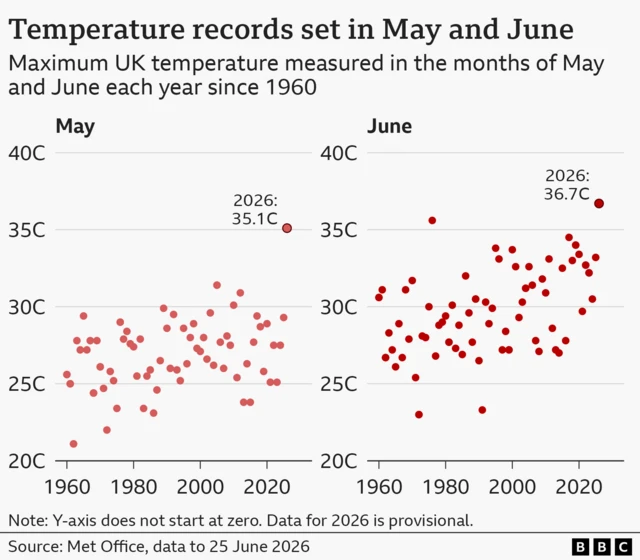
    It is likely that the UK’s June temperature record, currently 35.6C, will be broken.

    Temperatures of 30-34C are expected across large swathes of south-west England, east Wales, the Midlands and Northern England.

    High humidity will make it feel particularly hot when combined with the strong sunshine.

    Scotland and Northern Ireland had their hottest day of the year so far yesterday, but today is likely to be cooler with temperatures peaking in the low to mid-20s.

    People walking in Hyde Park in the sunImage source, EPA
  8. Do you have any questions about the hot weather?published at 09:34 BST

    On Thursday, we’ll be running a live Q&A with correspondents and experts from BBC teams including climate and science, health, learning and identity, business and weather.

    You can get in touch in the following ways: 

    Please read ourterms & conditions andprivacy policy

    In some cases a selection of your comments and questions will be published, displaying your name and location as you provide it unless you state otherwise. Your contact details will never be published.

    A BBC graphic that says "Your Voice" in white font against a purple background.
  9. At least 500 schools in England fully or partially closedpublished at 09:20 BST

    Hazel Shearing
    Education correspondent

    There's no official data to show how many schools are closing because of the heat, so we've been looking through council and school websites to try to get an idea.

    So far we've counted at least 578 full or partial closures - the vast majority of them in the south of England.

    The total number is likely to be much higher, though, because many councils do not publish lists of schools which have to close unexpectedly due to extreme weather.

    Lots of schools are also part of multi-academy trusts, which may not appear on council lists if they're closed.

    The disruption comes just after the end of timetabled GCSE, A-level and other exams.

  10. How do weather warnings work?published at 09:13 BST

    Weather warnings are given a colour – yellow, amber or red - depending on a combination of two things; the impact the weather is likely to have and the likelihood of it happening.

    A matrix system is used to help decide on the severity of the warnings, which then helps decide the colour.

    Yellow is the lowest tier of warning, amber is a middle-tier warning and red is the most serious type of warning possible. The warning is determined by what best matches the impact of the weather against the likelihood of it happening.

    Eight different types of weather are covered: rain, snow, wind, thunderstorms, lightning, fog, ice, and extreme heat.

    A graphic showing the different types of weather warnings and what they mean
  11. What does a red extreme heat warning mean for me?published at 09:03 BST

    A visitor to the capital fans herself in front of Parliament with a red fan. London's Palace of Westminster is visible in the background.Image source, Getty Images

    The Met Office's red warning for extreme heat has just come into effect, meaning an "exceptional spell" of hot and humid weather can be expected across the affected region.

    This is only the second time a red warning has been issued since extreme heat warnings began in 2021.

    Among the areas included are the East Midlands, East of England, London & South East England, South West England, Wales and the West Midlands.

    The Met Office says to expect population-wide impacts, affecting not just those who are most vulnerable to extreme heat, including serious illness or danger to life.

    The service says "substantial changes" in working practices and daily routines will be required, while there is also a high risk of heat-sensitive systems and equipment failing.

    This could result in power cuts and the loss of other essential services such as water, electricity, gas or mobile phone signal.

    Furthermore, delays on roads and road closures are expected alongside delays and cancellations to rail and air travel. Those who experience even moderate delays on such services are at risk of significant welfare issues.

    There is also an increased risk of water safety incidents, due to significantly more people visiting coastal areas, lakes and rivers.

  12. Red weather warning comes into effectpublished at 09:00 BST
    Breaking

    A rare red weather warning has just come into effect and will remain in place until 21:00 BST on Thursday.

    It covers parts of southern England, as well as the Midlands and south Wales, with people in those areas warned there is a risk ofserious illness or danger to life.

    Graphic showing extreme heat warning areas
  13. How to help young babies in the heatpublished at 08:53 BST

    Marthe de Ferrer
    Senior journalist

    For parents with young babies, keeping them cool can be a major concern - especially as infants cannot regulate their body temperature properly until they are nearer nine to 12-months-old.

    The NHS advises that babies be kept out of direct sunlight, but says to avoid covering prams with a blanket, as this can reduce airflow and lead to overheating.

    When it comes to sleep, it’s recommended to keep babies’ rooms at 16-20C - which can be impossible during a heatwave.

    Safer sleep charity The Lullaby Trust suggests placing a fan pointing away from the baby while they sleep, to help cool the room and using a room thermometer so you have an accurate idea of temperature.

    The Lullaby Trust says to use lighter, or even no bedding at night to keep babies safer while sleeping in hot conditions.

  14. Quieter than usual London-bound train servicepublished at 08:36 BST

    Chris Partridge
    Reporting from Newbury

    People stand at train platform while train approachesImage source, BBC/Chris Partridge

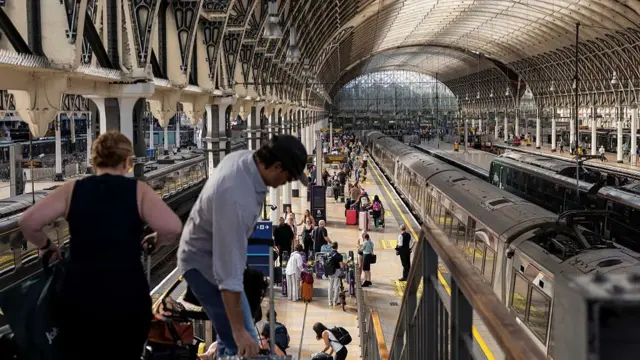
    Train services seem to be running normally on GWR through Newbury into London Paddington right now. Fewer people than usual are at the station, with many heeding the advice not to travel.

    Carriages are quieter too, indicating fewer passengers boarding further back along the line.

    This is a busy commuter route into London, and many of the trains are electric with air conditioning as standard.

  15. 'Feels like' temperature to climb above 40C in partspublished at 08:20 BST

    Temperatures could reach up to 36 or 37C today - but that's only part of the story.

    The "feels like" temperature is likely to be much hotter, reaching into the 40s in parts of England.

    BBC Weather presenter Matt Taylor explains why that is and how it might lead to an uncomfortable day for some.

    Media caption,

    UK heat: Feels like temperature to reach above 40C

  16. Dog walkers told to 'be sensible' and avoid walks, says RSPCA expertpublished at 07:59 BST

    Pet owners have been advised not to take their dogs out for walks during the red extreme heat warning.

    Lauren Bennett from the RSPCA tells BBC Breakfast that while dogs should still be brought outside briefly to go to the toilet, it's about "being sensible" and keeping to shaded areas while minimising high impact exercise.

    She says: "Certainly, with this red weather warning, actually we would advise probably not to walk your dogs at all because there isn't actually a cooler time of day."

    She says dogs could be taken out very early in the morning or very late at night, as well as being given plenty of water and keeping cool in homes through air conditioning and fans.

    She adds: "Just like people, it can be fatal, which is why we tell people to change their behaviour because our pets are completely under our control so the responsibility is on us."

    A dog cooling off in the Serpentine in Hyde Park on TuesdayImage source, EPA
  17. How to stay cool in hot weatherpublished at 07:43 BST

    This Flourish post cannot be displayed in your browser. Please enable Javascript or try a different browser.

  18. Tuesday's heat in picturespublished at 07:30 BST

    Temperatures on Tuesday peaked at 34.6C in Wisley, Surrey, while highs of 32.2C were reached in Wales.

    Ahead of the red warning coming in to force later this morning in some parts, here are some pictures showing how people coped with the heat yesterday:

    People in London stand beside a souvenir stand in London. The London Eye is visible in the background.Image source, Getty Images
    Image caption,

    Tourists could be seen struggling in central London over Tuesday afternoon

    A man in a striped shirt and dark trousers sits on a concrete bench on a sunny day.Image source, Getty Images
    Image caption,

    A man in Huddersfield sits in the afternoon heat

    Multiple people can be seen in a packed outdoor lido. A line of people can be seen sitting on the edge of the pool in the blurred background.Image source, EPA/Shutterstock
    Image caption,

    Swimmers at London Fields Lido cool off on Tuesday

    A woman and a man walk in central London on a sunny day. The woman is holding an umbrella to shield themselves from the sun.Image source, Reuters
    Image caption,

    People have been spotted using umbrellas as an attempt to shield themselves from the sun

  19. Passengers being advised to only travel if it's absolutely necessarypublished at 07:08 BST

    Katy Austin
    Transport correspondent

    Rail passengers in England and Wales are being advised to only travel if absolutely necessary today and Thursday.

    Lots of train operators have asked that people only make essential journeys, and have put in place reduced timetables: South Western Railway, Thameslink, Northern and Avanti West Coast to name just a few.

    Gatwick Express won’t run on Wednesday or Thursday afternoons, and LNER “strongly recommends” its customers don’t travel.

    Running fewer trains puts less stress on the railway infrastructure. The idea is also to minimise the number of people caught up in any disruption, and create breathing space in the timetable so any delays cause less of a knock-on impact.

    If you decide not to travel and already have a ticket, you’re probably able to use it another day or get a refund. Check with your operator.

    Information about travel advice during hot weather at Euston railway station during a heat waveImage source, Getty Images
  20. How hot was it yesterday?published at 06:52 BST

    A lady sits on a ledge with her leg up as she reads the paper as the sun shines on her in HuddersfieldImage source, Getty Images

    The short answer is... very hot.

    Scotland and Northern Ireland recorded their hottest days of the year so far, and while it was still a scorcher in England, overnight storms meant the temperature wasn’t as hot as predicted.

    The maximum temperatures on Tuesday across the UK were:

    • England: 34.6C at Wisley, Surrey
    • Scotland: 29.0C at Dyce, Aberdeen
    • Wales: 32.2C at Cardiff Bute Park
    • Northern Ireland: 28.1C at Katesbridge, County Down