

EXPLORE EPISODE FIVE - 24 to 21
Local Navigation

Bringing to life spectacles of natural wonder on our doorstep
No.23
Common Crane
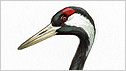
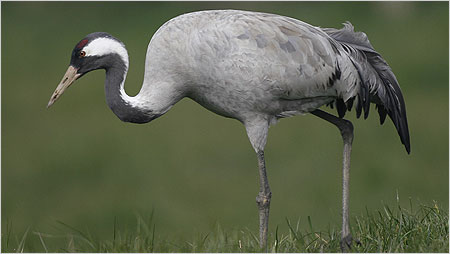
The Common Crane (Grus grus) is the only one of the world’s 15 species of crane which has ever been native to Britain. They like extensive wetlands and breed in remote marshy areas in North and North Eastern Europe. Cranes make a loud bellowing or trumpeting call often in the early morning.
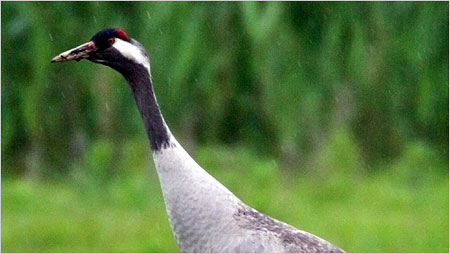
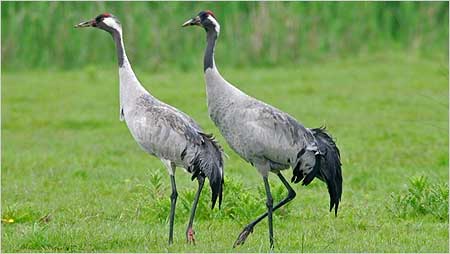
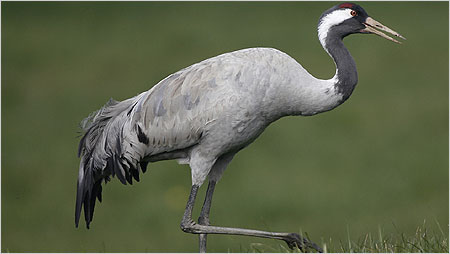
Cranes have long straight necks and a wingspan of around seven feet. They look a little like herons when standing but have smaller heads and beaks as well as a neck which widens to a thick base. Adults are mainly grey with black and white on the head and neck and a patch of red on the top of the head. Their feathers also droop into what appears to be a big ‘bushy’ tail when the bird is standing.
They call and display in pairs with their heads thrown back and beaks pointing upwards. This usually happens at their nesting sites. The birds perform a dance, not just as part of a courtship ritual but existing pairs also dance to reinforce their ‘marital’ bonds.
The male raises his wings over his back while the female keeps hers folded they then exchange calls and ‘dance’, bowing, jumping, throwing sticks and flapping their wings.
Photo gallery
Watch and Listen
See the rather flamboyant mating display of the Common Crane:
Listen to the sound of Common Cranes on the RSPB website:
Help playing audio/video
Tips
Tips for viewing this species:
- Hickling Broad, Norfolk is one of the best places to look for Wild Crane in the UK from the comfort of a hide.
- Binoculars or a scope are useful if watching from a hide.
- When watching birds from a hide it pays to plan your visit... For example, check which way the hide faces…if it faces east, it may be better to visit in the afternoon so that the sun is behind you.
- The Crane has a distinctive high pitched call which is described as sounding like children shouting at each other in a playground.
- The best time to see cranes dance is mid February to mid March - but only when the temperature is above 10 degrees or there's a warm sun.
- Watching Cranes on the Norfolk Broads can be a matter of good timing. In the morning’s they’ll fly off to nearby fields to feed and will be gone all day before returning in the evenings. The birds are most easily seen when they’re flying out at dawn or back at dusk.
Habitat
Cranes like marshland and bogs. East Anglia is a suitable habitat for Cranes and is one of the more likely places for seeing them in the UK. There’s Hickling Broad, on the Norfolk Broads and Pensthorpe in Norfolk has a captive population of Cranes, while Lakenheath Fen in Suffolk which was transformed from a carrot field into a wetland nature reserve more than 10 years ago, has attracted breeding wild birds.
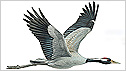
There are few breeding sites in Britain. In 2007 Cranes were found breeding in the fens of East Anglia for the first time in 400 years. Drainage of the fens for agricultural use led to the birds disappearance in the 1600s. RSPB figures suggest there are now four breeding pairs in the UK and around 40 birds which pass through the UK on migration.
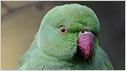
No. 24 - Parakeet roost
They're not native to this country but the RSPB estimates that there are about 30,000 ring necked pararkeets living in South East England.
Best places to see - London and South East England.
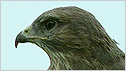
No. 22 - Birds of Prey
Birds of Prey, or raptors, cover a wide range of birds, find out which one has such keen eyesight it's reputed to be able to see a rabbit twitch two miles away.
Best places to see - UK-wide although Golden Eagle sightings are generally restricted to the Highlands and Islands of Scotland.
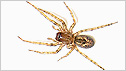
No. 21 - Arachnids
They're all poisonous and lots of people don't like them but spiders are fascinating... find out why!
Best places to see - UK-wide, in your own back garden!


Also on Nature's Top 40
BBC Nature & Wildlife
More from bbc.co.uk nature

BBC iD
BBC iDBBC navigation
BBC links

BBC © 2014The BBC is not responsible for the content of external sites. Read more.
This page is best viewed in an up-to-date web browser with style sheets (CSS) enabled. While you will be able to view the content of this page in your current browser, you will not be able to get the full visual experience. Please consider upgrading your browser software or enabling style sheets (CSS) if you are able to do so.
