

EXPLORE EPISODE TWO - 36 to 33
Local Navigation

Bringing to life spectacles of natural wonder on our doorstep
No.36
Moths
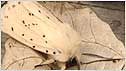
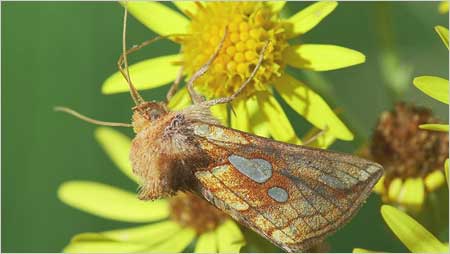
Moths are beautiful and fascinating creatures and you can find several hundred different species just in your garden. There are 2,500 different species in the UK ranging from the large and colourful to the plainer brown or grey varieties.
Most Moths have feathery or unclubbed antennae compared with butterflies which have thin, filament-like antennae that are club shaped at their ends.
Moths are a neglected species and many varieties are in decline - and yet they are really important. They are the prey of animals such as birds, bats and small mammals, and they pollinate many plants. They’re also an indicator of the health of our environment.
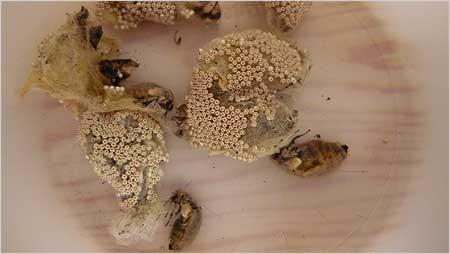
The life cycle of a moth takes in the same egg, caterpillar, pupa, and adult stages as a butterfly. Some species live for only a short time whilst others can survive for several months and even hibernate.
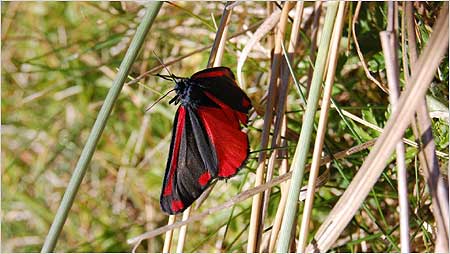
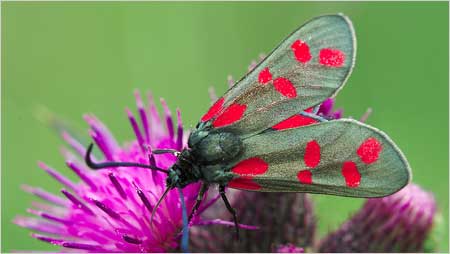
A common and colourful moth is the Cinnabar which can be found throughout England and Wales. It is often mistaken for a butterfly as it can be seen during the day. The red and black Cinnabar lays its eggs on common ragwort and you can find the yellow and black striped caterpillars in July and August.
A single plant is sometimes covered with many of the caterpillars which have been known to reduce the plants to bare stems. Although the Cinnabar is relatively common, it has declined by 83 per cent in the last 35 years.
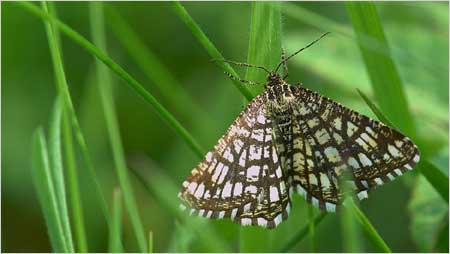
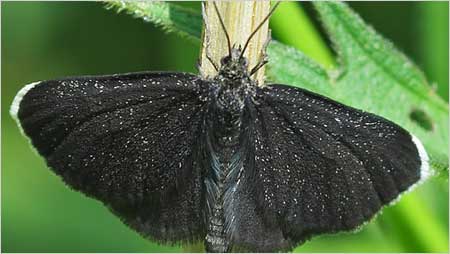
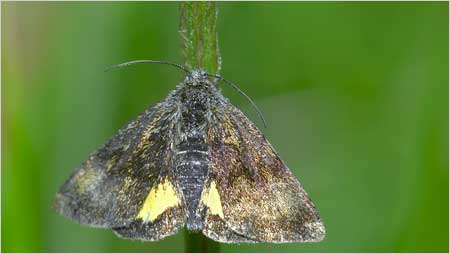
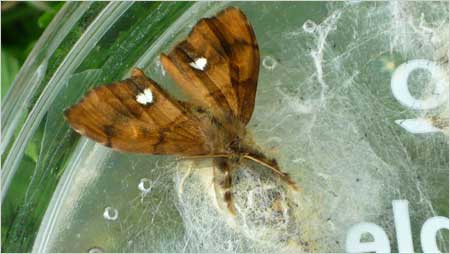
Colourful moths include the impressive Emperor, with eye spots on each wing; the brown and white spotted Tiger Moth; the black, yellow and white Magpie Moth; and the grey Pussmoth.
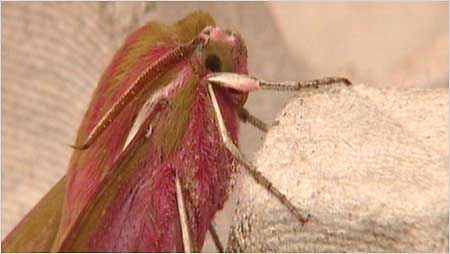
The Peach Blossom is particularly beautiful and is a fairly common woodland species. The distinctive pink and olive green Elephant Hawk Moth is so named because its caterpillar looks like an elephant’s trunk. The Large Yellow Underwing is probably the most abundant of the larger moths - the yellow underwing is a defence mechanism which they flash to put off predators.
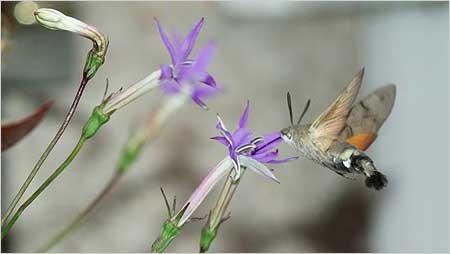
The rare Hummingbird Hawkmoth is a migrant visitor to the south of England during the summer - and is sometimes mistaken for a bird due to its daytime habit of feeding on nectar and its hovering motion.
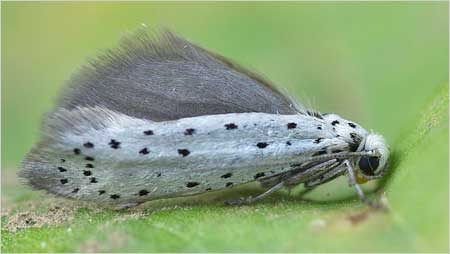
The striking Leopard Moth is a white moth with black spots which looks like it is wearing a large white Afro wig. When disturbed it secretes a yellow fluid from ducts behind its head.
Web links
National History Museum - Moths
Forestry Commission - Wareham Forest
The BBC is not responsible for the content of external internet sites.
Photo credits
Jaybee and North East Wildlife.
Photo gallery
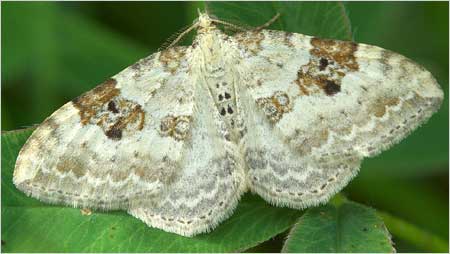
Watch and Listen
Find out how to go moth spotting. Presenter Iolo Williams provides his top tips from Wareham Forest in Dorset:
Help playing audio/video
Tips
Tips for viewing this species:
- Look in your own backyard where you may find several dozen species. Check carefully as some moths have markings which camouflage them against tree bark and plants. There is some good advice on the Butterfly Conservation Gardening website
- Be prepared to stay up late - moths are mainly nocturnal and can be difficult to find during the day. You can build your own moth traps simply by leaving outside lights on – check for lighted windows and lit walls or fences.
- On a warm summer evening, hang up a plain white sheet when it goes dark. Use a bright light like a torch to illuminate the sheet to attract the moths. Choose a variety of habitats to maximise the number of moth species. Try 'sugaring' - painting a sugar solution onto a wall or tree - to see if you can attract moths to your garden. To make the sugar solution, mix stout, molasses and brown sugar in a pan and simmer for half an hour. But be careful where you paint the solution as it may stain. Leave for a couple of days and you may attract butterflies as well. Prepare to be amazed!
- There are two more sophisticated types of moth trap – the very bright mercury vapour version that runs off a generator – and the smaller battery operated Actinic traps which have a less bright florescent tube.
- Buy or borrow a good moth guide to help with identification.
- August is a good month to moth trap when there’s a variety of colourful and scarce species on the wing. Also it's good time to look out for migrants from other parts of Europe or even Africa if the conditions are right.
- Become a moth spotter! Butterfly Conservation is asking people to look out for them and report sightings so they can build a better picture of how moths are doing.
- Join a moth watching group. Many organise events and talks to help members learn more about moth behaviour and conservation - Butterfly Conservation groups
- Don't forget to put any moths you find at home back outside in a place safe from predators.
Habitat
Moths are distributed across a very wide variety of habitats across the UK including woodlands, heaths, coastal areas, grasslands and country estates.
Gardens are also excellent locations to spot moths - and some varieties can even be seen in mountain areas.
Great places to go moth trapping are Thorp Perrow (North Yorkshire), Wareham Forest (Dorset), Portland Bill (Dorset), and Minsmere (Suffolk) although moths are very widespread.
Many moth species are nationally threatened or scarce. Butterfly Conservation estimates that 62 moth species became extinct in Britain during the last century, largely as a result of habitat loss.
The use of pesticides, climate change and increasing light pollution are also thought to have contributed to the decline of some species. The intensification of farming and forestry practices has also had a detrimental effect on the management of semi-natural habitats especially for specialised species of moth.
Butterfly Conservation monitors moth numbers using over 10,000 volunteer recorders, and this data is used by the Government to indicate the health of the environment.
Moths can be found all year round, even in winter, although migrant varieties are seasonal in summer.
The Garden Tiger Moth, a striking looking variety, can often be seen in gardens - its patterns vary considerably and no two moths are identical. Also common in gardens is the Elephant Hawk Moth which feeds from tubular flowers such as honeysuckle. The Spectacle Moth looks like it is wearing spectacles – this moth is often found in gardens feeding on nettles.
No. 36 - Seals
Nature's Top 40's expert tips on observing Grey and Common Seals around the British Isles - whether from sea or land.
Best place to see - Isles of Scilly.
No. 34 - Knot
Roosting Knot are on many nature watchers' lists of top bird spectacles - find out the best season to see this amazing display.
Best place to see - North Norfolk.
No. 33 - Machair flowers
The machair is one of the greatest wildflower displays anywhere in the British Isles - find out how to enjoy it at its best.
Best place to see - North West Scotland.


Also on Nature's Top 40
BBC Nature & Wildlife

More from bbc.co.uk nature

BBC iD
BBC iDBBC navigation
BBC links

BBC © 2014The BBC is not responsible for the content of external sites. Read more.
This page is best viewed in an up-to-date web browser with style sheets (CSS) enabled. While you will be able to view the content of this page in your current browser, you will not be able to get the full visual experience. Please consider upgrading your browser software or enabling style sheets (CSS) if you are able to do so.
