| 13 November 2014 |

| |
| BBC Homepage | | |
| |||
| Contact Us | | |
Mining historyYou are in: Leeds > History > Mining history > From pit to park 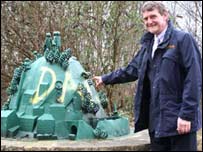 Fred with the park sculpture From pit to parkFred Duff of Leeds City Council is our guide to Rothwell Country Park, site of the former Rothwell colliery (1867-1983). Rothwell Country ParkRothwell Country Park is a colliery reclamation with 60 acres of woodland. In the Middle Ages the area was part of a vast wooded area used as a royal hunting ground. Gradually it became a grazing area for cattle, as the area became more populated and grazed, there was gradual erosion of trees and coal mining increased. Bell pits were used to mine coal until deep coal mining started in 1867, industry continued until the closure of the Rothwell pit and the subsequent loss of jobs in 1983. In 1995 Leeds City Council transformed the site into a country park. "The park was opened by Richard Whiteley, complete with striped blazer, and I remember looking up on the opening day and seeing a red kite flying in the air, the birds had recently been re-introduced at Harewood. I thought it was a good omen. See more pictures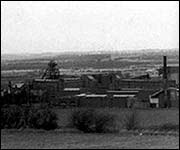 Rothwell Colliery, is now a country park "This park is on the site of Fanny pit, there was another one in Rothwell called Rose. The pits were named after the owner's daughters. "The pit had a railway line branch off the mainline because most coal was moved by rail and you can still see the former route of the railway in the park. "The railway is represented, with other features, on a sculpture in the park. It shows people stood right on the top of an exaggerated pit heap and represents trees as well as the canal, railway and the colliery itself. "Apart from the nearby sculpture there isn't much to see where the actual shafts used to be - just slabs of concrete. Much of the colossal underground machinery was left down there when the shafts were capped because it was just too difficult to get it back up. "We do have some trouble on the site with vandalism but we have created an area that has some deer (they've probably made their way from the Temple Newsam estate), rabbits, foxes and badgers, and is a bird watching haven. I have seen yellowhammers and goldfinches in a hedge near the entrance to the park. "The park is rich in silver birch, some have self-seeded, and we have young oak seedlings that have not been planted but brought here by jays dropping seed on the ground. In the Middle Ages this area was a hunting ground and the story goes that the last wild boar in England was killed here, and that's why Rothwell's coat of arms has a boar's head on it. 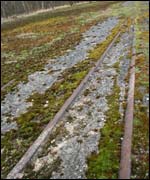 The rails are a poignant reminder "One particularly poignant place in the park is a large open area where coal was transferred from the colliery's wagons to the mainline. You can see two different rail gauges converging in the concrete but the lines are slowly disappearing under a coverage of moss. In a few years time it will be much harder to spot the rails. "At the peak of moving coal there used to be 3 million coal wagons on the rail network, can you imagine how much coal that represented? "The large hill that dominates the park is actually the spoil heap of the colliery and it still contains quite a proportion of waste coal, towards the top of the hill the soil is quite black and you can clearly see lumps of coal in it. It will take longer for nature to take over this ground because it is of poorer quality. 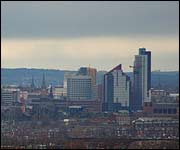 In the distance is Leeds city centre "The view from the top of the heap is a stunning panorama that used to be dominated by several nearby cooling towers but they have been demolished. Now if you look westwards you can clearly see the skyline of Leeds city centre and that city is gradually growing eastwards. "This river valley is dominated by mining and you can see Skelton lake below which is a flooded open-cast mine, over to the east you can see St Aidan's another opencast area. You would also once have been able to see other pits like Waterloo Main (near Temple Newsam) and Middleton Broom. "To the east in the distance are more power station cooling towers. To the south you can see Rothwell spread out before you. It is a view well worth walking up for. "From the top looking north you can clearly see another Leeds landmark Temple Newsam House which is built over a rich coal scheme. "I live locally and remember the massive impact that the 1984/5 strike had round here. We often saw the pickets out on the road with people tooting their car horns in support. I also remember seeing miners collecting for food for their families. "I live about a mile away from this site and I have seen a picture of the completely collapsed gable end of the house I now live in. In the picture you could see straight into the rooms of the house. The collapse was caused by subsidence from the colliery that was on the site of this park." See more picturesRothwell Country Park: Vehicle access is through Bullough Lane, where car parking is last updated: 17/03/2009 at 11:44 SEE ALSOYou are in: Leeds > History > Mining history > From pit to park   |
| | About the BBC | Help | Terms of Use | Privacy & Cookies Policy |