

- Contributed by
- Brian Napper
- People in story:
- Rosemary and Brian Napper
- Location of story:
- Singapore
- Background to story:
- Civilian
- Article ID:
- A6204665
- Contributed on:
- 19 October 2005
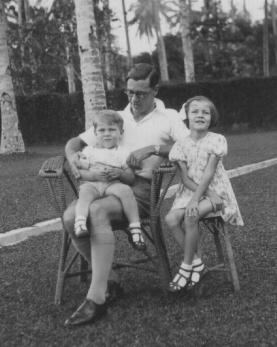
Brian, Piri, Rosemary [K.L., 1940]
Background
My father Robert Piriam N. (“Piri”) Napper was a Plant Pathologist at the Rubber Research Institute in Kuala Lumpur. In the 1930s he revolutionised the treatment of diseases in rubber plantations1. My sister Rosemary was born in 1934; I was born in 1937, but our mother Maude (who had a Ph.D. in plant diseases) never recovered from my birth, and died six months later. On the way back from leave in the U.K. in 1939 Piri met and fell in love with a Dutch nurse, Suzanna (“Suze”) Balfoort, who was returning home by boat from Holland to Batavia (now Jakarta in Indonesia). They were married the next year. In the intervening three years we were looked after by a young Christian Malay Indian girl, Martha.
The Evacuation
The Japanese invaded Malaya, in the North, on December 8th 1941, the same morning as the attack on Pearl Harbour2. They worked their way towards Singapore, taking Penang by December 18th, and K.L. by January 11th. Our family evacuated K.L. by car (a rather splendid Lagonda), moving to Singapore. Rosemary remembers a very long journey, travelling in convoy, and staying overnight in a large communal hall, sleeping on wooden floorboards. My only memory is that in Singapore we stayed at a house with a child’s pedal car, a new and exciting experience! Our father had volunteered for the MAS (Medical Auxiliary Service) in K.L. (before the invasion), and offered his services to the MAS again in Singapore. Our step-mother, being a trained nurse, also offered her services.
Women and children were evacuated from Singapore in the troop ships which had brought in reinforcements for the defence of Malaya. As our step-mother knew no-one in England, and was so clearly required in Singapore, she elected to stay on. This was possible because the wife of a close friend, Freda Stanleigh, travelling with her unmarried sister G.E.M. (“Gem”) Davis and daughter Hazel, volunteered to look after us on the boat, and deliver us to our (paternal) grandparents in England. So we travelled with them, accompanied by the letter written by our step-mother, reproduced at the bottom of this page.
We travelled in the “Empress of Japan”, a large liner requisitioned from The Canadian Pacific Railways3. The ship sailed on January 31st, a fortnight before the Fall of Singapore (Feb 15th 1942). I have no memory of the embarkation, which must have been chaotic and traumatic. The docks were being bombed all day. Rosemary only remembers going on board this huge ship, and then waving goodbye to our parents from the deck as they went back down the gangplank, with a cheery “Bye-bye Daddy! Bye-bye Mummy!” as we set off on life’s next adventure!
The Journey to England
The journey to England took 7 weeks. We went first to Batavia, to repair minor bomb damage sustained at Singapore. Then we sailed through the Sunda straits between Sumatra and Java, and on to Columbo, Durban and Cape Town. In the area of the Sunda straits we were bombed and had a near miss. It was probably this that provides my most vivid memory of the journey. We were having a meal in the large dining room, which comprised two sets of long tables, edge on to the sides and with a passage between them down the middle of the room. Suddenly the ship made a big roll to one side and all the crockery and cutlery from our set of tables slid down and landed in a heap in the passageway in the middle. The ship then did a large roll the other way, causing everything on the other set of tables to join them on the floor in the middle (presumably having sought temporary refuge against the far wall!).
I have the vaguest of memories of life aboard ship, e.g. being told off by a naval officer for standing too close to the rails. In particular I remember being annoyed some times by two-year-old Hazel following me around, and calling out “Bun, Bun” (for Brian)! Rosemary remembers spending a lot of time carrying someone’s six-month-old baby on her hips, and being called ‘the Little Mother’! She also remembers being in a small cabin, but not as such that that was where we slept (more likely where the baby slept?). The majority of passengers slept on mattresses on a large deck below. Rosemary remembers that the few personal possessions she was allowed to take with her all the way from K.L. included a green art-deco-style hair brush and clothes brush, a silver engraved serviette ring and a small empty scent bottle, from which she would have the occasional reassuring sniff to remind her of home!
Gem said4, when she delivered us to our Grandparents, that it had been a nightmare journey home. The ship was shockingly overcrowded. There were long queues for everything. All portholes had to be kept closed all night, as part of the blackout precautions. The heat in consequence was stifling. Another accountS1 reported that the passengers were anything but comfortable, and were sleeping in hundreds on mattresses on the deck and doing their own washing-up and cleaning in addition to many ship's chores. ”Midge”s and Jenny’s stories give a much fuller description of life on board ship. In particular the amount of passenger self-help required is explained as due to the crew being mostly Hong Kong Chinese, who refused to do much of their duties in protest against the poor British effort in protecting Hong Kong from the Japanese.
In Cape Town some of the refugees were invited to take a short holiday in Cape Town, and carry on to England on another boat. Their place was taken by a group of sailors, who presumably needed to get back to England as quickly as possible. According to an article published in a Liverpool newspaper the day after the “Empress of Japan” arrived, the sailors helped to run life on board ship better, and were a great hit with the passengers. They were popular with the children because they organised games for them. They were presumably popular with the ladies because they were young men (and sailors to boot!) -- as well as keeping the children occupied! I guess they were responsible for my last strong memory, that of crossing-the-equator rites (which I did not enjoy, whatever they were) organised by a group of men in white. Rosemary remembers having her face decorated with white face paint and then being dunked in a free standing plunge pool on the deck.
Arrival in England
The “Empress of Japan” arrived in Liverpool around March 19th. I have no memory of the disembarkation. But I do remember waiting for the train in a very large and gloomy station, with lots of people and their baggage.
I assume we were taken to London for a few days to stay with Freda and family, and then her sister (Aunty Gem) brought us by train to our grandparents near Bristol.
My Aunty Ena recalledS7 :
We were all shocked when we saw the children. They had changed unbelievably since that day, two and a half years before, when we had waved goodbye to them and to Piri and Martha. Rosemary now had huge grey eyes in a little thin face. Brian too was very thin. Their escort Gem, a sick woman herself, stayed a night with us, and then left for her own home.
Back with the Family in England
We went to stay with our paternal grandparents, Granddad Napper, aged about 70 and Grandma, 65, in a small village near Bristol. They had originally retired to a one-acre plot, which my grandfather populated with apple trees, vegetables, tomatoes, chickens and a small garden. However they subsequently built a smaller bungalow in the grounds for themselves so that they could earn rent from the original bungalow, but after a short while their other child, Rowena (“Ena”), moved into it with her husband Felix and children John and Pat. Our cousins at the start of 1942 were 9 and 7 respectively; we were 7 and 4.
Aunty Ena’s husband worked for a Bristol shipbuilding firm, and the house was given the luxury of a telephone for use as an emergency out-of-hours contact number for any of their ships (by radio-telephone). Sadly, and by a dreadful coincidence, Felix died suddenly of meningitis on December 7th 1941, the day which contained the attack on Pearl Harbour and the invasion of Malaya. What a disastrous 24 hours for the family!
-----------------------------------------------------
Further Pages :
Escape from Singapore — 1b. The Napper Story Background
This page is used to contain reference material and background for the set of pages 1 to 4 on the Napper family.
This includes references to source material used in creating these pages, including books which specifically cover the last minute evacuation of Singapore by boat, in which our parents were involved.
References to these sources throughout the pages are shown by a superscript, e.g.S4, giving the number in the list of sources.
Escape from Singapore — 2. A View from England
This gives a small set of letters written by our paternal Grandmother to our maternal Grandmother in the month before the Fall (2a), and then describing our arrival at her house (2b).
Escape from Singapore — 3. Life in K.L. preparing for War
These are a set of letters covering June to August 1941 from our Dutch step-mother and our father back to his parents, 3a and 3b. Written mostly by our step-mother, in her rather quaint English, they give a good feel as to how life was dominated by all the extra work required in the volunteer services.
Escape from Singapore — 4. My Parents’ Fate
This describes the fate of our parents, who escaped on February 13th, but were lost the next day.
Escape from Singapore — 5. 50 Years on : a Small World!
This gives a short account of a chance meeting in 1996 with a fellow traveller on the “Empress of Japan”, a 90 year old lady known as "Midge".
A friend got the full story from her on tape at the time. It parallel's our story, but with much more detail, so I have transcribed it, and added it to these pages, as ...
Escape from Singapore — 6. "Midge"s Story
Midge’s story is given on three pages, 6a, 6b and 6c.
Escape from Singapore — 7. Jenny's Childhood Memories
Midge’s daughter Jenny is a year older than me, but has a much better memory of events than I have. This is her story. The two stories can be cross-referenced by using the similar section headings.
-----------------------------------------------------------------
Photographs
Each of the pages directly involving the Napper Family have a photograph at the front. They are listed below. The identification [Bristol 1939] refers to pictures taken when we were on leave in 1939, in the Napper grandparent's garden. [K.L. 1940] refers to pictures taken in K.L., probably in 1940, but possibly 1941. I am not sure if they are all taken in the garden of the last house we were in.
- 1 -- [K.L., 1940] Brian, Piri, Rosemary
- 1b -- [Bristol 1939] Piri, Grandad Napper (with his vegetable patch behind!)
- 2a -- Granddad and Grandma Napper
- 2b -- [Bristol 1939] Rosemary, Martha, Brian in Granddad's "Summer House"
- 3a -- [K.L. 1940] Piri, Freda Stanleigh, Mrs. X, Basil Stanleigh Mr. X -- drinks in our garden after a game of badminton. It is in fact Basil's lagonda in right background, but it looks just like Piri's!
- 3b -- [K.L. 1940] Rosemary, Suze, Brian, Martha
- 4 -- [K.L. 1940] Freda, Suze with Brian, Basil (somewhere on water!)
- 5 -- [Bristol 1939] Brian (at Grandparent's back door)
-----------------------------------------------------------------
Instructions for the Journey Home
... written by Suze for Freda
[My annotation is in square brackets]
Could you please tell Mrs. Napper that I did not want to leave Piri, and as you were willing to take them to England we decided to do that. I suggest the best thing to do is to send them to Mrs. Napper and leave it to her what to do with them. If we send sufficient money to Ena perhaps she can look after them and get someone to help her with the house keeping. For the time being they can go to the same school as Pat and John till our financial position is more clear and we can decide whether we can send them to a boarding school. This is only a suggestion and you had better do exactly what you think is right. Mr and Mrs Phillips [whose address was given at the end] were friends of Maude and perhaps they may have a suggestion. They have often asked whether they could do anything for the children.
Good luck
Suze
Food Children
[rather optimistic I suspect! -- "Tiffin" is lunch]
Breakfast
- Grape Nuts
- Porridge or egg
- Toast & marmalade
- Milk & fruit
Tiffin
- Potatoes
- Vegetables
- Meat
- Pudding
Supper
- Grape Nuts
- Bread & jam
- Pudding or fruit
- Milk or tea
3.30 Milk & biscuit
They have a rest just when it is convenient to you.
Rosemary has got about 3 frocks & 3 blouses & skirts which she can wear in the morning and 3 nice frocks for the afternoon.
Brian has got 4 good rompers and quite a lot of ugly ones (I am afraid). If he can’t use them, please throw them away. One pair of trousers I could not finish. I packed it however. He may have enough without that one.
Brian’s feet [Eczema] You just have to wash them firmly and dry very well. When they are very bad a bit of powder is good. (I packed a small tin.)
Brian eats everything and a lot. Rosemary just the other way round, but I would be very glad if she eats what you give her.
[Addresses of two sets of grandparents plus Mr & Mrs Phillips.]
1 From the entry for Napper in A Dictionary of Plant Pathology: “His pioneering, original and economically extremely important studies on fungal root pathogens, in particular Rigidoporus lignosus, led to their control and the dominance of the S.E. Asian natural rubber industries -- factors that efforts in Brazil could not overcome.”
2 Japan made surprise attacks on a number of places around the West Pacific on the same morning, but the date for Pearl Harbour is December 7th, as it is the other side of the date line.
3 CPR had a fleet of liners plying the North Atlantic and North Pacific to provide the missing links in the westward railway journey from Europe to the Far East(!) — the ship was soon to be renamed the “Empress of Scotland”.
© Copyright of content contributed to this Archive rests with the author. Find out how you can use this.


 Recommended story
 Story with photo