

- Contributed by
- Brian Napper
- People in story:
- Piriam Napper and Gwilym Owen
- Location of story:
- Singapore
- Article ID:
- A7697055
- Contributed on:
- 11 December 2005
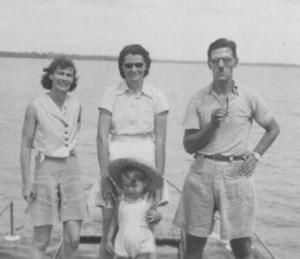
Freda Stanleigh, Suze with Brian, Basil (somewhere on water!) [K.L. 1940]
See Background for context. This includes a set of sources for this account, given as superscript S followed by the number of the source.
My father Piri and step-mother Suze stayed on in Singapore after my sister and I had left, and escaped in the formal evacuation of key personnel in a set of small ships and boats on Friday February 13th, two days before Singapore fell.
Piri was an "ardent Conscientious Objector"S7, which is presumably why in K.L. he had volunteered for the M.A.S. (Medical Auxiliary Service) rather than a military Volunteer Force. Suze was a trained nurse. So Piri would have carried on with auxiliary medical duties as soon as he was settled in Singapore, and Suze would have joined a hospital, certainly full time after we children had left.
Singapore was bombed in the early morning of the invasion of Malaya in the north on Dec. 8th. It was not bombed again till December 28th S1, but then it was bombed on a daily basis with increasing frequency, with the targets being military and strategic rather than civilian. The Japanese advanced steadily south, reaching the tip of the peninsular by the end of January. From then on bombing was augmented by shell fire from guns. On January 31st, the Commonwealth troops were pulled back onto Singapore Island, and the causeway breached. By this time there was already a lot of damage to buildings and roads, and getting around was becoming more difficult by the day. Nevertheless the basic facilities of electricity, water and telephone kept working surprisingly well, except locally where there had been a direct hit on a facilityS1. There was a comparative lull for a week while the Japanese prepared an invasion by boat across the narrow straits. The invasion was launched on the night of February 8th, accompanied by a fierce bombardment. They crossed over onto Singapore island itself, and started working their way across the island towards the centre of Singapore City. Singapore island was a diamond shape, about 15 miles from the northern tip (the causeway) to the southern tip (just beyond the city centre), and 25 miles East-West.
As the Japanese advanced, more and more people and vehicles became concentrated in the few miles around the city centre. This included a large number of refugees who had been pushed down the Malay peninsular, but of course the pressure had been relieved by the flow of refugees out of the docks by boat. In particular there was the large number of women and children escaping in the big troop-carrying liners up to February 8th. Thereafter, various people were able to escape by any small boats they could gain access to.
The formal directive from Churchill was that people should stay at their posts in Singapore till the end, destroying facilities and supplies ahead of the Japanese advance. But on February 12th, when the Japanese were only around five miles from the city centre, and were clearly not going to be stopped, there was an official review of what small ships and boats were available to take significant numbers. The potential capacity was established and then instructions sent to the various military and civil organisations, giving them an allocation of passes, and telling them to select personnel who would be more useful trying to escape and continue the war effort rather than face certain death or capture in the next few days. In general these people had to leave without letting colleagues know what was going on, to minimise loss of morale and a stampede at the docks of unauthorised people trying to escape.
The official flotilla comprised over 40 vessels. including a large number of small boats (e.g. launches) and a few larger ones (e.g. the Kuala and Tien Kwang described below). The personnel selected were mostly military, but there were 300 passes for key civilians, e.g. Fire Service, ARP, and Public Works Department (75 passes), and a large party of nurses. There was also a considerable number of women and children. (These probably included many of those who had spurned the earlier opportunities and insisted on staying with their husbands.) On February 13th the officials had to work out who should get passes and notify them (mostly already on duty of course), and then the personnel had to get to the docks, with minimal hand luggage, and find their allocated boat, and board it. With the docks as ever under heavy bombardment, warehouse fires raging, and unauthorised people trying to muscle in, the chaos can be imagined.
Piri, together with three other R.R.I. colleagues, Mr. Page, the Director of the R.R.I., Mr. Sharp and Mr. Owen, who wrote the eyewitness account below, were allocated to the Tien Kwang -- an Auxiliary Patrol Vessel, 787 tons, taking 300 - 400 passengers. Suze was on the Kuala -- an Auxiliary Patrol Vessel, 954 tons, taking over 500 passengers. The Kuala was the only vessel of the flotilla taking women and children, maybe around 200, including a large contingent of nurses (and some doctors).
The two ships sailed together, and were guided through the minefield outside the harbour, the Tien Kwang following the KualaS3. They had instructions to sail to Batavia via the straits of Rhio, Barbala [Berhala?] and BankaS4, nearly 600 miles, the route most of the earlier ships had taken. However even by now the Japanese had control of the Banka straits, over 200 miles away, taking the key airport of Palembang the next day. This controlled both the oilfield nearby and the Banka straits. Many of the people escaping by boat in the days before were killed or captured in this area. The Japanese very soon had control of both Northern and Southern Sumatra, with the only feasible escape route being through central Sumatra -- 250 miles up the Indragiri river and over to the port of Padang on the West side, which was still open. This was the route organised at the last minute in an S.O.E.-related operation, providing provisions, accommodation and transport to help move large numbers of escapees across to PadangS1.
Immediately south of Singapore are two archipelagos, the Rhio and then the Lingga, owned by the Dutch (now Indonesia), comprising hundreds of islands, mostly small and uninhabited. The immediate plan for the two ships was to travel by night and at daybreak seek shelter as close as possible to such an island. They would camouflage the ships with foliage from the jungle and hope they would be undetected by enemy planes until they could resume their journey at night.
The first morning they reached the small island of Pompong (to choose one of its many spellings) around 50 miles away. They anchored 200 - 300 yards from the shore, and a similar distance apart, with the Tien Kwang the closer to the shore. At daybreak the ships despatched boats to gather foliage from the island to decorate the ships. (There is a photograph extantS3 of a boat returning to the Tien Kwang laden with foliage.) Pompong was a small uninhabited island, covered in jungle, with the sides rising steeply from the water, except for a small beach on either side. It rises to 200 - 300 feet, and is around half a mile wide and a mile long. There were two small springs, but no food (e.g. coconuts).
At about 11 a.m. the following events happened, as described by one of the R.R.I. personnel, Gwilym Owen, in a letter to my Grandparents after the war.
The Bombing of the Tien Kwang and Kuala
As witnessed by Gwilym Owen on Saturday February 14th 1942
Both ships were anchored close together near an uninhabited island in the Lingga Archipelago on the morning of the February 14th 1942. On board the Kuala were women and children together with some men, the total number of passengers and crew estimated at about 500. Mrs Napper was a passenger on this ship. On board the Tien Kwang were men only, members of the armed forces and civilians, the total number estimated to be about 300. Mr Napper and the writer were passengers on this ship.
The Japanese bombers came over and dropped a salvo of bombs. The Tien Kwang was not touched then but the Kuala received a direct hit and was set on fire immediately. It is known that many people were killed on board but of course the exact number is not known. I distinctly remember seeing hundreds of people jumping over the side of the ship but we were not sufficiently close to recognise individuals with the naked eye. When this happened we received orders to abandon ship. I did not go overboard immediately as I realised I could never reach the island. I can't swim and I did not have a lifebelt. I remember looking over the side after a short interval and seeing Messrs Napper, Page and Sharp amongst hundreds of others swimming towards the island. As far as I could judge my three colleagues were not in difficulties then. Just at that moment the Japanese bombers came over again and I rushed down to the bowels of the ship. The Tien Kwang was hit but apparently no serious damage was done, at least the ship was not sinking. I shall not attempt to describe what I saw when I came to the side of the ship again but suffice it to say that it was evident that most of the bombs dropped by the Japanese bombers when they came over a second time must have fallen in the water between the ship and the island and the result can be imagined. Those who were still swimming were too far away to be recognised and I did not see Napper, Page or Sharp.
In that brief interval of time (I went overboard myself soon afterwards) I did not look to see whether or not the Kuala was still afloat but judging by her condition when I saw her before the Japanese bombers came over a second time it is highly probable that she was already sunk.
I jumped overboard when a raft was dropped into the water from the top deck. I clung to this (along with others) and we were carried away by a very strong current which flowed parallel with the island and despite our efforts we failed to reach this particular island. (We were picked up by natives in a rowing boat about 8 hours later).
Soon after I jumped into the water the planes came over a third time and more bombs were dropped. I got the impression then, as did many others, that the enemy machine-gunned the people in the water but there seems to be some doubt about this. However, perhaps this is of little importance now except in so far as it might account for a number of deaths at this stage.
When the immediate danger was over I looked back and saw that the Tien Kwang was still afloat but there was no sign of the Kuala.
That describes briefly the events as I observed them at the time. It is clear from the foregoing that I cannot state definitely at what precise moment Mr and Mrs Napper lost their lives. It is known that neither reached the island near which the ships were anchored (Mr Page can vouch for this) and it is unlikely that they reached any of the other islands in the archipelago as it is believed that all those who did succeed in reaching any of the numerous islands were accounted for later.
It remains to consider at what stage in these happenings did Mr and Mrs Napper lose their lives. [My grandparents were particularly interested to know if there was any evidence as to which of Piri and Suze had died first - for legal reasons.] It is of course not known whether Mrs Napper was killed or severely wounded while still on the Kuala. If the latter was the case she would have perished soon afterwards because it must be remembered that the ship was on fire. Assuming that she jumped overboard, then she was in the water several seconds before her husband jumped over the side of the other ship. In this connection it should be noted that Napper was seen swimming more than half way between the ships and the island. The question arises would Mrs Napper have reached the shores of the island by this time if she had survived the first bombing? That is a question I cannot answer but can only suggest that if she was a strong swimmer there was every chance that she would be very near the island at any rate if she were still alive at that stage.
Immediately after Napper was seen swimming the enemy planes came over the second time and dropped several bombs. Since Napper never reached the island I am inclined to think that he was either killed or injured then. It is possible of course that both of them suffered the same fate at this stage, but the fact remains that Napper was definitely seen immediately before the second bombing whereas as far as I can tell Mrs Napper was not seen.
There are two other possibilities which occur to me :-
- That either or both were only slightly injured during the second attack by the bombers, or got into difficulties because of the strong current and so survived the second bombing but perished later when the bombers came over a third time.
- That either or both survived the three bombing attacks, drifted away from the island and were drowned some time later.
I regard this second possibility especially as being very unlikely because if they had been floating in the water for some time they would have been observed by some of the survivors. I need hardly add that all survivors, when they got together later, questioned each other closely with a view to tracing missing friends. The events of that day were discussed on several occasions during subsequent days but both Mr Page and I failed to get any information whatsoever regarding Mr and Mrs Napper. None of the survivors had noticed them in the water.
G. Owen 3/4/46
In the end around 600 people made it to the island. Of the rest, say 300, some were killed outright by the three direct hits on the Kuala, some drowned swimming for the shore, many were killed by the subsequent bombing attacks on the people in the water, and some were swept away from the island by the strong current, to be picked up in time like Mr Owen, or suffer a long drawn out fate by exposure and drowning. As well as rafts, all movable floating material was torn from the ships before they were abandoned and thrown into the water.
The survivors on Pompong were taken off by various boats of different types over the following week. The first batch of 200 women, children and badly injured were taken on board by the small Dutch Steamer Tandong Pinang, bound for Batavia, which was soon to be captured by the Japanese. Most of the others, and those swept away but picked up like Mr. Owen, managed to get to the mouth of the Indragiri river, maybe via a short stay on one of the inhabited islands, with the help of the organised search and rescue teamsS1. There they were joined by survivors from other boats and made their way across Sumatra to Padang. But the majority failed to get a ship out in time to Batavia or Columbo, and were taken prisoner when the Japanese arrived in early March. (And not every ship out of Padang reached safety.) Of the surviving R.R.I. personnel, Mr Page and Mr Owen ended up captured at Padang, but Mr Sharp managed to get away safely.
© Copyright of content contributed to this Archive rests with the author. Find out how you can use this.


 Recommended story
 Story with photo