

- Contributed by
- Brian Napper
- People in story:
- Brian Napper
- Location of story:
- Singapore
- Background to story:
- Civilian
- Article ID:
- A7923954
- Contributed on:
- 20 December 2005
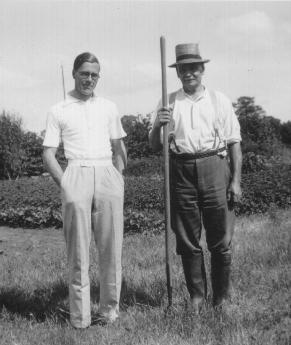
Piri, Grandad Napper (with his vegetable patch behind!) [Bristol 1939]
This page holds reference and background information for the set of pages Escape from Singapore — 1. to 4.
The top level page is 1. My Childhood Escape.
Contents
- The Basic Story
- The People
- Acronyms
- Note on the Letters from K.L.
- Suze’s Background
- Source Documents
The Basic Story
My father Robert Piriam N. (“Piri”) Napper was a Plant Pathologist at the Rubber Research Institute in Kuala Lumpur. In the 1930s he revolutionised the treatment of diseases in rubber plantations. My sister Rosemary was born in 1934, I was born in 1937, but our mother Maude never recovered from my birth, and died six months later. On the way back from leave in the U.K. in 1939 Piri met and fell in love with a Dutch nurse, Suzanna (“Suze”) Balfoort, who was returning home by boat from Holland to Batavia. They were married the next year. In the intervening period we were looked after by a young Malay Indian girl, Martha.
The Japanese invaded Malaya, in the North, on December 8th 1941, the same morning as the attack on Pearl Harbour1. They worked their way towards Singapore, taking Penang by December 18th, and K.L. by January 11th. Our family evacuated K.L. by car, moving to Singapore. Our father had volunteered for the Medical Auxiliary Service in K.L. (before the invasion), and offered his services to the MAS again in Singapore. Our step-mother, being a trained nurse, also offered her services.
Women and children were evacuated from Singapore in the troop ships which had brought in reinforcements for the defence of Malaya. As our step-mother knew no-one in England, and was so clearly required in Singapore, she elected to stay on. This was possible because close friends (the Stanleighs, see below) volunteered to look after us on the boat, and deliver us to our paternal grandparents in England.
We travelled in the "Empress of Japan", which sailed on January 31st, a fortnight before the Fall of Singapore (Feb 15th 1942).
Our father and stepmother escaped on February 13th, but were lost the next day. It was not till after the war that it was established that they were almost certainly killed or drowned when their boats were bombed.
We went to stay with our grandparents, Granddad Napper, aged about 70, and Grandma, 65, in a small village near Bristol. Their other child, Rowena (“Ena”) lived next door, with her husband Felix and children John and Pat.
Aunty Ena's husband worked for a Bristol shipbuilding firm. Sadly Felix died suddenly of meningitis on December 7th 1941.
The People
Ages, e.g. (34), as on Dec. 31st 1941
- Piri Napper (34) My father
- Maude Napper (née Hough) My mother, died 1937, aged 31
- Suze Napper (née Balfoort) (25) My step-mother, married May 1940, a trained nurse, Dutch, from Java.
- Brian Napper (4) Me!
- Rosemary Napper (7) My sister
- Granddad and Grandma Napper ("Dad" and "Mum") (c.70 and 65) My paternal grandparents, living near Bristol
- Grandma Hough ("Mus") (c.60) My maternal grandmother, recently widowed, living in Manchester
- Ena My father's only sibling, lived next door to her parents
- Felix Ena's husband, died 7/12/1941
- John and Pat (9 and 7) Ena's children
- The Stanleighs My father's best friends in K.L., Basil and Freda, with daughter Hazel (2?) and Freda's unmarried sister Gem
- Martha A young Christian Malay Indian girl, employed from a few months before my birth to a few months after the second marriage. She took ever increasing responsibility for looking after us, especially me.
Acronyms
- F.M.S. The Federated Malay States (often just Malaya); they did not include Singapore, which was part of the Straits Settlements.
- K.L. Kuala Lumpur, capital of the F.M.S.
- R.R.I. The Rubber Research Institute (now RRIM, the Rubber Research Institute of Malaysia); this is where my father worked.
- A.R.P. Air Raid Precautions, the umbrella voluntary civilian organisation which dealt with civil defence.
- M.A.S. Medical Auxiliary Service; the branch of the A.R.P. that dealt with medical matters, e.g. Ambulances, First Aid posts. My father and another man organised the M.A.S. in K.L. from April 1941.
Note on the Letters from K.L.
These letters are the full set of (6) letters from Piri and Suze in K.L. back to Grandma and Granddad Napper between the 5th of June and the 1st September 1941. They give a snapshot of life in K.L. under the threat of war. They are mostly written by my Dutch step-mother Suze (aged 25). Suze had never met Grandma and Granddad Napper, but she had been writing/receiving letters to/from them on a weekly basis since her marriage in May 1940. The writing is often hard to read, and the English is awkward. I have done a small amount of editing, but in general I have kept to her words and phrasing, as I think they are clear enough, and have a certain charm. I have removed a few sentences here and there, mostly to keep the material within the standard page size for this site, and so use two pages rather than three.
Note that there are references to Piri going to choir practice and church. He was a member of the choir at St Mary's Church, now St Mary's Cathedral, on the side of the Padang in K.L. My father and mother (Maude) were members of the choir, and there is a plaque in memory of Maude in the choir stalls. My sister and I have recently added a small supplementary plaque in memory of our father.
Suze’s Background
Suze’s parents went out from Holland to the Dutch East Indies (D.E.I., now Indonesia). They had two children. Her father had a good job which involved him living for extended periods in most of the big cities of Java and Sumatra. When Suze was 16 he had complications after an appendix operation, and was very ill in hospital for some time before eventually dying. Suze was very close to her father (but had less empathy with her mother) and saw a lot of him in hospital. She was convinced his death was directly due to poor hospital and nursing practice. She resolved to go to Holland to train as a nurse, and then return to D.E.I. to do what she could to improve standards. She soon travelled to Holland with her elder brother Dé, to complete her education. They stayed with an Aunt [I am not sure how closely related] who was married but had no children. Suze struck up a very close relationship with her Aunt and Uncle, living with them for seven years, except when she had to live in at hospital during the week, and regarded their house as her home. She never saw her mother during this time, and communication was bad. Dé however became a sailor, and he did see his mother in Batavia (now in Jakarta) periodically.
At the outbreak of war Suze’s mother ordered her home for safety. Suze was very cross and unhappy, but complied. She travelled to Lisbon with an Uncle who had business there, and then switched boats to join Piri’s ship. Coming to Lisbon she was so miserable she barely left her cabin. But a lady took her in hand, and showed her the sights of Lisbon. On the second night on board the new ship the lady was seasick, so Suze was moved from her allocated table to Piri’s. They struck up an immediate and deep friendship, and she got on very well with us two children and Martha. They arrived in Singapore and Batavia early December 1939. They had already decided to get married, but then did not see each other till they were married. Tentative plans had been made for a marriage in July, but when Holland fell mid May, they made plans to get married as quickly as possible to avoid any technical political problems. They were married in Singapore, on Monday May 27th 1940, in St Andrew’s Cathedral, but with minimum ceremony and no family.
Source Documents
This is a list of sources, all in my possession, from which I have drawn in the accounts on these pages, especially in 4. My Parents’ Fate . References to these sources are given in the form of a superscript “S” followed by the number in this list.
Sources S1 to S4 in particular relate to the abortive voyage of the pair of boats my parents escaped on, the Tien Kwang (Piri) and Kuala (Suze). They sailed together from Singapore on February 13th 1942, and were sunk the next day, with considerable loss of life, including my father and step-mother. All sources except S5 give an account of the attack in which my parents were (presumed) killed.
- Singapore to Freedom. Gilmour, Oswald W. London: E. J. Burrow, [1943]. Gilmour was a deputy Municipal Engineer in the Public Works Department in Singapore. He escaped from Singapore on the boat Suze was on, but was one of the few who got across Sumatra in time to catch a boat out from Padang to Columbo. He wrote a detailed account, soon after his escape, mostly from memory, of his life in Singapore after the invasion of Malaya, his escape in the Kuala, its sinking the next day, and his complicated journey to get to Padang, using the rescue organisation described in Gough’s bookS2. He returned to Singapore after the war, and wrote the book (which I haven’t seen) With Freedom to Singapore (London, Benn 1950.)
- The Escape from Singapore. Gough, Richard. London: William Kimber [1987] — latest reprint Singapore: Raffles [2000]. This book tells the story of the clandestine secret unit which, in cooperation with the SOE (Special Operations Executive) Malayan section, set up at the last minute a potential escape route for military and civil escapers from Singapore. It stocked desert islands with supplies, and arranged supplies, accommodation and transport on the mainland of Sumatra to move large numbers of escapers 250 miles from the mouth of the Indragiri river over to the West coast port of Padang. Thousands of people escaped from Singapore by sea in the days before and after the Fall of Singapore. Large numbers perished, most of the rest were captured, but since in the end it turned out the Japanese already had good control of Northern and Southern Sumatra, this route through the middle gave escapers the best chance. Even so relatively few managed to get away by ship from Padang before the Japanese themselves reached it. The book also tells in detail the stories of this flotilla of small ships and boats, and the fate of their passengers, and it includes a good account of the fate of the Tien Kwang and Kuala.
- Escape Impossible. Saddington, Stanley. Stockport: Arthur Lane [1997]. This book tells the story of a young radar mechanic’s escape on the Tien Kwang, following much the same route as GilmourS1, using the organisation described by GoughS2. He was captured at Padang, and being military rather than civilian he was moved in time from Padang to work on the Burma railway, passing through 25 POW camps before the end of the war! A third of the book describes his experiences up to leaving Padang, but the jewel of the book, at least from my viewpoint, is that it contains around 30 photographs he took of the journey to Padang. These he managed to preserve throughout the rest of his captivity. It includes three photographs of the Tien Kwang and Kuala during those deceptively peaceful hours between daybreak on February 14th and the bombing attacks around 11.00 that killed so many people.
- The Loss of HMS Kuala, 1942. An account by her commanding officer, appearing in “Naval Historical Review September 1979”, found recently on the WWW. This is a short informal account (1700 words) of the journey of the Kuala from Singapore and its sinking the next day as told by its captain to a Commander in the Australian navy.
- Sinister Twilight: The Fall and Rise Again of Singapore. Barber, Noel: London, Collins [1968]. This is the famous account of the loss of Malaya and Singapore to the Japanese. There is no detail on the fate of the flotilla that sailed out of Singapore on February 13th. Rather I get the impression that the fate of the official rats that deserted the sinking ship on that day was not worth recording! (This is not to say that I don't think he has a fair viewpoint.)
- Recollections of a Wayfaring Tefler: English Language Teaching in Four Continents 1966 — 1998. Owen, Gareth T. ISBN 0-620-330619 [2004]. This is the story of the professional life of Gareth Owen. His father Gwilym Owen was one of the three R.R.I. colleagues on the Tien Kwang with my father. He got as far as Padang, but was then captured and, being a civilian (in contrast to SaddingtonS3), he remained as a POW near Padang till the end of the war. He contacted my grandparents after the war, and at their request gave a detailed account of the bombing of the Tien Kwang and Kuala. It is this account that I have used as the centrepiece of the page 4. My Parents’ Fate. Gareth (as has his brother Robert) has taken a big interest in his early history since his formal retirement, and done much authentic research (e.g. inspecting public records). By a great stroke of luck I discovered his father’s account, buried in my attic, in time for him to give a shortened version in his book. He has a lot of private primary sources from his own professional life, but this account was the only extant private primary source for the first chapter of his book, recounting his life before “Tefling”2. Of course in a sense I am a source for Gareth’s book, and not the other way round. But I owe him a great debt, in that it was he who introduced me to the books of GilmourS1 and GoughS2, lending me his copies — Gilmour’s being his father’s copy, with his occasional comments in the margin. I have also used pieces of relevant information (to me) that he has acquired from his researches and passed on to me.
- Little Wena. Pearse, C.F. Godfrey, unpublished. My Aunty Ena took over Rosemary and myself after Grandma Napper died, so we were brought up in our teens as brother and sister to our cousins Pat and John. After we had all left home Ena married again, Godfrey Pearse. He rechristened Ena “Wena” (which did not endear him to our side of the family) — she being much shorter than him. He wrote up the story of her life, written in the first person (i.e. as if by Ena), but written by him from her account. This includes a brief version of the history on these pages, including a copy of the “legal” version of Gwilym Owen’sS6 account of our parents' death, i.e. the one he produced for the lawyers dealing with my father’s affairs, as opposed to the original account (written in pencil!) that I have used, and which is the basis of Gareth’s version.
1 Japan made surprise attacks on a number of places around the West Pacific on the same morning, but the date for Pearl Harbour is December 7th, as it is the other side of the date line.
2 TEFL stands for “Teaching English as a Foreign Language”!
© Copyright of content contributed to this Archive rests with the author. Find out how you can use this.


 Recommended story
 Story with photo