


Facebook: Are you a broadcaster or a whisperer?
- 10 Dec 09, 09:52 GMT
Had you looked at your privacy settings on Facebook before this week?
No, me neither, and I have to confess that I had some trouble finding them when I set out to look. And I'm by no means unusual.
In a conference call with the company, I asked how many had actually bothered to adjust those settings before this week's initiative asking them to do so. Between 15 and 20% was the answer.
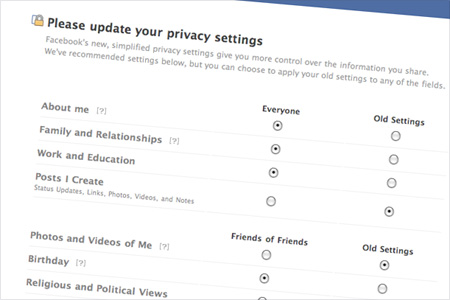
So for the vast majority of Facebookers the enforced visit to their privacy settings imposed by the company in the last 24 hours will have proved a novel experience.
Facebook says it has acted to give everyone more control over how they share their information, and made it simpler too.
One key change is that big geographical networks - like London or Australia - are going. Once Facebook moved off the campus, they provided many new users with their starting point but they've become far too big and have led to privacy gaffes, including one notorious incident.
Earlier this year a woman shared photos of her husband in his swimming trunks and the location of their flat with the six million people on Facebook's London network. Which might have been OK had she not been the wife of the incoming head of MI6.
From now on there are three basic privacy settings - you can share with friends, friends of friends, or everyone, which means the whole of the internet.
There is also a custom option but that's only likely to be used by people who've already fiddled with their settings.
While you do get to choose, Facebook makes recommendations for how many people you should allow to see each category of information.
So for instance it says you should allow your status updates and some basic personal information to be seen by everyone, while your photos should be restricted to friends of friends, and your address just to friends.
One Facebook friend was not impressed:
"As far as I see it, profile pic, friend lists, pages - and a few other 'insignificant' details, ie, status & sexuality are now on view to EVERYONE - and I've not found away to hide these, other than by deleting the information from your actual profile."
This did not please my friend. "I'm a teacher & we're supposed to hide our profiles from current students."
Facebook told me it was too simplistic to say that users were now being encouraged to be less private, but did admit "we believe users will feel comfortable sharing more" and conceded that Twitter - or rather what it described as "services for people wishing to share with a wider audience" - had made an impact.
What is clear is that users of social networks are now splitting into two camps - what I would call the broadcasters and the whisperers.
The broadcasters see social networking as a very public medium, somewhere to get their message across to as many people as possible, whether it's their rage at the fact that the 07:53 from West Wittering is late again, their support for an X Factor contestant or their views on the government's pre-Budget report.
The whisperers still see the networks as private places, where they can communicate with close friends without their employers, their mums and dads, or any curious passer-by listening in.
While there's no real point in being on Twitter if you're not prepared to "broadcast", it seems Facebook wants to be in both camps.
But will it really be possible to cater for everyone, from the most public users to those seeking just a private conversation with friends? I'm not sure.
You may not be surprised to hear that I put myself firmly in the broadcasting category. I quickly realised that Facebook was not a private place so that it was best not to put anything there that I didn't want the world to see.
In any case, I now spend far more of my time on Twitter, where there's even more danger of letting slip something private, but at least everyone is clear that it's a public space.
Oh, and if you want to keep track of my social networking gaffes you can follow me at twitter.com/ruskin147.

American infoglut
- 10 Dec 09, 09:10 GMT
Does your head ever feel like it is about to explode because of the number of e-mails you read, videos you trawl though, websites you browse, blogs you consume, programmes you watch, games you play and media you download?
In the States, Americans not only have a reputation for muffin tops and lardiness but it seems they can also add information overload to the count.
A survey just released by the Global Information Industry Centre of San Diego University reveals that households in the US consumed a mind boggling total of 3.6 zettabytes of data and 10,845 trillion words in 2008.
Zettabytes haven't exactly become common parlance yet and according to Wikipedia a ZB is a "unit of information or computer storage equal to one sextillion bytes." The university says a zettabyte is 1,000,000,000 trillion bytes.
Those explanations don't really cut it, but the brains behind this report have said it is equal to covering the continental United States and Alaska in a 7ft high stack of thick paperback novels.
The aim of this report called How Much Information is to look at all forms of American communication and consumption in a bid to create a census of the information consumed.
So where is it all coming from? Exactly where you expect as this graph shows.
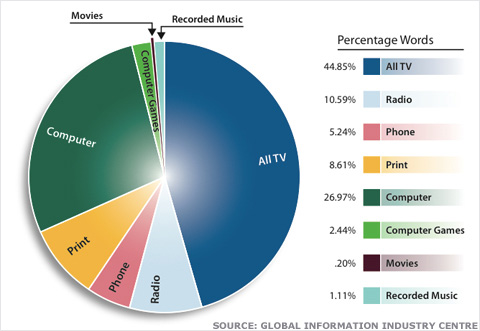
What is more surprising is that while I think I never have time to read books, it seems on average I actually gorge on around 100,000 words of information a day.
What the study says that really means is that all those words are hurtling headlong via various channels like TV, radio, the internet, texts, videos, tweets and so on.
In the age of the internet though it is the goggle box that is winning out.
People averaged around five hours watching TV and 2.2 hours listening to the radio. The computer comes in third at just under two hours, video games an hour and reading a poor and distant fifth place with just a half an hour of time.
 "The report is a snapshot of what the information revolution means to the average American on an average day," says report author Roger Bohn who is also the Centre's director.
Surprisingly gaming saw a big leap with 18.5 gigabytes per day for the average consumer - that's about 67% of all bytes consumed says the report.
In a piece of good news for all those social/casual gaming companies out there, the study notes that around 80% of the population plays some kind of computer game, including casual games such as my favourite, Bookworm and the like.
Mr Bohn says:
"Games are almost universal, but most of the gaming bytes comes from graphically intensive games on high-powered computers and consoles, which have the equivalent of special-purpose supercomputers from five years ago."
Gazing to the future, the Centre say the information landscape will change by 2015 thanks to the widespread use of HDTV, mobile TV and video over the internet.
The report acknowledges that as information consumption is expected to continue to grow, there are some real problems to worry about.
"What is clear is that we consume orders of magnitude more information than can be stored on hard drives or transmitted over today's internet," says Internet pioneer Larry Smarr and the director of the California Institute for Telecommunications and Information Technology.
"Even small changes in how Americans consume information would have serious implications for network planners and require large-scale investments."
The BBC is not responsible for the content of external internet sites
This is dot.life - a blog about technology from BBC News.
Rory Cellan-Jones is the BBC's technology correspondent.
Maggie Shiels is the BBC's tech reporter based in Silicon Valley.
Archive
« January 2010
| Sun | Mon | Tue | Wed | Thu | Fri | Sat |
|---|---|---|---|---|---|---|
| 1 | 2 | |||||
| 3 | 4 | 5 | 6 | 7 | 8 | 9 |
| 10 | 11 | 12 | 13 | 14 | 15 | 16 |
| 17 | 18 | 19 | 20 | 21 | 22 | 23 |
| 24 | 25 | 26 | 27 | 28 |
Being Discussed Now
- Logging out... and straight back in(3)
- Gadgets of the Noughties(20)
- Plastic Logic's long journey to Vegas(21)
- Sexting teens(17)
- Wikipedia on the wane?(49)
- 'Cooling-off' for mobile phones? Not on the High Street(37)
- 2009 - the social year(36)
- Twitter, Iran and #uksnow(25)
- Broadband Britain - how far down the league?(55)
- Microsoft and Murdoch: Teaming up to bash Google?(34)
BBC Technology Headlines
- %28none%29
%28none%29 - %28none%29
%28none%29 - %28none%29
%28none%29
Visit the Technology index
Visit the BBC News website
Rory's TV/Radio reports
- Residents block Google car
Broadcast: 3 April 2009 - New adverts to tackle film piracy
Broadcast: 2 April 2009 - Call to scrap 'illegal databases'
Broadcast: 23 March 2009 - Female robot takes to the catwalk
Broadcast: 16 March 2009 - Super-charged battery breakthrough
Broadcast: 12 March 2009

- News Editors
- Sport Editors
- Journalism Labs
- BBC Internet Blog
- Radio 4 Blog
- Peston's Picks
- Nick Robinson's Newslog
- Stephanomics
- Mark Easton's UK
- Mark Mardell's America
- Nick Bryant's Australia
- Andrew Harding on Africa
- Gavin Hewitt's Europe
- Soutik Biswas' India
- dot.Rory
- Science: Jonathan Amos
- Richard Black on environment
- Today: Tom Feilden
- Fergus Walsh's medical files
- Newsnight: Paul Mason
- Newsnight: Mark Urban
- Torin Douglas
- Will Gompertz's arts
- Phil Coomes on photojournalism
- Magazine Monitor
- Mark D'Arcy in Westminster
- NI: Mark Devenport
- Scotland: Brian Taylor
- Scotland: Douglas Fraser
- Wales: Betsan Powys
- Martin Rosenbaum on FOI
- 5 Live Breakfast
- Newsnight
- PM programme (iPM)
- World Tonight: Robin Lustig
