


A YouTube election?
- 11 Dec 09, 15:57 GMT
Will 2010 bring us the UK's first "internet election"?
Well, obviously not.
The internet has been around since the 1970s, and the political parties started dipping their toes in the waters of the web back in 2001. But it will be the first YouTube election.
At a gathering in Westminster last night, an audience made up of parliamentary researchers, political groupies and just one MP was reminded that the video-sharing website was only founded in 2005 - too late to play a part in that year's general election.
Next year's, though, could be a very different affair.
The meeting had come to hear Steve Grove, YouTube's head of politics and news, who had come from California to spread a simple message to the good people of Westminster: the video-sharing site had a huge effect on the last US presidential campaign, and it could do the same for you.
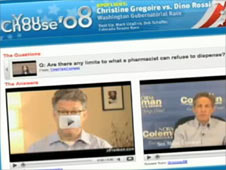 First, he showed a video featuring highlights from that 2008 campaign - from a candidate caught out when filmed on a mobile phone using questionable language, through Obama meeting Joe the Plumber, to all sorts of voters using YouTube to get their messages to the parties.
The message was that both the candidates and the voters had used YouTube and other web-based tools to bypass the mainstream media and to speak directly to each other.
By the end of the campaign, Barack Obama was getting more than a million views for campaign videos, and Mr Grove said he'd been told by US broadcasters that they'd struggled to cope with the sheer volume of content produced by the politicians.
More important, though, was the way the voters used YouTube and other social media platforms to discuss the issues, put their own messages out and engage directly with the politicians.
 "It's not just a shrunken TV screen where you can pipe out your political commercials to a new audience," Mr Grove insisted. "It's actually a dialogue, more like a window into your campaign."
But does the American experience, where candidates have months, even years, to build up an online campaign really tell us much about what will happen in a much shorter and more intense UK general election campaign?
Mr Grove says candidates has better be prepared:
"When the election is called... and the 90% of people who haven't been paying attention start paying attention and go to YouTube to search for the candidates' names, they're going to quickly get a sense of what that candidate is about."
What really caught the attention of the Westminster audience was Steve Grove's list of top ten tips for campaigning with YouTube. Here they are:
1) Build an audience
• steady stream of footage builds subscribers and grows audience
• create one video per issue
• better to post one video every day than seven videos on one day
2) Personalize your campaign
• video is the most effective way for the electorate to get a sense of who you are
3) Optimize your videos
• good title, rich meta-data, subtitles and captions
• enable syndication: embeds, Facebook, Twitter
• time of upload - hit peak hours: 10am to 2pm
• stick to one message per video, and in most cases two minutes is all you need
• be fast, be first
4) Target your audience: Insight
• use YouTube Insight to get data on what demographics and what geographies are watching your video the most
• also discover how they're finding your videos - through search, related videos and so on
5) Test your message
• listen to comments, rankings, video responses: use YouTube as an automatic focus group
6) Ask for ideas, questions, and feedback from voters
• use existing YouTube functionality, or Google Moderator
7) Pay for Promotion
• join the "Promote Your Video" programme to buy placement on search results pages
8) Drive action to your cause
• buy Promoted Video credits on YouTube, and you can use a "call-to-action" overlay to drive traffic to your site
9) Kill harmful smears
• respond rapidly to smears, and use the same words in your metadata so your response comes up along with your opponents' views
10) Search every day
• keep searching for yourself and your key policies on YouTube so you're always aware of what voters are seeing.
Now, some of these ideas may not really work at all in the UK - there were some wry smiles at the obvious self-interest of number eight, where YouTube is encouraging candidates to pay up to promote their campaign websites through the site.
Given the limited resources available to UK candidates - and the far stricter rules on campaign spending - prospective MPs may be reluctant to commit as much time and money to this one form of communication with voters as their US counterparts.
All the parties are now scratching their heads and trying to work out what impact YouTube, Facebook, microblogging and the blogosphere will have on the campaign, though I have the impression that most MPs still believe the mainstream media will play a far more important role.
Would there have been more than one MP, for instance, at an event on campaigning run by a newspaper group?
It's also slightly distressing that just about all of this innovation is coming out of American companies. But there is some very interesting home-grown work on putting voters in touch with the issues.
Just today, a site called Where Does My Money Go? was launched, giving all of us access to a lot of detailed information about where our tax money is spent.
So it might be a YouTube election, but it may also be a DIY affair, where smart young British web developers give voters all sorts of new ways to engage in the debate and keep the politicians on their toes.
And if you want to hear a short interview I recorded with Steve Grove, here it is:
In order to see this content you need to have both Javascript enabled and Flash installed. Visit BBC Webwise for full instructions. If you're reading via RSS, you'll need to visit the blog to access this content.

Science and the sexes
- 11 Dec 09, 14:54 GMT
A big conundrum facing the US, the UK and many other European countries is this: how do you keep young people engaged in science and mathematics, and how especially do you keep young girls fired up about the subjects?
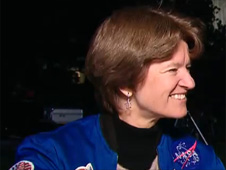 In a chat with Dr Sally Ride, the first American woman in space, she talked a lot about the stereotypes that create and sustain the situation: girls being led to think that science is a boys' subject; preconceptions of science as dull; the idea that it's just too downright hard.
I certainly remember those messages seeping into my brain, even though I was actually - I'm happy to say - a whizz at trigonometry and consistently scored top marks in my accounts exams.
Dr Ride points out that all children are interested in science. It is innate. They are born curious. They like to know how the world works, how their bodies work, how their favourite toy works and so on. If you are a parent, you know that at a certain age the favourite question of every child is "Why?".
While these stereotypes have persisted for years, Dr Ride believes that the issue has to be tackled at this early stage in order for there to be change up the pipeline.
She also told me that the country has to get excited again about maths and science and she applauds President Obama's efforts with his newly-launched Educate to Innovate initiative:
"On and off, there has been political will to changes things - but this feels different. This feels very special with this president, and perhaps that is because he has two young daughters and is very focused on the importance of a science education."
And while she laments the present situation, Dr Ride recalls how the space race of the 1950s and '60s caught the imagination of the nation:
"When the Soviets launched Sputnik, it completely changed the focus of US education. Suddenly, maths and science became the most important things that could be taught to our kids."It became a national priority - and it became really cool to want to be a scientist or an engineer. A lot of kids grew up dreaming of building rockets to the stars. Over the years, we have lost that magic, that focus, that spark."
For years, Dr Ride says, she has worked to redress the balance and to get children hooked on science and maths - especially young girls, who tend to drop the ball on the subject when they are ten and 11.
She runs a company that creates programmes and products to educate and inspire children in these subjects, and with ExxonMobil, she has set up a science academy aimed at helping teachers learn how to get children excited about science.
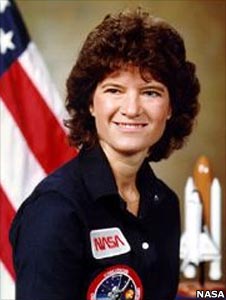 Dr Ride told me that science was in her blood from a very young age and that she just never lost the passion for the subject. Her plans to either get a job as a research scientist or as a teacher went up in smoke when she saw an advert in the local Stanford student newspaper:
"I had just finished my PhD and was about to start applying for jobs when I saw the Nasa advert. They were looking for astronauts and it was the first time in ten years that they were taking applications and they were looking for women. It was when I saw that ad, that I knew this was something I wanted to do. Something that I had to do."
Dr Ride was one of 8,000 people who applied, and only one of six women included in a class of 35.
And the rest, as they say, is history as Dr Ride became the first American woman and the then-youngest American to enter space as a member on Space Shuttle Challenger.
The BBC is not responsible for the content of external internet sites
This is dot.life - a blog about technology from BBC News.
Rory Cellan-Jones is the BBC's technology correspondent.
Maggie Shiels is the BBC's tech reporter based in Silicon Valley.
Archive
« January 2010
| Sun | Mon | Tue | Wed | Thu | Fri | Sat |
|---|---|---|---|---|---|---|
| 1 | 2 | |||||
| 3 | 4 | 5 | 6 | 7 | 8 | 9 |
| 10 | 11 | 12 | 13 | 14 | 15 | 16 |
| 17 | 18 | 19 | 20 | 21 | 22 | 23 |
| 24 | 25 | 26 | 27 | 28 |
Being Discussed Now
- Logging out... and straight back in(3)
- Gadgets of the Noughties(20)
- Plastic Logic's long journey to Vegas(21)
- Sexting teens(17)
- Wikipedia on the wane?(49)
- 'Cooling-off' for mobile phones? Not on the High Street(37)
- 2009 - the social year(36)
- Twitter, Iran and #uksnow(25)
- Broadband Britain - how far down the league?(55)
- Microsoft and Murdoch: Teaming up to bash Google?(34)
BBC Technology Headlines
- %28none%29
%28none%29 - %28none%29
%28none%29 - %28none%29
%28none%29
Visit the Technology index
Visit the BBC News website
Rory's TV/Radio reports
- Residents block Google car
Broadcast: 3 April 2009 - New adverts to tackle film piracy
Broadcast: 2 April 2009 - Call to scrap 'illegal databases'
Broadcast: 23 March 2009 - Female robot takes to the catwalk
Broadcast: 16 March 2009 - Super-charged battery breakthrough
Broadcast: 12 March 2009

- News Editors
- Sport Editors
- Journalism Labs
- BBC Internet Blog
- Radio 4 Blog
- Peston's Picks
- Nick Robinson's Newslog
- Stephanomics
- Mark Easton's UK
- Mark Mardell's America
- Nick Bryant's Australia
- Andrew Harding on Africa
- Gavin Hewitt's Europe
- Soutik Biswas' India
- dot.Rory
- Science: Jonathan Amos
- Richard Black on environment
- Today: Tom Feilden
- Fergus Walsh's medical files
- Newsnight: Paul Mason
- Newsnight: Mark Urban
- Torin Douglas
- Will Gompertz's arts
- Phil Coomes on photojournalism
- Magazine Monitor
- Mark D'Arcy in Westminster
- NI: Mark Devenport
- Scotland: Brian Taylor
- Scotland: Douglas Fraser
- Wales: Betsan Powys
- Martin Rosenbaum on FOI
- 5 Live Breakfast
- Newsnight
- PM programme (iPM)
- World Tonight: Robin Lustig
