


Day Three: What price the web?
- 16 Sep 09, 08:21 GMT
What kind of mood is Kenya in as the fast internet revolution arrives? Excited, yes, enthusiastic certainly - but also impatient and just a little bit cynical. This is a country with a vigorous and argumentative democracy - but whose people have earned the right to be cynical about the promises made by politicians and corporations. They were promised fast broadband at an affordable price - but a few weeks after the fibre cable went live, they're questioning what it will deliver.
In order to see this content you need to have both Javascript enabled and Flash installed. Visit BBC Webwise for full instructions. If you're reading via RSS, you'll need to visit the blog to access this content.
Not much cynicism, though, at St Charles Lwanga Secondary, a school crying out for connectivity. We arrived to a fantastic greeting from the choir, dancing and singing about President Obama, revered here as the son of a Kenyan father. We were then shown to the one classroom out of 12 which did have computers. The 20 reconditioned PCs had been donated by British companies through the Computer Aid charity, and pupils were hard at work on a Word document.
But what they didn't have was an internet connection. The head teacher Peter Watoro explained that while a couple of computers in his office were connected, the bill to put every class online could be as much as £350 a month - way beyond the means of the school. Now he hopes and believes the cable will bring that cost down.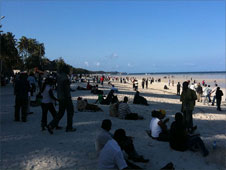
Our next stop was the Blue Fin Cyber Cafe in downtown Mombasa where, for a princely 20p, I got half an hour's surfing. Mind you it was at a snail's pace - a quick test revealed that I was downloading at an average speed of 0.1Mbps.
The owner told us that he was not yet connected to the fibre link - but when he was, his customers would get faster web access for no extra cost. There again, he was only promising a doubling of speeds, so don't expect to watch YouTube at the Blue Fin. Like just about everyone else he laid the blame at the door of the internet service providers - "true competition hasn't hit the market," he explained.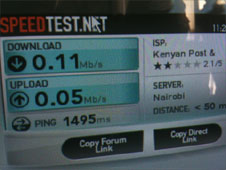
So then we talked to an ISP. Jacque Mbandi of Access Kenya wanted to give us the good news about the faster service her firm could now offer business and residential users. But when she read out the prices we had to make her repeat them a couple of times.Previously, she explained, they'd sold businesses a 1mbps connection for around £2,500 a month. Now post-fibre, as she put it, that had come down to around £750.
Better news for home customers - they used to pay £30 a month for a 256Kbps connection, now they'd get 512kbps for the same £30. Now that's probably around what you would have paid in the UK for broadband a few years back, but in this country it puts in the luxury bracket. Jacquee Mbandi admitted that most Kenyans wouldn't be able to afford broadband for a while - but she denied that the ISPs were profiteering, insisting they had to recoup the extra costs of building their own fibre networks.
The most cynical, but also the most exuberant person I've met in Kenya has been Tonee N'Dungu. He came on the overnight bus from Nairobi to meet us, so keen was he to put over the viewpoint of a new tech-savvy generation. 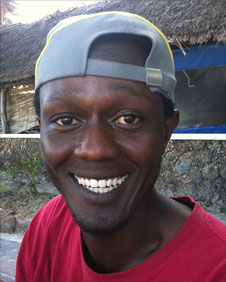
Tonee, who seems to have at least three jobs in the media and social networking field, met me on the public beach in Mombasa. He immediately produced two laptops, a smartphone and a mini video camera, all tools of his trade.
"We're all on Twitter, Facebook - anything that allows us to express ourselves," was how he described young Kenyans, and he said the arrival of good internet connections could be the biggest event since independence for his generation.
Then he explained why he was cynical; "I've seen how things work in my country - there are always strings attached, nothing comes for free." It was the last mile to the home that mattered - and the danger was that millions of people outside the big cities would miss out.
Tonee may be dubious about the promise of a wired Kenya - but he already seems to be halfway there. As he travelled back to Nairobi, he was still in a frenzy of communication, sending messages on Twitter on his phone from the bus. The road to this country's digital future may be littered with potholes, but the energy of people like Tonee should help Kenya get there.
The BBC is not responsible for the content of external internet sites
This is dot.life - a blog about technology from BBC News.
Rory Cellan-Jones is the BBC's technology correspondent.
Maggie Shiels is the BBC's tech reporter based in Silicon Valley.
Archive
« January 2010
| Sun | Mon | Tue | Wed | Thu | Fri | Sat |
|---|---|---|---|---|---|---|
| 1 | 2 | |||||
| 3 | 4 | 5 | 6 | 7 | 8 | 9 |
| 10 | 11 | 12 | 13 | 14 | 15 | 16 |
| 17 | 18 | 19 | 20 | 21 | 22 | 23 |
| 24 | 25 | 26 | 27 | 28 |
Being Discussed Now
- Logging out... and straight back in(3)
- Gadgets of the Noughties(20)
- Plastic Logic's long journey to Vegas(21)
- Sexting teens(17)
- Wikipedia on the wane?(49)
- 'Cooling-off' for mobile phones? Not on the High Street(37)
- 2009 - the social year(36)
- Twitter, Iran and #uksnow(25)
- Broadband Britain - how far down the league?(55)
- Microsoft and Murdoch: Teaming up to bash Google?(34)
BBC Technology Headlines
- %28none%29
%28none%29 - %28none%29
%28none%29 - %28none%29
%28none%29
Visit the Technology index
Visit the BBC News website
Rory's TV/Radio reports
- Residents block Google car
Broadcast: 3 April 2009 - New adverts to tackle film piracy
Broadcast: 2 April 2009 - Call to scrap 'illegal databases'
Broadcast: 23 March 2009 - Female robot takes to the catwalk
Broadcast: 16 March 2009 - Super-charged battery breakthrough
Broadcast: 12 March 2009

- News Editors
- Sport Editors
- Journalism Labs
- BBC Internet Blog
- Radio 4 Blog
- Peston's Picks
- Nick Robinson's Newslog
- Stephanomics
- Mark Easton's UK
- Mark Mardell's America
- Nick Bryant's Australia
- Andrew Harding on Africa
- Gavin Hewitt's Europe
- Soutik Biswas' India
- dot.Rory
- Science: Jonathan Amos
- Richard Black on environment
- Today: Tom Feilden
- Fergus Walsh's medical files
- Newsnight: Paul Mason
- Newsnight: Mark Urban
- Torin Douglas
- Will Gompertz's arts
- Phil Coomes on photojournalism
- Magazine Monitor
- Mark D'Arcy in Westminster
- NI: Mark Devenport
- Scotland: Brian Taylor
- Scotland: Douglas Fraser
- Wales: Betsan Powys
- Martin Rosenbaum on FOI
- 5 Live Breakfast
- Newsnight
- PM programme (iPM)
- World Tonight: Robin Lustig
