


Live from Mombasa
- 17 Sep 09, 08:56 GMT
Coming to Africa to report on the new broadband cable was always going to be a challenge to our own technology. How would we get our video and audio reports back to London and then broadcast live?
 These days we try to save money when we're away from the office by sending our material over the internet rather than booking an expensive satellite link. But despite the arrival of the fibre-optic cable in East Africa, there's still very limited bandwidth in most places.
Sending a 5Mb audio file from our hotel, for instance, took almost half an hour - so it was not really going to be a practical way to send a 100Mb compressed video report, let alone my colleague Dan Simmons' piece for this week's Click, which weighed in at an uncompressed 1.2Gb.
So the answer was to go to the one place where you should be able to get online at a decent speed, the Seacom cable landing-station in Mombasa. The kind folks there rolled out two ethernet cables for us, and on Tuesday evening we sent a video report almost five minutes long to London in just over 15 minutes.
Having sat cursing the wi-fi in hotels across Europe as our video took hours to crawl back to base, this was a welcome change.But on Wednesday we faced a bigger challenge - broadcasting live on TV and radio for nearly twelve hours.
Using broadband to go "live" is a trick we've tried at home during a couple of our Broadband Britain tours. It's hairy, because we use two methods which are just slightly experimental. VPoint is video-conferencing software, which broadcasters originally adopted mainly to broadcast from warzones or other places where immediacy was the priority and Luci Live is live audio software, with which I've tangled more or less successfully a number of times.
Both depend on some kind of internet access, and often they can deliver slightly sub-standard levels of picture or sound if you haven't got a reasonably speedy connection. With VPoint for instance, it's not wise to use a panning shot - or for the presenter to move around a lot if they don't want to look like a badly oiled robot.
So we prepared with some trepidation for a day in which we were going to be swiftly moving from radio to TV broadcast and back again for 12 solid hours.
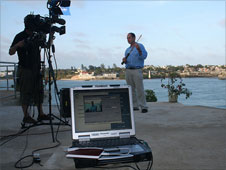
We arrived at the landing-station in plenty of time for cameraman, picture editor and all round technical genius Neil Drake to set up his battery of equipment - which included an emergency satellite dish and a satellite phone in case the broadband connection failed.
But from the first appearance on BBC Breakfast until the last on BBC World, in the pitch black, things went remarkably smoothly. There was one little wobble in the middle of the day when the pictures got very jerky - and we started - but it turned out that our laptop had overheated and once it had been given a rest inside the air-conditioned landing station, our images looked crisp and clean once more.
In order to see this content you need to have both Javascript enabled and Flash installed. Visit BBC Webwise for full instructions. If you're reading via RSS, you'll need to visit the blog to access this content.
A broadcasting exercise that we had found tricky in locations from the west coast of Scotland to the west coast of the USA proved reasonably simple in Kenya. So why am I telling you all this in a blog post about Africa? Because it illustrates the very point we were trying to illuminate by coming to here, that new technology could now link this region up to the rest of the world, with profound effects on its economy and society.
Today we're off to a country whose president certainly believes in the transformative power of technology. And tomorrow I'll be giving my first impressions of Rwanda - at least I will if I can get a good internet connection.
The BBC is not responsible for the content of external internet sites
This is dot.life - a blog about technology from BBC News.
Rory Cellan-Jones is the BBC's technology correspondent.
Maggie Shiels is the BBC's tech reporter based in Silicon Valley.
Archive
« January 2010
| Sun | Mon | Tue | Wed | Thu | Fri | Sat |
|---|---|---|---|---|---|---|
| 1 | 2 | |||||
| 3 | 4 | 5 | 6 | 7 | 8 | 9 |
| 10 | 11 | 12 | 13 | 14 | 15 | 16 |
| 17 | 18 | 19 | 20 | 21 | 22 | 23 |
| 24 | 25 | 26 | 27 | 28 |
Being Discussed Now
- Logging out... and straight back in(3)
- Gadgets of the Noughties(20)
- Plastic Logic's long journey to Vegas(21)
- Sexting teens(17)
- Wikipedia on the wane?(49)
- 'Cooling-off' for mobile phones? Not on the High Street(37)
- 2009 - the social year(36)
- Twitter, Iran and #uksnow(25)
- Broadband Britain - how far down the league?(55)
- Microsoft and Murdoch: Teaming up to bash Google?(34)
BBC Technology Headlines
- %28none%29
%28none%29 - %28none%29
%28none%29 - %28none%29
%28none%29
Visit the Technology index
Visit the BBC News website
Rory's TV/Radio reports
- Residents block Google car
Broadcast: 3 April 2009 - New adverts to tackle film piracy
Broadcast: 2 April 2009 - Call to scrap 'illegal databases'
Broadcast: 23 March 2009 - Female robot takes to the catwalk
Broadcast: 16 March 2009 - Super-charged battery breakthrough
Broadcast: 12 March 2009

- News Editors
- Sport Editors
- Journalism Labs
- BBC Internet Blog
- Radio 4 Blog
- Peston's Picks
- Nick Robinson's Newslog
- Stephanomics
- Mark Easton's UK
- Mark Mardell's America
- Nick Bryant's Australia
- Andrew Harding on Africa
- Gavin Hewitt's Europe
- Soutik Biswas' India
- dot.Rory
- Science: Jonathan Amos
- Richard Black on environment
- Today: Tom Feilden
- Fergus Walsh's medical files
- Newsnight: Paul Mason
- Newsnight: Mark Urban
- Torin Douglas
- Will Gompertz's arts
- Phil Coomes on photojournalism
- Magazine Monitor
- Mark D'Arcy in Westminster
- NI: Mark Devenport
- Scotland: Brian Taylor
- Scotland: Douglas Fraser
- Wales: Betsan Powys
- Martin Rosenbaum on FOI
- 5 Live Breakfast
- Newsnight
- PM programme (iPM)
- World Tonight: Robin Lustig
