


Africa's internet journey: Day One
- 14 Sep 09, 08:49 GMT
The first stop on our journey in East Africa was a nondescript building in an idyllic location looking out over the Indian Ocean. In fact, the Seacom Landing Station is worse than nondescript - it's the kind of building which Prince Charles might describe as a monstrous carbuncle, located right next to Mombasa's most imposing sight, Fort Jesus, built by Vasco da Gama in the 16th century.
In order to see this content you need to have both Javascript enabled and Flash installed. Visit BBC Webwise for full instructions. If you're reading via RSS, you'll need to visit the blog to access this content.
But maybe the identikit shed above the beach where the Seacom cable comes ashore may one day be seen as a historic site in its own right - the place where East Africa finally got a decent connection to the internet.
Mahmoud Noor, an impressive young Kenyan telecoms engineer who runs the station, was immensely proud of it.
"It's a privilege to be part of history, to be giving the first real broadband connection to the East African region" he told me. "As Obama says, we are on the right side of history."
He lifted a manhole cover to show me the cable, which looks pretty flimsy, stripped of the armour which protects it on the floor of the ocean. But this is just one link in a network stretching from Mumbai to Kenya, and along the cost of East Africa, and bringing the fast internet here for the first time.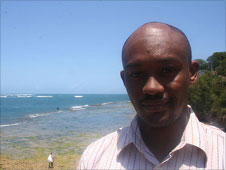
Then Mahmoud took me on a tour of his small empire - no more than a few prefab rooms housing servers, equipment installed by the internet service providers who will now link customers up to the cable, and, most important, a couple of standby generators.
"Power is one of our biggest problems," he admitted, explaining that electricity rationing meant that you could see around three power cuts a week at the moment. The generators would allow them to keep on running for three months.
In the transmission room, Mahmoud sketched a few sums on a piece of paper to show me the increase in capacity promised by the cable. He said it could carry 114 million voice calls simultaneously - and that was around 240 times the previous capacity of Kenya's telecoms system. This country, like the rest of East Africa, has been dependent on satellite links to hook it up to the outside world - and that's made getting online both expensive and slow.
So the cable - and others now arriving on this coast - could make a huge difference. But what I hadn't quite realised until I got here was how much all of this depended on the mobile phone networks. 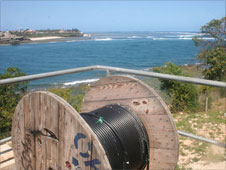 The mobile industry is visible everywhere, from the huge adverts for the two main operators, Safaricom and Zain, to tiny shops selling mobile access or offering the chance to use M-Pesa, the mobile money transfer scheme.
I'd heard that far more people here had access to a mobile phone than had bank accounts - but apparently it's also more common than access to fresh water.
And with the fixed line telephone system something of a national joke, mobile will be the route to the internet for most. So, despite the promise of a big leap in speeds, customers will be getting online via 3g phone networks linked to the new cable. A quick test on my laptop showed download speeds of around 256Kb - better than what was on offer before, but some way from broadband. And we've just passed a big advert offering a broadband service for 2,999 Kenyan shillings a month - that's around £27 which is way beyond the reach of most Kenyans.
It was Mahmoud Noor's infectious enthusiasm about the revolution the cable could bring which really struck me on my first day in East Africa, But now comes the hard bit - delivering on that promise for millions of Africans eager to be connected.
The BBC is not responsible for the content of external internet sites
This is dot.life - a blog about technology from BBC News.
Rory Cellan-Jones is the BBC's technology correspondent.
Maggie Shiels is the BBC's tech reporter based in Silicon Valley.
Archive
« January 2010
| Sun | Mon | Tue | Wed | Thu | Fri | Sat |
|---|---|---|---|---|---|---|
| 1 | 2 | |||||
| 3 | 4 | 5 | 6 | 7 | 8 | 9 |
| 10 | 11 | 12 | 13 | 14 | 15 | 16 |
| 17 | 18 | 19 | 20 | 21 | 22 | 23 |
| 24 | 25 | 26 | 27 | 28 |
Being Discussed Now
- Logging out... and straight back in(3)
- Gadgets of the Noughties(20)
- Plastic Logic's long journey to Vegas(21)
- Sexting teens(17)
- Wikipedia on the wane?(49)
- 'Cooling-off' for mobile phones? Not on the High Street(37)
- 2009 - the social year(36)
- Twitter, Iran and #uksnow(25)
- Broadband Britain - how far down the league?(55)
- Microsoft and Murdoch: Teaming up to bash Google?(34)
BBC Technology Headlines
- %28none%29
%28none%29 - %28none%29
%28none%29 - %28none%29
%28none%29
Visit the Technology index
Visit the BBC News website
Rory's TV/Radio reports
- Residents block Google car
Broadcast: 3 April 2009 - New adverts to tackle film piracy
Broadcast: 2 April 2009 - Call to scrap 'illegal databases'
Broadcast: 23 March 2009 - Female robot takes to the catwalk
Broadcast: 16 March 2009 - Super-charged battery breakthrough
Broadcast: 12 March 2009

- News Editors
- Sport Editors
- Journalism Labs
- BBC Internet Blog
- Radio 4 Blog
- Peston's Picks
- Nick Robinson's Newslog
- Stephanomics
- Mark Easton's UK
- Mark Mardell's America
- Nick Bryant's Australia
- Andrew Harding on Africa
- Gavin Hewitt's Europe
- Soutik Biswas' India
- dot.Rory
- Science: Jonathan Amos
- Richard Black on environment
- Today: Tom Feilden
- Fergus Walsh's medical files
- Newsnight: Paul Mason
- Newsnight: Mark Urban
- Torin Douglas
- Will Gompertz's arts
- Phil Coomes on photojournalism
- Magazine Monitor
- Mark D'Arcy in Westminster
- NI: Mark Devenport
- Scotland: Brian Taylor
- Scotland: Douglas Fraser
- Wales: Betsan Powys
- Martin Rosenbaum on FOI
- 5 Live Breakfast
- Newsnight
- PM programme (iPM)
- World Tonight: Robin Lustig
