


Spinvox saga: What was the staff told?
- 24 Aug 09, 18:02 GMT
There have been more twists and turns in the saga of Spinvox, the leading British voice-to-text service that isn't quite as high-tech as it claims. We know that the company has had to employ thousands of call centre staff to transcribe voicemail messages - what's become clearer is the rocky state of the firm's finances.
Last week, a filing at Companies House showed where the company had gone to raise the £15m it found it needed at the end of July after apparently getting through the $100m (£61m) it raised in March 2008. The filing showed that Tisbury Master Fund - an existing backer - had provided a loan, or rather what's known as mezzanine finance, but with some serious strings attached. Tisbury can now demand to be repaid a total of £30m - it looks as though an existing loan due for repayment next July has been rolled up with the new money - by Christmas this year. Finding that money could prove quite a challenge.
As if to emphasise just how difficult it will be, the Sunday Times has reported that what it called "unaudited" accounts showed that Spinvox's losses had climbed 30% to £49m in 2008, with revenues of £10m, far short of what the company's co-founder Christina Domecq had claimed last year would be achieved. A few days ago, I sat down with someone who has intimate knowledge of Spinvox's finances, and after a few rapid sums on the back of an envelope, he too came up with an estimated loss of somewhere around £47m. Spinvox's new PR firm is Brunswick, which I learn was called in by John Botts, who as chairman of both Tisbury and Spinvox, now appears to hold the future of the company in his hands. Brunswick has not sought to deny the story in the Sunday Times.
But here's an interesting question. What were the employees of Spinvox told back in July when they were encouraged to invest in their own company? They were told it was vital that they should swap part of their pay for July and August for share options, in order to see the company through to profitability. But did they know about the document sent to investors making serious allegations about financial mismanagement?
No, says the Spinvox PR team. And did they know about the accounts showing their company had made a big loss in 2008? No again - though they were given monthly updates about the company's progress. I've been looking back at some notes from the 20 July when I spoke to the Spinvox co-founder Daniel Doulton about the share offer to staff.
"We offered staff the opportunity to buy stock now before the next big (investment) round where our value increases by orders of magnitude and they're going to benefit," he told me. "It's only fair that we share the upside with our staff and don't keep it all to ourselves." So it appears they were told that the outlook was very bright.
The week before, Spinvox's Head of Social Media James Whatley, responding to a blog post about the employee share offer, wrote this:
"I'd really like to clarify some things:
1) Headline of piece:
'SpinVox Paying Staff In Stock To Save On Costs' Well, no. Not really.
'SpinVox Offers Staff *Opportunity* To Be Paid In Stock'... is closer to the truth, i.e.: it's the truth.
Remember, the important parts here are 'offers' & 'opportunity'. While this may well be part of a longer term to save money - it's actually a bloody good offer (one that I've taken up myself)."
Mr Whatley, you may remember, wrote a Spinvox company blog post describing the BBC's original story as "a veritable maelstrom of accusations, misapprehensions and sometimes just plain lies". But today, he has left Spinvox. Like many of those who have left, he has apparently signed a non-disclosure agreement, so he won't be talking about his experiences at the company.
So we are unlikely to find out soon whether he still thinks that he and his colleagues were given a "bloody good offer" back in July.
Teenage hackers: Making a better world
- 24 Aug 09, 08:17 GMT
What kind of image does the phrase "teenage hacker" conjure up? A spotty, unfit adolescent, with poor social skills, trying to break into the Pentagon's network from his bedroom? Well, on Saturday, I found out just how inaccurate that is.
I had to pop into central London to get a new passport - and then wait around to collect it. So I went on to a "popular social network" (I won't name it, don't worry) and asked for suggestions as to how I should use my time. Someone pointed out that at Google's offices, around the corner from the Passport Office, an event called "Young Rewired State" was taking place.
I dropped in - and was confronted with a remarkable sight. Around 70 teenagers had gathered for this weekend event which is the brainchild of Rewired State - an organisation thinking of clever ways to free up public data.
The young hackers - I know that word once had negative connotations, but it's how the organisers describe them - were male, female, from near and far, and from all kinds of backgrounds. One wore a "Future Millionaire" T-shirt, others appeared to have their headphones surgically attached to their ears. Some described themselves as hardcore coders, others as web designers, and quite a few already seemed to have part-time jobs in the software industry.
But what they had in common was that they all seemed well-adjusted, sociable and incredibly smart. They split into groups, with mentors from Google and Rewired State, and set about their creative mission to come up with something useful by the end of the weekend. I wandered among the different groups as they spread themselves across the third floor of the Googleplex, taking advantage of the free wi-fi - and food - laid on by the search company.
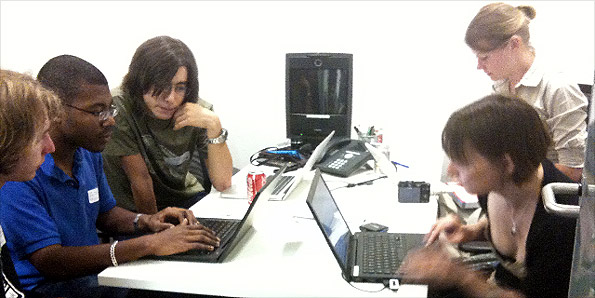
One group was seeking a way to scrape bus timetable information from the Transport For London website, another was trying to give learner drivers easier access to the DVLA's theory test questions, and in another corner an earnest gathering was looking at a flipchart with the heading "Mapping Prison Capacity", and talking about how you put together a Google heatmap.
At lunchtime, they mingled, discussed software, the rights and wrongs of file-sharing, how to get free access to Spotify's premium music streaming service - and how they'd found out about the event through a friend or some enthusiastic teacher. At one point, a girl rushed up to the group I was with and said "we got some data!" - the sheer enthusiasm about the task in hand was infectious.
Then on Sunday afternoon, they presented their ideas to a panel of government officials and web luminaries. Among the winners was that group trying to free up London bus data - TFHell won the "Most Likely to be Bought By Google" award. One of the judges, Ben Hammersley of Wired UK, said he "found the standard of the work produced by 15-18-year-olds in many cases infinitely superior to that produced by government professionals."
Now, you could put a negative spin on all this. On a lovely sunny weekend, dozens of teenagers spent all their waking hours indoors, staring at computer screens and "hacking" into government databases, while munching pizza. But that, like so much written about young people in Britain, is a parody. Meeting the Young Rewired State participants brightened up my weekend - and made me realise there's a generation now growing up determined to use their computing skills to make all of our lives better.
The BBC is not responsible for the content of external internet sites
This is dot.life - a blog about technology from BBC News.
Rory Cellan-Jones is the BBC's technology correspondent.
Maggie Shiels is the BBC's tech reporter based in Silicon Valley.
Archive
« January 2010
| Sun | Mon | Tue | Wed | Thu | Fri | Sat |
|---|---|---|---|---|---|---|
| 1 | 2 | |||||
| 3 | 4 | 5 | 6 | 7 | 8 | 9 |
| 10 | 11 | 12 | 13 | 14 | 15 | 16 |
| 17 | 18 | 19 | 20 | 21 | 22 | 23 |
| 24 | 25 | 26 | 27 | 28 |
Being Discussed Now
- Logging out... and straight back in(3)
- Gadgets of the Noughties(20)
- Plastic Logic's long journey to Vegas(21)
- Sexting teens(17)
- Wikipedia on the wane?(49)
- 'Cooling-off' for mobile phones? Not on the High Street(37)
- 2009 - the social year(36)
- Twitter, Iran and #uksnow(25)
- Broadband Britain - how far down the league?(55)
- Microsoft and Murdoch: Teaming up to bash Google?(34)
BBC Technology Headlines
- %28none%29
%28none%29 - %28none%29
%28none%29 - %28none%29
%28none%29
Visit the Technology index
Visit the BBC News website
Rory's TV/Radio reports
- Residents block Google car
Broadcast: 3 April 2009 - New adverts to tackle film piracy
Broadcast: 2 April 2009 - Call to scrap 'illegal databases'
Broadcast: 23 March 2009 - Female robot takes to the catwalk
Broadcast: 16 March 2009 - Super-charged battery breakthrough
Broadcast: 12 March 2009

- News Editors
- Sport Editors
- Journalism Labs
- BBC Internet Blog
- Radio 4 Blog
- Peston's Picks
- Nick Robinson's Newslog
- Stephanomics
- Mark Easton's UK
- Mark Mardell's America
- Nick Bryant's Australia
- Andrew Harding on Africa
- Gavin Hewitt's Europe
- Soutik Biswas' India
- dot.Rory
- Science: Jonathan Amos
- Richard Black on environment
- Today: Tom Feilden
- Fergus Walsh's medical files
- Newsnight: Paul Mason
- Newsnight: Mark Urban
- Torin Douglas
- Will Gompertz's arts
- Phil Coomes on photojournalism
- Magazine Monitor
- Mark D'Arcy in Westminster
- NI: Mark Devenport
- Scotland: Brian Taylor
- Scotland: Douglas Fraser
- Wales: Betsan Powys
- Martin Rosenbaum on FOI
- 5 Live Breakfast
- Newsnight
- PM programme (iPM)
- World Tonight: Robin Lustig
