


Mapping the Afghan elections
- 20 Aug 09, 13:16 GMT
Yesterday, my colleague Jonathan Fildes wrote a fascinating piece about the way text messages are being used to help monitor the presidential election in Afghanistan.
A project combining two technologies developed for use elsewhere in the developing world, Frontline SMS and Ushahidi, is enabling people in remote areas of the country to send in reports of incidents or vote-tampering so that they can be plotted on an online map.
I wasn't the only person interested - Jon received an e-mail last night from US Aid, the American government development agency, praising his piece and describing a similar project.
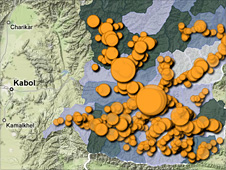 They've joined up with the likes of Google and GeoCommons to map all kinds of trends and data connected to the elections. So far, they've come up with a series of maps showing everything from polling station locations to levels of violence and opium poppy cultivation.
The project started as an initiative of MIT's Fablab - a department of the American university which describes its mission as exploring:
"[H]ow the content of information relates to its physical representation".
They set up a hard drive in a hotel bar in Jalalabad, where people could come and upload their data in return for a beer.
That data was then mapped for everyone to share. A Fablab team is now back in Afghanistan to collect and map more data, working with the Alive in Afghanistan project described in our article.
Using online mapping as a way of picturing what's happening during crises or elections is a growing trend, used already in countries like Angola, Kenya and India.
Maps have always been important - look at the history of cartography and you'll see what an effect it's had on politics and economics.
So it will be fascinating to see how the Afghan projects develop over the coming days - and whether they do add another perspective on the elections to that provided by traditional coverage.
Update, 09:20: US Aid have been in touch to say they mistakenly credited the wrong organisation with initiating the Afghan election mapping project. They say it wasn't MIT's FabLab but something called the Synergy Strike Force which first set the ball rolling.
And as for the beer for data offer in a Jalalabad hotel bar (comment 2), I too thought it sounded culturally unlikely. But, as you will see from comment 4 below, there is an explanation.
The watchphone: Gadget or gimmick?
- 20 Aug 09, 10:43 GMT
Whenever some shiny new plaything arrives on the scene, it's worth asking one question: is it a gadget or a gimmick?
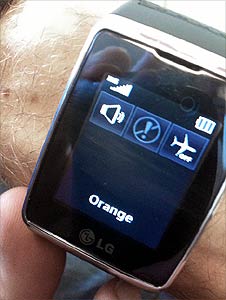 And when a nice man from Orange turned up in my office earlier this week, I quickly decided that what he was carrying was little more than a gimmick - albeit an expensive one.
What he'd brought with him was described as "the world's first touchscreen watchphone".
It's made by LG and Orange has the exclusive deal to sell it in the UK on a pay-as-you-go deal for a mere £500.
You can make calls just by tapping on the watchface - I found it pretty awkward - but it comes with a Bluetooth headset which does at least make it easier to receive calls.
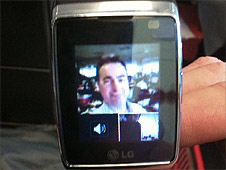
It's not really a smartphone - you can't, for instance, surf the web or navigate your way around town with it - but it does have video calling.
We tried it and I was reminded once again why this supposed "killer app" of 3G communications never took off.
You don't really want to stare at the person you're calling, unless you're sitting down at the computer for a long chat with someone far away.
Of course the video calling helps the watchphone achieve what must be its primary aim - to make the wearer feel like a rather retro action hero from a spy movie. James Bond? The Saint? Or maybe Austin Powers?
 The trouble is, that if you'd had one of these phones in the 1980s, you might well have been the object of wonder and admiration as you dialled up Mission Control from your wrist, or spoke to Miss Moneypenny.
But I can't help feeling that anyone seen staring at their chunky LG wristwatch as they make a call is more likely to be a figure of fun.
In short: a gimmick, not a gadget.
But just as I was explaining all this to the man from Orange - while he listened with a fixed smile - a colleague stepped in.
He was a cameraman, with a mild interest in gadgets, but a more pressing need to make his working life easier. "That's the future," he enthused. "I'm carrying all sorts of stuff with me, and just having the phone in a watch, rather than a separate piece of kit, would be a life-saver."
While he blanched at the price, he said he was sure that would come down, and that the watchphone would catch on.
So maybe I'm wrong. But I still think that, like the Sinclair C5, the internet-connected fridge and the Amstrad e-mailer, the watchphone will turn out to be a gimmick rather than the must-have gadget of 2010.
The BBC is not responsible for the content of external internet sites
This is dot.life - a blog about technology from BBC News.
Rory Cellan-Jones is the BBC's technology correspondent.
Maggie Shiels is the BBC's tech reporter based in Silicon Valley.
Archive
« January 2010
| Sun | Mon | Tue | Wed | Thu | Fri | Sat |
|---|---|---|---|---|---|---|
| 1 | 2 | |||||
| 3 | 4 | 5 | 6 | 7 | 8 | 9 |
| 10 | 11 | 12 | 13 | 14 | 15 | 16 |
| 17 | 18 | 19 | 20 | 21 | 22 | 23 |
| 24 | 25 | 26 | 27 | 28 |
Being Discussed Now
- Logging out... and straight back in(3)
- Gadgets of the Noughties(20)
- Plastic Logic's long journey to Vegas(21)
- Sexting teens(17)
- Wikipedia on the wane?(49)
- 'Cooling-off' for mobile phones? Not on the High Street(37)
- 2009 - the social year(36)
- Twitter, Iran and #uksnow(25)
- Broadband Britain - how far down the league?(55)
- Microsoft and Murdoch: Teaming up to bash Google?(34)
BBC Technology Headlines
- %28none%29
%28none%29 - %28none%29
%28none%29 - %28none%29
%28none%29
Visit the Technology index
Visit the BBC News website
Rory's TV/Radio reports
- Residents block Google car
Broadcast: 3 April 2009 - New adverts to tackle film piracy
Broadcast: 2 April 2009 - Call to scrap 'illegal databases'
Broadcast: 23 March 2009 - Female robot takes to the catwalk
Broadcast: 16 March 2009 - Super-charged battery breakthrough
Broadcast: 12 March 2009

- News Editors
- Sport Editors
- Journalism Labs
- BBC Internet Blog
- Radio 4 Blog
- Peston's Picks
- Nick Robinson's Newslog
- Stephanomics
- Mark Easton's UK
- Mark Mardell's America
- Nick Bryant's Australia
- Andrew Harding on Africa
- Gavin Hewitt's Europe
- Soutik Biswas' India
- dot.Rory
- Science: Jonathan Amos
- Richard Black on environment
- Today: Tom Feilden
- Fergus Walsh's medical files
- Newsnight: Paul Mason
- Newsnight: Mark Urban
- Torin Douglas
- Will Gompertz's arts
- Phil Coomes on photojournalism
- Magazine Monitor
- Mark D'Arcy in Westminster
- NI: Mark Devenport
- Scotland: Brian Taylor
- Scotland: Douglas Fraser
- Wales: Betsan Powys
- Martin Rosenbaum on FOI
- 5 Live Breakfast
- Newsnight
- PM programme (iPM)
- World Tonight: Robin Lustig
