


Whatever happened to public wi-fi?
- 19 Aug 09, 16:07 GMT
What's your biggest technology disappointment? For me, it's pervasive public wi-fi.
 Only a few years back a whole host of commercial and community schemes were underway in the UK and elsewhere which promised to blanket towns in free - or very cheap - wireless connectivity.
But as I wander round Britain or visit the United States - I rarely find wi-fi that is both easy to use and affordable.
I'm far more likely to get on the internet on the move using either a 3G phone, or a USB mobile broadband dongle (not cheap either - but easier) and given the soaring data traffic across mobile networks, I suspect that's the same for many people.
Municipal wi-fi, which attracted a lot of interest and investment in the early part of the decade, has proved something of a "bubble" phenomenon with many projects abandoned and others failing to deliver a return for their investors.
I put my view that public wi-fi has been a huge disappointment to Dave Hughes, director of Wireless Broadband at BT Retail.
He'd come on the phone to trumpet BT's announcement that it had now built half a million wi-fi hotspots across the UK, and to set a target of hitting a million by next February.
So naturally he disagreed with my diagnosis - he felt the wi-fi revolution was marching forward.
But eventually we found some common ground. He accepted that wi-fi in the open air had its limitations - and I agreed that in hotels, cafes and airports (when you can find it - it usually offers a much better connection than 3G).
Mind you, I've still not used a wi-fi connection indoors in the UK to make a voice over internet protocol (VoIP) phone call - one of the most attractive uses of the technology - whereas I have downloaded web pages using 3G, despite the cost.
So for now wi-fi appears to have retreated from the park and headed back indoors, to cafes and public buildings. But Mr Hughes at BT isn't giving up.
He says the technology is moving forward and the demand for mobile connectivity is growing exponentially. That's obviously true - the question is which technology will triumph.
It could be Wimax - although this "wi-fi on steroids" technology is doing better in the developing world than in places like the UK.
It looks more likely to be new flavour of mobile network, whether it's called 4G or LTE (Long Term Evolution). Users won't really care, as long as they can get online anywhere at a reasonable price.
But it matters for businesses which will want to offer customers a seamless broadband experience at home and on the move. Mobile operators - already offering broadband at home - will believe that they have the most complete wireless technology offering.
BT - which doesn't have its own mobile network - will be wondering whether it's wise to keep on betting on wi-fi as its solution.
The surfing day
- 19 Aug 09, 08:53 GMT
Those of us who contribute to this website are very happy if stuff we write gets posted first thing in the morning. Why? Because that, we believe, is when most people log on for a quick scan of what's new, and if an article pops up then we believe it has a good chance of building an audience as we approach our peak hour, around lunchtime.
But that may not be entirely true, according to an interesting blog post by Arbor Networks, which monitors internet traffic. They've set about comparing usage patterns in the US and Europe. They've found similarities - but also some striking differences.
Just as my colleagues and I surmised, it does look as though we start going to our computers at around seven in the morning - I have to confess to starting even earlier myself. But traffic carries on building through the day, and it appears to peak on both sides of the Atlantic at around dinnertime - 7pm. By the way, the graph below has brought the US and European timelines together, so 7 pm GMT is 7 pm EDT - or New York time.
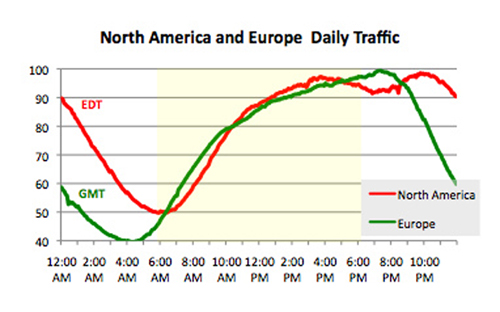
But here are the two big differences - according to this research at least. The Americans - whisper it not in London or Paris dining-rooms - are more proper and polite about surfing over dinner. There is a noticeable dip in US traffic between 6pm and 8pm, when Americans sit down to eat. Whereas in Europe, surfing doesn't tail off until around 8pm - but it then keeps on falling pretty sharply.
As Arbor points out, it appears that Europeans just don't use the internet much at night. While Americans seem to stay online into the small hours, with traffic still at 90% of its peak levels at midnight, it's down to 60% in Europe by then.
Mind you, as a number of commenters on the blog have pointed out, treating Europe as an amorphous mass may not be very useful. We dine at different times - it's hard to get dinner in Spain before 9pm - and we have differing levels of web access. So I'm not quite sure what the lesson is for those of us writing for the web. With a bit of luck this blog post will be posted around nine in the morning - so here's a question. Are you there? Hello? Don't tell me, you're updating your Twitter status.

Disappearing in the digital age
- 19 Aug 09, 08:02 GMT
The author Evan Ratliff has gone missing. Wired magazine has put a bounty of $5,000 (£3,030) on his head. Wannabe private eyes have less than 30 days to track him down to his lair and turn him in.
Mr Ratliff is truly testing the ability to just simply disappear in an age of 24/7 connectedness and digital clues that litter our lives.
It's an intriguing project that at its heart aims to find out "what does it take to up and disappear these days? Not to head off the grid for a few days, mind you, but to actually vanish from your life?"
In a piece Mr Ratliff has written for Wired he explained that one of his inspirations was a chap called Matthew Alan Sheppard who at 42 devised a plan to disappear from the lives of his wife of 10 years and his 7-year-old daughter.
On a weekend away with his family, he jumped into a river as his wife watched and simply seemed to vanish. All searchers found at the time was his orange hat.
But not everyone was convinced he was dead and as the story in Wired reveals, it is the simple things that result in the unravelling of this tale.
Now Mr Ratliff is testing out how easy, or difficult , it is to go on the lam and see how long he can remain hidden at a time when digital information collection, location-aware technology and post 9/11 security measures are everywhere. Or certainly seem to be.
As Mr Ratliff noted "where once you could move a few states over, adopt a new name and live on with minimal risk, today your trail is littered with digital breadcrumbs dropped by GPS-enabled cell phones, electronic bank transactions, IP addresses, airline ID checks, and, increasingly, the clues you voluntarily leave behind on social networking sites.
"It's almost easier to steal an identity than to shed your own," he noted.
To make the chase a little more interesting, Mr Ratliff is dropping digital clues here and there. The magazine is scooping all its intelligence together and revealing IP addresses and other titbits to help anyone trying to track down Mr Ratliff close in on their prey.
While he says that "going on the lam is not like it used to be" Mr Ratliff wants to find out what the Matthew Alan Shepards of the world can't tell us: "how hard is it really, to disappear?"
The hunt is on and only time will answer that question.
The BBC is not responsible for the content of external internet sites
This is dot.life - a blog about technology from BBC News.
Rory Cellan-Jones is the BBC's technology correspondent.
Maggie Shiels is the BBC's tech reporter based in Silicon Valley.
Archive
« January 2010
| Sun | Mon | Tue | Wed | Thu | Fri | Sat |
|---|---|---|---|---|---|---|
| 1 | 2 | |||||
| 3 | 4 | 5 | 6 | 7 | 8 | 9 |
| 10 | 11 | 12 | 13 | 14 | 15 | 16 |
| 17 | 18 | 19 | 20 | 21 | 22 | 23 |
| 24 | 25 | 26 | 27 | 28 |
Being Discussed Now
- Logging out... and straight back in(3)
- Gadgets of the Noughties(20)
- Plastic Logic's long journey to Vegas(21)
- Sexting teens(17)
- Wikipedia on the wane?(49)
- 'Cooling-off' for mobile phones? Not on the High Street(37)
- 2009 - the social year(36)
- Twitter, Iran and #uksnow(25)
- Broadband Britain - how far down the league?(55)
- Microsoft and Murdoch: Teaming up to bash Google?(34)
BBC Technology Headlines
- %28none%29
%28none%29 - %28none%29
%28none%29 - %28none%29
%28none%29
Visit the Technology index
Visit the BBC News website
Rory's TV/Radio reports
- Residents block Google car
Broadcast: 3 April 2009 - New adverts to tackle film piracy
Broadcast: 2 April 2009 - Call to scrap 'illegal databases'
Broadcast: 23 March 2009 - Female robot takes to the catwalk
Broadcast: 16 March 2009 - Super-charged battery breakthrough
Broadcast: 12 March 2009

- News Editors
- Sport Editors
- Journalism Labs
- BBC Internet Blog
- Radio 4 Blog
- Peston's Picks
- Nick Robinson's Newslog
- Stephanomics
- Mark Easton's UK
- Mark Mardell's America
- Nick Bryant's Australia
- Andrew Harding on Africa
- Gavin Hewitt's Europe
- Soutik Biswas' India
- dot.Rory
- Science: Jonathan Amos
- Richard Black on environment
- Today: Tom Feilden
- Fergus Walsh's medical files
- Newsnight: Paul Mason
- Newsnight: Mark Urban
- Torin Douglas
- Will Gompertz's arts
- Phil Coomes on photojournalism
- Magazine Monitor
- Mark D'Arcy in Westminster
- NI: Mark Devenport
- Scotland: Brian Taylor
- Scotland: Douglas Fraser
- Wales: Betsan Powys
- Martin Rosenbaum on FOI
- 5 Live Breakfast
- Newsnight
- PM programme (iPM)
- World Tonight: Robin Lustig
