


My Street View of shame...
- 19 Mar 09, 14:04 GMT
I'm at a conference today on the future of the media as we navigate the deepest recession any of us in this industry can remember - so as you can imagine the room is full of some very worried looking people. The most cheerful among them is the brand new boss of Google UK, Matt Brittin.
He's plenty of reasons to be happy. After all he has just taken over at what must be Britain's most powerful - or at least richest - media business, which overtook ITV as the biggest advertising earner last year. And despite the various concerns about Google's growing power which I outlined on this blog earlier this week, the business continues to churn out new products which draw an even bigger audience to its site.
Today's effort is Street View, the Google Maps add-on service which started in the US and now gives a street level view of 25 major cities in the UK.
It's one of those ideas that goes "viral" very quickly - I've been getting messages all morning from people who've been checking out what their house or street looks like - or at least how it appeared when Google's Street View cars combed their area last year.
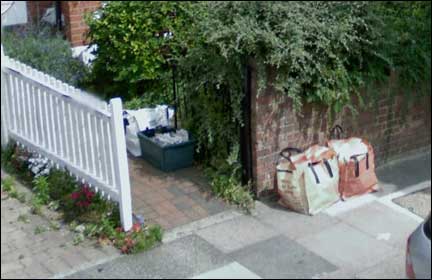
Finally, I couldn't resist having a go myself - and was somewhat dismayed to find that the folks from Google had dropped by on the very day I'd put the rubbish and recycling out, and just a couple of days before my herculean efforts to tidy the front garden.
Now this is all good fun but it also raises a couple of questions. Such as what does this mean for our privacy - and what does Google hope to achieve with street View?
Matt Brittin told the Changing Media conference that the whole privacy issue had been sorted, with the Information Commissioner giving his blessing to the project, and a big effort by Google to "blob" any faces or car number-plates caught by its cameras.
He also promised that anyone who is unhappy to have their home featured in Street View will be able to get in touch and have it removed.
Mind you, that raises the prospect of streets pockmarked with blurry gaps where homeowners have objected - surely that will only make them even more conspicuous?
I think the privacy row will die down - after all Street View has been introduced elsewhere without much bother - but then there'll be more questions about what exactly the product is for.
After the initial interest when we all check out our streets, the traffic will probably die down - have you used Google Earth much lately? But Google is hoping that its new product may be particularly attractive on mobile phones as a navigational tool.
And let's not forget that the whole search business is all about generating advertising revenue - so presumably the hunt will be on for ways to monetise Street View.
Location-based services - in other words advertising for products based on knowledge of where you are - are all the rage now.
Does that mean adverts will start appearing for my local garden centre next to the picture of my shabby front garden? I'd better have given it a trim by the time the cameras return.

Microsoft hopes to turbo charge IE
- 19 Mar 09, 08:39 GMT
A new version of Internet Explorer is always a major event in the browser wars.
 With each iteration Microsoft is striving to hold market share, play catch-up in the technical stakes, convince the doubters that IE is now safe and find something innovative to add to the mix.
While the Internet Explorer range of browsers dominate the market, the arrival of IE8 and the likely shift of many IE7 users to the new version, it will leave the landscape in a state of near equilibrium.
Arun Ranganathan, from Mozilla, said this week: "There is no real single majority browsing engine now."
We've certainly come a long way since the days when the browser wars was a struggle between Netscape and Internet Explorer; a fight that was always going to go Microsoft's way once IE was bundled with Windows.
That relationship between IE and Windows is called anti-competitive by some (Opera and Google), and essential by others, well, one other (Microsoft).
According to Net Applications, a company that monitors the browser types users are running when they are online, the IE family fell to 67.4% of the market lat month from 74.9% a year earlier.
Mozilla's Firefox jumped to 21.8% from 17.27%, and Apple's Safari rose to 8% from 5.7%.
Add into that mix Opera and Chrome and a number of specialised user browsers, such as Flock, and the landscape looks quite healthy in terms of users' choice.
But choice and choosing are not always the same thing: Opera and Google remain very unhappy that Microsoft is able to pipe new versions of IE to Windows users directly and have complained to the European Union.
Whenever a new version of IE comes out many people immediately compare it to Firefox, the second most popular browser in the online space.
Chris Wilson, Microsoft's chief architect for all things IE, told me this week that Internet Explorer remained the browser for the mainstream.
IE8 will not adopt the the deep configurability of Firefox, but it will start to add features related to what the mainstream user does when online.
Chief among them is the accelerator, which lets users highlight text on a page and automatically search for those terms on sites such as Facebook and eBay, or blog directly on Microsoft's services.
Microsoft is also putting an emphasis on speed, not least because Google Chrome and Safari 4 are much faster at rendering pages than IE7.
Chris Wilson told me: "One of the big focuses in IE8 is performance."
"We looked at pages people were looking at on the web, standard apps like Gmail, MSN and Live and did profiles.
"The experience we have is super fast. It's amazing how smooth and natural it feels when browsing with IE8."
Wilson wouldn't say directly that IE8 is faster than Chrome or Safari 4, but he did say that out of the top 25 websites in the world, IE8 was noticably faster at displaying about half of the sites.
For the other 12 or 13 there was little difference between the browsers, he said.
IE8 will need to be fast: the beta of Google Chrome 2 is apparently twice as fast as the previous iteration.
Microsoft will hope that IE8 will halt the slide in its browser market share, and more crucially will give businesses an incentive to upgrade; enterprise is much slower than consumers in moving to new browser versions.
The BBC is not responsible for the content of external internet sites
This is dot.life - a blog about technology from BBC News.
Rory Cellan-Jones is the BBC's technology correspondent.
Maggie Shiels is the BBC's tech reporter based in Silicon Valley.
Archive
« January 2010
| Sun | Mon | Tue | Wed | Thu | Fri | Sat |
|---|---|---|---|---|---|---|
| 1 | 2 | |||||
| 3 | 4 | 5 | 6 | 7 | 8 | 9 |
| 10 | 11 | 12 | 13 | 14 | 15 | 16 |
| 17 | 18 | 19 | 20 | 21 | 22 | 23 |
| 24 | 25 | 26 | 27 | 28 |
Being Discussed Now
- Logging out... and straight back in(3)
- Gadgets of the Noughties(20)
- Plastic Logic's long journey to Vegas(21)
- Sexting teens(17)
- Wikipedia on the wane?(49)
- 'Cooling-off' for mobile phones? Not on the High Street(37)
- 2009 - the social year(36)
- Twitter, Iran and #uksnow(25)
- Broadband Britain - how far down the league?(55)
- Microsoft and Murdoch: Teaming up to bash Google?(34)
BBC Technology Headlines
- %28none%29
%28none%29 - %28none%29
%28none%29 - %28none%29
%28none%29
Visit the Technology index
Visit the BBC News website
Rory's TV/Radio reports
- Residents block Google car
Broadcast: 3 April 2009 - New adverts to tackle film piracy
Broadcast: 2 April 2009 - Call to scrap 'illegal databases'
Broadcast: 23 March 2009 - Female robot takes to the catwalk
Broadcast: 16 March 2009 - Super-charged battery breakthrough
Broadcast: 12 March 2009

- News Editors
- Sport Editors
- Journalism Labs
- BBC Internet Blog
- Radio 4 Blog
- Peston's Picks
- Nick Robinson's Newslog
- Stephanomics
- Mark Easton's UK
- Mark Mardell's America
- Nick Bryant's Australia
- Andrew Harding on Africa
- Gavin Hewitt's Europe
- Soutik Biswas' India
- dot.Rory
- Science: Jonathan Amos
- Richard Black on environment
- Today: Tom Feilden
- Fergus Walsh's medical files
- Newsnight: Paul Mason
- Newsnight: Mark Urban
- Torin Douglas
- Will Gompertz's arts
- Phil Coomes on photojournalism
- Magazine Monitor
- Mark D'Arcy in Westminster
- NI: Mark Devenport
- Scotland: Brian Taylor
- Scotland: Douglas Fraser
- Wales: Betsan Powys
- Martin Rosenbaum on FOI
- 5 Live Breakfast
- Newsnight
- PM programme (iPM)
- World Tonight: Robin Lustig
