


Bletchley Park's social media war
- 18 Mar 09, 16:23 GMT
It's a collection of ramshackle buildings on the fringes of Milton Keynes.
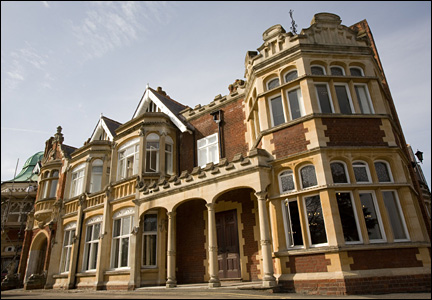
A bizarre choice then, you might think, for an architectural award. But Bletchley Park has just won the top prize in the Building With Pride awards, beating rivals such as Cardiff's Millennium Stadium and Liverpool's Cavern club in a poll to choose the building which inspires most pride in the British public.
That the World War II coding centre - and now National Museum of Computing - has been recognised in this way is largely due to the work of a few individuals who've been determined that this historic site should have a secure future.
I visited Bletchley Park last July to meet Dr Sue Black, a computer scientist who'd organised a letter to the Times appealing for a concerted effort to save the site.
In order to see this content you need to have both Javascript enabled and Flash installed. Visit BBC Webwise for full instructions. If you're reading via RSS, you'll need to visit the blog to access this content.
It was clear then that a lot needed doing. The main building, an undistinguished 19th Century house from which the wartime decoding operation was run, needed a new roof.
But what was really shocking was the state of the huts - prefab buildings where Alan Turing and thousands of others had gone about the business of decoding the messages produced by Germany's Enigma machine.
Many looked ready for nothing better than demolition, with tarpaulin covering the roof and holes in the walls. Even one hut that had been restored looked a makeshift effort, not really conveying its wartime character.
What's more, the exhibition dedicated to the history of British computing - including the Colossus machine which cracked wartime codes at the Park - was not displayed in any coherent fashion, despite the heroic efforts of the volunteers who've assembled the collection.
But Dr Black - and the small team that runs the Bletchley Park Trust - have made progress with their fundraising efforts. So far just under a million pounds has been donated to restoration work by the likes of Microsoft, IBM, and the Heritage Lottery Fund.
A vital component in this campaign has been what you might call the propaganda war - although one which has employed the most modern of weapons. Dr Black has assembled a significant crowd of supporters for Bletchley Park - geeks, history buffs, technologically literate celebrities - using all the modern social media tools.
There's a "Save Bletchley Park Group" on Facebook, a group on the photo-sharing site Flickr where images of the site can be viewed, and there's a lot of activity on Twitter.
Dr Black told me she realised in December that a critical mass of people she knew in the computing world were now on the micro-blogging site, and decided to set up an account (@bletchleypark) for Bletchley Park. It's acquired over 1,000 followers, but its influence has spread far wider, informing a tech-savvy crowd about developments at the site and used as a way of organising visits.
45% of the votes in the Building With Prides awards went to Bletchley Park, and it seems likely that many of them were mobilised by the various social media sites.
"We wouldn't have won without social media," Dr Black told me, "this kind of campaign wouldn't have been possible a few years back. It's power to the people."
Mind you, there's a long way to go before Bletchley Park looks like a fitting monument to the brilliant codebreakers who helped shorten the war - and to computing pioneers like Alan Turing and Tommy Flowers, the Post Office engineer who built Colossus. Let's see whether social media can continue to prove a potent weapon in the fundraising battle.

Does Dell covet Apple's design status?
- 18 Mar 09, 10:37 GMT
For many years Dell was regarded by some people as the anti-Apple firm.
The company was founded on the ethos of selling computers to as many companies and individuals as they could.
In order to see this content you need to have both Javascript enabled and Flash installed. Visit BBC Webwise for full instructions. If you're reading via RSS, you'll need to visit the blog to access this content.
Dell computers were grey, drab boxes that lacked soul, in as far as a computer can have a soul.
They served a highly utilitarian purpose: they delivered cheap computers to the masses and have helped drive down the cost of computing power, putting it into the hands of many millions of people.
But Dell became synonymous with dull.
Almost two years ago Dell endeavoured to turn that perception around - first by offering colours for many of its laptops and then partnering with artists to add designs to machines.
Its latest step is to launch a laptop, called the Adamo, whose sole purpose is to make people re-think their perceptions of Dell.
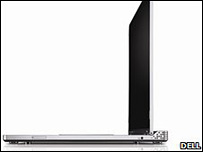 I spent an hour with the Adamo at South by SouthWest trying to find out if Dell indeed had managed to turn heads and shift expectations.
At first glance, the silver, or Pearl, Adamo looks not to dissimilar to the aluminium Macbook and MacBook Pro range of computers. Indeed both Dell and Apple are using a unibody design to make the machines out a single metal sheet.
The clean lines of the Macbook range, however, have given way to more stylised details.
A Dell staffer told me that the company had wanted to invoke that sense of personal ownership people have with special pieces of technology.
Everywhere you look on the machine there is detail, detail and more detail.
The ventilation grill at the back of the machine is not just a drilled piece of metal - it is a curved sheet in which the holes fade away.
The top of the machine is part glass and part metal that has been etched by laser to produce a geometric design.
The little support legs under the machine have been designed to within an inch of their lives.
There are none of the usual Windows and Intel stickers - a fact the Dell staffer was only to happy to point out. Instead they too are etched into the underside of the machine.
Some of the legal notices will be hidden under a removable panel, which was created purely so the legal notices could be hidden from view.
The laptop is described by Dell as the world's thinnest - but if you were to look at the MacBook Air and Adamo in profile, Apple's machine looks a lot thinner.
But that is largely to do with the stylised tapering of the MacBook Air, and in fact, the Dell staffer points out, the Adamo is thinner at its thickest point than the Air at its thickest point.
Certainly, the Air is lighter than the Adamo, no matter how you measure it. Although the Adamo feels a lot more durable than the Air.
It is hard not to think that Dell have tried to out-Apple, Apple. And in some regards they have succeeded.
But why is Dell releasing a $2,000 laptop at a time of recession?
I was told it was because people will always want fine cars and fine watches and that Adamo is no different.
It is a luxury laptop for the fashion conscious - as evidenced by the magazine photo shoot images that accompany the launch.
But what about its performance? Does that matter? After all a fine watch tells the time no better than a cheap quartz wristwatch.
The specs of the Adamo are probably the most underwhelming aspect of the machine.
It has a 1.2GHz Intel Core 2 Duo, 2GB of RAM, and a 128GB SSD hard drive. You won't be editing much video on this machine, and some might question the value the laptop offers under the hood.
People have made the same point about the MacBook Air - although it does have a faster processor and better integrated graphics and, crucially for road warriors, is a one pound lighter at three pounds.
My colleague, business editor Tim Weber, pointed out in Twitter: "Are the people dissing Dell's Adamo the same people who are drooling over Apple's similarly priced and under-specced Air?"
It's a fair point.
But the biggest question about the Adamo is not about its size, weight or performance. It is about why Dell is launching a $2,000 luxury machine at a time when the market is crying out for innovation in the netbook market.
Dell has a number of netbooks and the market is growing rapidly. I have not seen the latest figures on premium laptops but I suspect the growth is either slow, steady or stagnant.
Dell told me that they had "modest expectations" for sale of the Adamo.
I suspect that Dell don't really care about sales of the Adamo. This isn't a balance sheet exercise this is part of a long and careful campaign to re-educate people about Dell and to shift pre-conceptions.
Given the interest surrounding the Adamo launch, sneers of Macbook Air owners aide, I think Dell is making progress.
SXSW: That's all folks
- 18 Mar 09, 10:13 GMT
As the web developers move out and the musicians move in to Austin, sporting more facial hair, tattoos and piercing, South by SouthWest Interactive closes for another year.
Highlights
The small British firms at SXSW proved once again that innovation in the web does not start in San Francisco and end in Palo Alto.
The success of SixToStart in winning the Best in Show prize for We Tell Stories, beating the likes of Hulu, was the crowning moment for UK web success.
Co-founder Dan Hon told me how surprised they had been: "Someone was doing a video interview with us outside the ballroom and we were told to come back in by the ushers.
"We were standing right at the back of the room thinking of getting our bags or sitting back down. Suddenly they were announcing we were Best in Show and we were running up to the stage."
Quotes of SXSW
Anonymous web developer in the toilet: "I don't want Microsoft to embrace browser standards and work with the other browser firms. I want hackers to keep targeting Internet Explorer so I know I'll be safe on Firefox."
Opera chief technology officer Hakon Wium Lie: "Why does Internet Explorer have so many users when in the past it has been such a terrible browser. There are so many better options out there."
Lawrence Lessig: "We would never think of democracy as a tool to solve public problems.
We have that view because we have lost faith in our institutions."
Anonymous delegate: "You can tell which hotels people are staying at here by the smell of their body lotion."
Chris Wilson, head of the Internet Explorer platform: "Even my wife's computer got hacked earlier this year."
Spotted at SXSW
A senior Microsoft executive playing with his iPhone.
The Press Room was a picture of rolling tumbleweed and silent journalists, the blogger's lounge was the pre-party party.
In a straw poll about one in three phones on show were iPhones. Blackberry was the second most popular mobile phone.

Apple playing catch up?
- 18 Mar 09, 09:22 GMT
Without too much fanfare, Apple took the wraps off its next generation software for the iPhone and the iPod Touch at a fairly low key event at their campus in Cupertino.
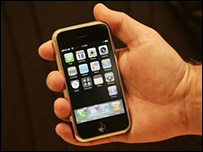 There was none of the mad jostling that has gone on at some of the company's other product launches. Though I do hate it when they make everyone wait outside like second class citizens. Still at least it was sunny and they did provide muffins and coffee.
At the end of the day there was no need to stop the presses and hold the front page with this announcement. I am not alone in thinking that. Ernest Doku of mobile phone news site Omio.com, e-mailed to say: "After the excitement surrounding Apple's last software update that brought us the groundbreaking App Store, this latest version seems to have a little less to set pulses racing."
Indeed it seemed to some degree like Apple playing catch up with the rest of the smartphone brigade by giving a lot of iPhone users functionality that is pretty standard on a lot of other smartphones.
The big headline is the ability to copy, cut and paste from one application to another. The other is multimedia messaging.
One missing piece from the puzzle for many users is the ability to record video or play video made using Adobe's Flash software.
At a question and answer session after the invitation only launch, Apple execs gave a "no comment" when pushed on the issue.
They were equally mum when I asked a question about a new iPhone. "Nothing to announce today", Apple's Phil Shiller told me.
I know I should know better because Apple never pre-announces anything, but I felt it would have been remiss to simply not ask the question. Afterwards Gartner Analyst Van Baker, who follows Apple, told me he reckons it will happen and it will happen in the summer around the same time as the software release.
Note of course that is when co-founder and CEO Steve Jobs is supposed to be back at the helm. And note also that since he went on sick leave, announcements out of Apple have so far been damp squibs. So they are going to need something that will wow when he gets back on deck.
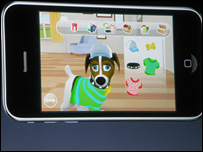 A host of developers also attended the launch to see what was in the SDK or software developers kit for them to help build their applications. In all Apple said there were some 1000 api's or software hooks for developers to use.
A few of the developers demonstrated some apps that they had produced after just two weeks of using the SDK Beta. ESPN showed how it can update games with scores while LifeScan, a Johnson & Johnson company, demonstrated how someone with diabetes could regulate their condition and track peaks and troughs.
Game developer Ngmoco demonstrated a virtual pet game where you can buy virtual clothes or toys and then veered to the other end of the spectrum with a first person shooter game where users could pay small sums of money to upgrade their gun. From hanging with fido to fragging it was one heck of a leap!
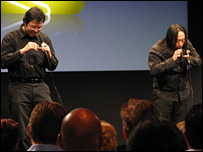 The most entertaining demo was from the Smule guys who create sonic media and are behind the phenomenally successful Ocarina app that has turned the iPhone into a musical instrument by blowing into it.
The app that company co-founder Ge Wang developed for this gig was called Leaf Trombone which allows users to play the iPhone like a trombone.
Their rendition of Phantom of the Opera rocked the event and got the loudest cheer of the day.
The BBC is not responsible for the content of external internet sites
This is dot.life - a blog about technology from BBC News.
Rory Cellan-Jones is the BBC's technology correspondent.
Maggie Shiels is the BBC's tech reporter based in Silicon Valley.
Archive
« January 2010
| Sun | Mon | Tue | Wed | Thu | Fri | Sat |
|---|---|---|---|---|---|---|
| 1 | 2 | |||||
| 3 | 4 | 5 | 6 | 7 | 8 | 9 |
| 10 | 11 | 12 | 13 | 14 | 15 | 16 |
| 17 | 18 | 19 | 20 | 21 | 22 | 23 |
| 24 | 25 | 26 | 27 | 28 |
Being Discussed Now
- Logging out... and straight back in(3)
- Gadgets of the Noughties(20)
- Plastic Logic's long journey to Vegas(21)
- Sexting teens(17)
- Wikipedia on the wane?(49)
- 'Cooling-off' for mobile phones? Not on the High Street(37)
- 2009 - the social year(36)
- Twitter, Iran and #uksnow(25)
- Broadband Britain - how far down the league?(55)
- Microsoft and Murdoch: Teaming up to bash Google?(34)
BBC Technology Headlines
- %28none%29
%28none%29 - %28none%29
%28none%29 - %28none%29
%28none%29
Visit the Technology index
Visit the BBC News website
Rory's TV/Radio reports
- Residents block Google car
Broadcast: 3 April 2009 - New adverts to tackle film piracy
Broadcast: 2 April 2009 - Call to scrap 'illegal databases'
Broadcast: 23 March 2009 - Female robot takes to the catwalk
Broadcast: 16 March 2009 - Super-charged battery breakthrough
Broadcast: 12 March 2009

- News Editors
- Sport Editors
- Journalism Labs
- BBC Internet Blog
- Radio 4 Blog
- Peston's Picks
- Nick Robinson's Newslog
- Stephanomics
- Mark Easton's UK
- Mark Mardell's America
- Nick Bryant's Australia
- Andrew Harding on Africa
- Gavin Hewitt's Europe
- Soutik Biswas' India
- dot.Rory
- Science: Jonathan Amos
- Richard Black on environment
- Today: Tom Feilden
- Fergus Walsh's medical files
- Newsnight: Paul Mason
- Newsnight: Mark Urban
- Torin Douglas
- Will Gompertz's arts
- Phil Coomes on photojournalism
- Magazine Monitor
- Mark D'Arcy in Westminster
- NI: Mark Devenport
- Scotland: Brian Taylor
- Scotland: Douglas Fraser
- Wales: Betsan Powys
- Martin Rosenbaum on FOI
- 5 Live Breakfast
- Newsnight
- PM programme (iPM)
- World Tonight: Robin Lustig
