


Hard times and gaming
- 23 Mar 09, 11:50 GMT
This week sees the start of the Game Developers Conference in San Francisco, the world's largest gathering of professional video game developers. Even though slightly fewer than 18,000 people are expected to attend, they will have one thing on their mind: the economy.
 There is no escaping the recession and the world of gaming has felt the effects as sharply as any other sector with layoffs and cutbacks. This year the conference is devoting several tracks to surviving in these tough economic times with titles like "Business in a Red Ocean," "Surviving the Squeeze" and "Raising Capital in a Recession."
Despite the doom and gloom background music, there will be a career pavilion where big names like Microsoft, Activision, Ubisoft and THQ will be setting up shop and recruiting. Those who can't make the conference can look on the website bulletin board to see what's on offer.
So what about the highlights at this years GDC? Well Nintendo's President Satoru Iwata will be giving the keynote speech on Wednesday, when the show and expo really gets under way.
There is lots of chatter that he will use the stage to make a big announcement and also talk about the DSi, the latest version of the company's successful Wii handheld DS, which has had phenomenal success.
I will be trying to speak to him one on one, so fingers crossed.
I will be schmoozing at the Independent Games Festival Awards, the Choice Awards and the Mobile Awards. Phew!
Among the industry people I will be talking to this week are Hal Haplin the founder of the video game industry's retail trade association the Entertainment Merchants Association. He will be talking to me about gamers rights and the issues that matter to gamers. If there is anything you would like me to put to him, just ask.
Joseph Olin, the President of the Academy of Interactive Arts and Sciences and I will chat about some of the industry trends and gaming sales figures.
Randy Stude of the PC Gaming Alliance will be talking about a new report on the state of the industry.
Let's not forget the games and the innovation. I will be looking at some games I can't talk about because of embargo rules, catching up with the guys behind Dragon Age, looking at facial animation, stereoscopic 3D and all things mobile.
I welcome any input and any insights and am more than happy to check out any particular favourites or wants. Just let me know.
I will also be twittering live from San Francisco and if you are interested you can find me at twitter.com/maggieshiels

Time for an audio revolution
- 23 Mar 09, 09:30 GMT
Here's a funny thing about working with digital media - it's an awful lot easier to play around with video than with audio.
If you're an amateur film-maker you'll almost certainly have a free video editing package on your computer - and once your masterpiece is complete, then YouTube and plenty of imitators make it very easy to get it hosted, and shared with the world.
And if you want to grab other people's video and embed it in your own blog, then the sharing sites usually offer you the code to copy and paste - and even we at the BBC are now allowing users to embed our video.
But if you want to make a podcast or simply put some audio online, that seems altogether harder. There is a free open source editing programme called Audacity - though it is pretty basic. And there are places where you can upload and share your music, your podcasts, or, in my case, your radio work with others. But it's fiddly and time-consuming, in complete contrast to the very user-friendly business of sharing video.
Now though a whole range of applications are suddenly arriving on the scene - so perhaps 2009 could be the year of audio?
I've started using a couple of audio hosting sites, Soundcloud and Mixcloud, the latter after it was mentioned by Darren Waters on this blog recently.
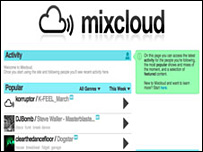 Right now, Mixcloud seems a bit less user-friendly - it won't for instance let you upload a single track (or radio package in my case), insisting that you have at least five tracks per upload. Its creators tell me they have plans to make it more useful for speech radio, but right now it seems to be aimed at aspiring DJ's, wanting to create their own radio shows.
Soundcloud is more intuitive, with an interface rather like YouTube's. As far as I can see, it's aimed mainly at the music industry, boasting that it "takes the daily hassle out of receiving, sending and distributing music for artists, record labels and other music professionals."
As an experiment, I've uploaded some of my old radio reports. Here, for instance, is a Today Programme piece about social networking from May 2007, where one of the presenters mentions "Faceback".
What was still missing was an application to broadcast live - or at least almost live - audio. Something like Qik, Flixwagon and Kyte, which allow mobile phone users to stream live video to the internet.
AudioBoo may be the answer. It's an application developed by a small company in London for Apple's iPhone. The idea is that you record anything you fancy on the phone, then press "publish" and it's uploaded into the "cloud", that is to AudioBoo's website.
I used it at the Millennium Stadium on Saturday to record and share the crowd singing the Welsh national anthem before the Wales v Ireland clash. If you link your AudioBoo account to Twitter or Facebook, your friends get a notification and can click and play your "boo" - as the fragments of audio are called.
It's quite crude right now - you can't edit the audio or store it locally on the phone. And you can't upload other audio material you may have stored on your computer. But when I got in touch with Mark Rock, the man behind AudioBoo, he explained that it was very much a work in progress. "The plan is to make it available on any device that can record audio and connect to the internet." So it should appear on other phones.
You may eventually be able to upload existing audio files - though that will mean a lot of wrestling with copyright issues of the kind that have dogged YouTube.
What is less clear is quite what AudioBoo is for. Mr Rock thinks it may be used by podcasters and ultra local journalists - he said one citizen journalist had used it to report from outside council meetings - but saw a whole new category of web activity being created: "It's what I call 'social audio' - capturing the sound of your world and then sharing it with the world."
But he freely admits that he isn't really sure what it is all about. There again, the founders of YouTube didn't have big plans - they just wanted an easy way to share videos amongst their friends.
So SoundCloud and AudioBoo may herald a new audio revolution online, with a wave of new applications following in their wake. Or we may find that the reason that video, not audio, has been faster to take off online is that a picture is worth a thousand sounds.
Flipping burgers or writing code?
- 23 Mar 09, 08:29 GMT
For students the world over, summertime marks the end of exams and a few months away from the books, tutorials, and professors. Harsh reality though soon comes knocking in the shape of economic reality and it also usually means, for most, the need to find a summer job.
 Instead of flipping burgers or washing dishes, Google is offering an alternative to the student geek by way of a programme called Summer of Code. Yes it does seem to revive memories of Summer of Love but by the sounds of it , it couldn't be further removed from such a scenario. For one thing, Google's Summer of Code involves work, dedication and commitment. Their words, not mine.
This year the programme, which is now in its fifth year, will match 1,000 students from 98 countries to 150 open source projects. The projects include lots of familiar names like Blender, MySQL, Apache, the Berkman Centre at Harvard, Creative Commons, the Electronic Frontier Foundation, the Linux Foundation, Mozilla, OpenMRS, Sahana and even Google. Well they are ponying up the $5m to fund this programme.
Each of these companies or projects will mentor the students throughout the whole of the summer giving them the chance to be exposed to real world problems.
"In a typical university project, students are likely working with a team of three or four in a lab on a project which they turn in and get a grade for," said Leslie Hawthorn who is the programme manager for open source at Google.
"What this programme offers is real world experience working with a team of developers who might be in say San Francisco and London and Beijing and Sydney all at the same time.
"They will be working on a project that doesn't just end in three months time because the software has to be maintained for years and years. Considerations of how to build it are very different from university and their exposure to the tools and the expertise represents a great opportunity to those taking part," said Ms Hawthorn.
She told me that the reason Google started the project was because co-founder Larry Page wanted to help students hone their skills and boost the open source community.
"He was worried about the age-old problem of students leaving on their summer holidays and more often than not finding it hard to get a job in their particular technical area of computer science.
"Some might go and wash dishes or flip burgers and Larry thought that overall computer discipline would backslide because these students weren't getting continuous reinforcement to perfect their skills during the holidays," explained Ms Hawthorn.
She said he hit on the idea of open source projects as an ideal way to corral students because it doesn't matter where they live as most of the work takes place online and it would be an "awesome" way for students to get real software development experience.
The Summer of Code is more or less full time work, though Ms Hawthorn stressed that it wasn't about the number of hours someones clocks up but about getting the work done.
The tasks will be set by the mentors who will monitor progress. Everyone will get an initial payment of $500 and halfway through another $2000 if they come up to scratch with a final installment of $2000 at the end if they complete the work satisfactorily.
"And don't forget the all important t-shirt", quipped Ms Hawthorn.
Michael Tieman who is the president of the Open Source Initiative told me he thinks the programme is a "fantastic idea" not least because his open source company Red Hat benefits through a project they run called the Blender Foundation.
"It's a 3D animation and modeling programme and we have benefitted tremendously over the years through Summer of Code which has given us people, resources and have helped keep Blender at the cutting edge."
Mr Tieman also said "I used to be one of those kids doing irrelevant summer jobs because I needed the money so the amount of money Google is giving is not some token amount. This is a serious bounty for serious work which will look great on any resume."
So what's in it for Google? Ms Hawthorn said "Google gets the same benefit as the rest of the world. All this great open source code is being produced and anyone can make use of it.
"There is also the beauty of the social ties that are formed during this project and that benefits Google and the world over if all these people are talking to one another and exchanging ideas and pushing forward the world of computer science and open source.
"Ultimately with Google being such a big user of open source, what's good for open source and for the web is good for Google and everyone else," stated Ms Hawthorne.
Application details are here, and Michael Sparks blogs about BBC Research's involvement in Summer Of Code here.
The BBC is not responsible for the content of external internet sites
This is dot.life - a blog about technology from BBC News.
Rory Cellan-Jones is the BBC's technology correspondent.
Maggie Shiels is the BBC's tech reporter based in Silicon Valley.
Archive
« January 2010
| Sun | Mon | Tue | Wed | Thu | Fri | Sat |
|---|---|---|---|---|---|---|
| 1 | 2 | |||||
| 3 | 4 | 5 | 6 | 7 | 8 | 9 |
| 10 | 11 | 12 | 13 | 14 | 15 | 16 |
| 17 | 18 | 19 | 20 | 21 | 22 | 23 |
| 24 | 25 | 26 | 27 | 28 |
Being Discussed Now
- Logging out... and straight back in(3)
- Gadgets of the Noughties(20)
- Plastic Logic's long journey to Vegas(21)
- Sexting teens(17)
- Wikipedia on the wane?(49)
- 'Cooling-off' for mobile phones? Not on the High Street(37)
- 2009 - the social year(36)
- Twitter, Iran and #uksnow(25)
- Broadband Britain - how far down the league?(55)
- Microsoft and Murdoch: Teaming up to bash Google?(34)
BBC Technology Headlines
- %28none%29
%28none%29 - %28none%29
%28none%29 - %28none%29
%28none%29
Visit the Technology index
Visit the BBC News website
Rory's TV/Radio reports
- Residents block Google car
Broadcast: 3 April 2009 - New adverts to tackle film piracy
Broadcast: 2 April 2009 - Call to scrap 'illegal databases'
Broadcast: 23 March 2009 - Female robot takes to the catwalk
Broadcast: 16 March 2009 - Super-charged battery breakthrough
Broadcast: 12 March 2009

- News Editors
- Sport Editors
- Journalism Labs
- BBC Internet Blog
- Radio 4 Blog
- Peston's Picks
- Nick Robinson's Newslog
- Stephanomics
- Mark Easton's UK
- Mark Mardell's America
- Nick Bryant's Australia
- Andrew Harding on Africa
- Gavin Hewitt's Europe
- Soutik Biswas' India
- dot.Rory
- Science: Jonathan Amos
- Richard Black on environment
- Today: Tom Feilden
- Fergus Walsh's medical files
- Newsnight: Paul Mason
- Newsnight: Mark Urban
- Torin Douglas
- Will Gompertz's arts
- Phil Coomes on photojournalism
- Magazine Monitor
- Mark D'Arcy in Westminster
- NI: Mark Devenport
- Scotland: Brian Taylor
- Scotland: Douglas Fraser
- Wales: Betsan Powys
- Martin Rosenbaum on FOI
- 5 Live Breakfast
- Newsnight
- PM programme (iPM)
- World Tonight: Robin Lustig
