


Palm and HTC hope to do magic
- 17 Feb 09, 16:29 GMT
I've seen two new phones in Barcelona today, and they're both devices on which an awful lot hangs. One may make Google's Android operating system go mainstream, the other could determine whether Palm, one of the pioneers of the PDA, survives into the converged future.
First the G2 - whoops, it's not called that. While the first Android phone, T-Mobile's G1, was heavily branded with the Google name, this time both Vodafone and the Taiwanese manufacturer HTC (also behind the G1) are determined to get their names out there.
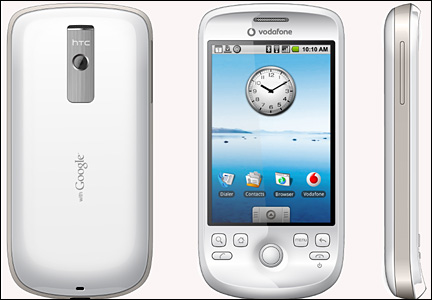
So this is the HTC Magic and at first glance, it is just a slightly more elegant version of the G1. What is different is that there is no slide-out keyboard - this time you are entirely dependent on the touchscreen interface, except for a little clutch of buttons at the bottom of the screen.
I only had time for a quick play, but the screen seems pretty responsive and the on-screen keyboard no more of a pain to use than the one on Apple's iPhone. There is a 3MP camera, without a flash, and it's clearly not going to be the phone for someone intent on giving up their digital camera.
But what matters is the software, and the possibilities that the Android platform opens up for developers. As with the G1, it is easy to find your way around the phone, surf the web, and launch applications - I noticed the one I used had apps for Facebook and last.fm.
HTC's Chief Executive Peter Chou and Patrick Chomet of Vodafone performed a double act at the press conference, and while there was some mention of features like Google Streetview, their key message was that this was a simple phone aimed not at the geeks and early adopters but a wider public.
Incidentally, one rather cross correspondent to this blog has commented that we have failed to differentiate between smartphones and the mass market. Well I think the boundary is increasingly blurred. A couple of years ago any phone that could do e-mail was considered "smart", now any handset that can't looks pretty dumb. Now Vodafone wants to convince a broad range of its customers that they need a phone which is, in effect a mini-computer.
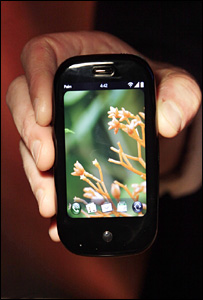 Those consumers will also be able to choose a phone made by the company that set the standard for PDAs and early smartphones, then watched as others came along and took the market away. At least they will once Palm's new Pre makes it to Europe, after its American launch in the first half of this year.
The Pre was actually unveiled a few weeks ago but this was my first chance to get my hands on a device that's received rave reviews from the bloggers. Mind you, there was some nervousness on Palm's part about my fat fingers actually touching their sacred object - the company told me that it would rather I let a demonstrator show me round.
But I did get to hold it for a few seconds - long enough to find out that it is both lighter and smaller than you-know-what. Yes the inevitable comparison will be with the iPhone and this does look a worthy competitor.
The touchscreen is if anything even better than that on the iPhone or the HTC Magic - and there's a keyboard just about big enough to be useful without making the device clunky. The Pre also has some of the missing links that are annoying about the iPhone - proper bluetooth, cut and paste, easy switching between applications. What it shares with the Apple device is an under-powered camera - just 3MP again - and a lack of video capture, though that may come. It should eventually have Flash too, following an agreement with Adobe. That means you will be able to play video in a browser window, something you can't do on the iPhone.
So two phones from companies that really need them to be hits for different reasons. Vodafone has failed to hitch its name to any stand-out product lately - the Blackberry Storm has been more of a squall. And for Palm the stakes are much higher - it has developed a whole new operating system for the Pre and if the phone doesn't win plenty of fans, then its makers might not be around in a few years' time.

Speed Diary: Day One
- 17 Feb 09, 15:10 GMT
I am one of the fortunate; a member of the broadband elite.
Last week I had a Virgin 50Mbps broadband connection installed and the goal is to put it to the test over the next week or so and explore the limits of the online fast lane.
Yesterday I described my set-up experiences but I wanted to focus Day One proper on raw speeds, and putting the connection through an obstacle course of downloads and uploads.
The first place to start is with some formal speed tests. Virgin's own website says that just one third-party site is equipped to deal with its XXL connection, Thinkbroadband.com.
I also had a link to an internal Virgin speed test site.
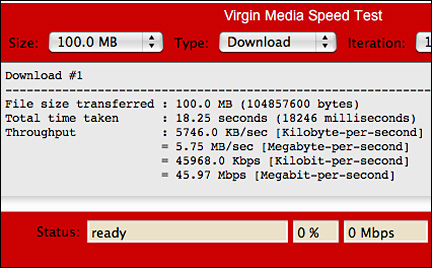
I tested the connection on both a wired and wireless configuration. (For those who want to know: an 802.11n router with WPA2 encryption)
Wired
Thinkbroadband put my download speeds at 37Mbps downstream and 1.5Mbps upstream.
The Virgin test put my speed at 46Mbps down and 1.5Mbps.
So why the variation? Andrew Ferguson, from Thinkbroadband.com, told me it was to be expected. The Virgin test had "less network" in the way between my connection and its own test.
Wireless
Both Thinkbroadband.com and Virgin put my download at about 35Mbps and upload at 1Mbps.
If you are seeking absolute speed then an Ethernet connection, always beats wi-fi - even the 802.11n standard. But even so, my contact at Virgin felt I should be seeing faster speeds over the wireless connection. I'll be keeping an eye on this speed over the week.
But there are plenty of other reasons why you won't always see the advertised speeds - even if you are on a wired connection.
The age of your computer, interference from other devices, bandwidth saturation on wi-fi can all have an effect.
So what about some real world tests? How would the connection perform under a heavy load?
The first thing I tried was a straight single download of a large file - in this case, the Linux distribution (an open source operating system) Ubuntu. This is a large file of almost 700MB and I got speeds of up to 5.4MB per second during the download and it landed on my desktop in about four minutes.
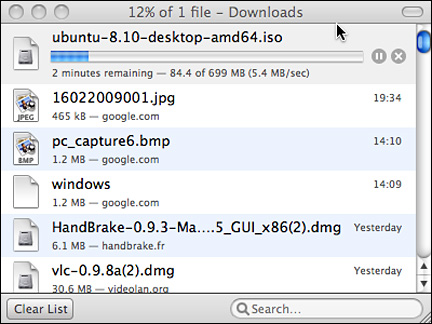
One of the best ways to test your download is to simultaneously download a series of large files and then add up all the downstream speeds. I downloaded five large game demo files and each one was flying down the pipe at more than 1MB per second.
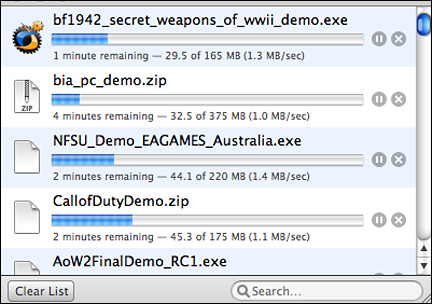
These two tests would seem to indicate that I was hitting very close to the advertised 50Mbps.
It's not that often I download a large program file but I do download and stream quite a bit of video. So how would the connection cope with HD video?
I picked a HD version of 30 Rock to download - in all, about 750MB of comedy heaven. I went from click to buy to click to play and Tina Fey in HD quality in under six minutes.
HD trailers streamed in 720p from the Apple movies website were ready to start watching in about 15 seconds, while a 720p HD download of a game trailer from Xbox Live took 50 seconds to download the 108MB file.
But what about the neglected sibling of broadband speed: upstream?
The tests would seem to suggest I have between 1Mbps and 1.5Mbps - but what does this mean in the real world?
I'll be testing these upload speeds with some online gaming later in the week - and inviting you all to come and join me in a game of Call of Duty 4 or Halo 3 - but I started with a simple test.
I uploaded five high quality Jpegs - about 17MB in all - to Flickr and the process took 90 seconds to complete.
So that's Day One of testing. I welcome your thoughts and questions. You can follow some more of my tests and experiences on my Twitter feed @darrenwaters. I'll be sharing my gamertag with people on the Twitter feed later in the week.
The BBC is not responsible for the content of external internet sites
This is dot.life - a blog about technology from BBC News.
Rory Cellan-Jones is the BBC's technology correspondent.
Maggie Shiels is the BBC's tech reporter based in Silicon Valley.
Archive
« January 2010
| Sun | Mon | Tue | Wed | Thu | Fri | Sat |
|---|---|---|---|---|---|---|
| 1 | 2 | |||||
| 3 | 4 | 5 | 6 | 7 | 8 | 9 |
| 10 | 11 | 12 | 13 | 14 | 15 | 16 |
| 17 | 18 | 19 | 20 | 21 | 22 | 23 |
| 24 | 25 | 26 | 27 | 28 |
Being Discussed Now
- Logging out... and straight back in(3)
- Gadgets of the Noughties(20)
- Plastic Logic's long journey to Vegas(21)
- Sexting teens(17)
- Wikipedia on the wane?(49)
- 'Cooling-off' for mobile phones? Not on the High Street(37)
- 2009 - the social year(36)
- Twitter, Iran and #uksnow(25)
- Broadband Britain - how far down the league?(55)
- Microsoft and Murdoch: Teaming up to bash Google?(34)
BBC Technology Headlines
- %28none%29
%28none%29 - %28none%29
%28none%29 - %28none%29
%28none%29
Visit the Technology index
Visit the BBC News website
Rory's TV/Radio reports
- Residents block Google car
Broadcast: 3 April 2009 - New adverts to tackle film piracy
Broadcast: 2 April 2009 - Call to scrap 'illegal databases'
Broadcast: 23 March 2009 - Female robot takes to the catwalk
Broadcast: 16 March 2009 - Super-charged battery breakthrough
Broadcast: 12 March 2009

- News Editors
- Sport Editors
- Journalism Labs
- BBC Internet Blog
- Radio 4 Blog
- Peston's Picks
- Nick Robinson's Newslog
- Stephanomics
- Mark Easton's UK
- Mark Mardell's America
- Nick Bryant's Australia
- Andrew Harding on Africa
- Gavin Hewitt's Europe
- Soutik Biswas' India
- dot.Rory
- Science: Jonathan Amos
- Richard Black on environment
- Today: Tom Feilden
- Fergus Walsh's medical files
- Newsnight: Paul Mason
- Newsnight: Mark Urban
- Torin Douglas
- Will Gompertz's arts
- Phil Coomes on photojournalism
- Magazine Monitor
- Mark D'Arcy in Westminster
- NI: Mark Devenport
- Scotland: Brian Taylor
- Scotland: Douglas Fraser
- Wales: Betsan Powys
- Martin Rosenbaum on FOI
- 5 Live Breakfast
- Newsnight
- PM programme (iPM)
- World Tonight: Robin Lustig
