


Speed Diary: Day Two
- 18 Feb 09, 12:31 GMT
"What do we need a 50Mbps broadband connection for?" was the first question asked of me when I had the fast broadband pipe installed in my house.
It's a valid question. With most people in the UK enjoying 3.6Mbps speeds and services like iPlayer, Spotify, Last.fm, Flickr, Xbox Live and PlayStation network working happily for many people, do we need such speeds?
But it's clear that our appetite for on demand content and the ways in which we are getting hold of our content is changing rapidly.
More than 60% of households in the UK now have a broadband connection, and almost one in five people with an internet connection now watch TV programmes online.
In 2008 there were 271 million requests to watch content on the BBC iPlayer. And more than 14.5 million people in the UK now listen to radio online.
At the moment a BBC iPlayer high-quality stream is delivered at 800kbps, which means the average broadband connection in the UK should have no problem streaming the video.
But in the future the BBC will deliver iPlayer streams in HD, and with more and more devices in the home capable of delivering video and rich web applications, more and more burden is being put on our broadband connections.
I may not have the typical home but with two laptops, a desktop, three internet-enabled games consoles, a Slingbox, an iPhone and a PSP there is plenty of competition for bandwidth in my house.
We may not use all of the devices all of the time - think of the electricity bill - but it's not uncommon for two of the laptops to be surfing the net while my desktop is downloading video files.
In an effort to test the bandwidth of my 50Mbps connection I performed some real world tests, which were about the experience, not any particular downstream or upstream speed.
As Forrester analyst Ian Fogg pointed out to me, "the only speed that matters is subjective".
In that spirit, watching iPlayer on the highest quality option on two laptops proved to be a very positive experience - no buffering or stutters.
Throw in a couple of background downloads of large files and the streaming continued unaffected. But add a third iPlayer stream on a third machine and at this point the stutters started and the viewing experience became intolerable.
All of this was done via wi-fi on a router that supports the fastest connections, 802.11n, and one could question just how often a household would be streaming three different TV programmes and downloading two 500MB+ files.
But projects like Canvas point to a time in the not too distant future when such tasks will become the norm rather than a rarity.
I also tested using the iPlayer in conjunction with some online gaming on Xbox Live and my wife was perfectly able to catch up on TV, while I shot some gamers on Call of Duty 4.
As commenters on this blog have pointed out, online gaming is more about latency than upload and download speeds but the fact we could share the broadband comfortably was a pleasant change from my experiences on the ADSL connection.
So what other real world, empirical observations do I have about the connection?
1. The faster your broadband connection the more irritating it is when a web page doesn't immediately snap onto the browser
2. Accessing the web over wi-fi on a portable device like an iPhone or PSP with a 50Mbps connection seems no different to using my ADSL 6Mbps connection
3. Speed Tests are useful but no replacement for the actual experience in using a connection
Tonight I'm going to be testing my "hosting" capabilities in online gaming so if you fancy taking part in some real world experiments then add me as a friend on Xbox Live. My gamertag is UNBELIEVER, which, yes, I know is a shocking name.
I'll probably play a mix of Halo 3, Call of Duty 4 and Gears of War 2 - so if you want to party up, feel free to add my gamertag. I'll be online from 2100GMT.
UPDATE I'm afraid I have to postpone the online gaming sesssion tonight. Small family illness!

Mobile Spanish lessons
- 18 Feb 09, 10:33 GMT
A couple of days at the Mobile World Congress have passed in a blur of new handsets and over-excited press releases, but I've learnt a few things.
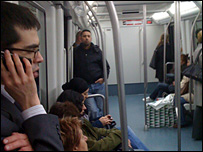 I now know, for instance, that Barcelona is a city where you can still smoke in the bars and you can make mobile calls from the Metro - a place somewhere between the past and the future then. But I've also learnt a few things about the mobile industry.
It's about the networks
I guess we're all going to have to get our heads round LTE, Wimax and 4g, because the big news over the next few years is going to be about that boring back-end stuff that phone customers don't care about. The jargon probably doesn't matter to mobile internet users either but their experience is about to get a lot better.
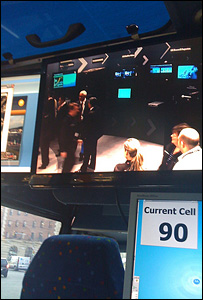 Mobile networks are getting faster. I've been using a 3g dongle here delivering a reliable 2Mbps, but a trip around the city in an LTE-enabled van, watching high definition television beamed over the network, showed me a whole new world.
Now we've learned to be sceptical about promises of technological advances from the mobile industry - a decade after its arrival 3g is only now making a real impact - but I do expect that in a couple of years I'll be surfing much faster on the move than I do currently at home.
VOIP isn't rocking the mobile world
The idea of free calls over the internet - or Voice over IP in the jargon - has been all the rage for years now, threatening to rock the fixed-line telecoms industry and now the mobile world.
At the show, Nokia announced a plan to put Skype on new handsets, and 3 has had some success in the UK with its Skype phone. But I'm sceptical about this, having tried out a couple of VOIP apps on my phone.
Fring and Truphone both look good - but only really work when you're on wifi. Getting a solid wifi connection is still a struggle outside - I've got one in my hotel room, but I've also got a laptop which is far better suited to making calls.
Truphone has an option called "Truphone Anywhere" for use away from wifi, but when I slowly cranked it into action, up popped a warning that it would not save me money when calling from abroad. Fully integrated Skype on a mobile may be a different proposition - but how happy are operators going to be with Nokia's plan? I wouldn't mind betting that those "free" calls on an N97 will turn out to be rather hard to make.
Mobile kills the digital camera?
The idea that we will have one converged device that will do everything has been over-hyped - but surely the time is coming when we can forget about carrying both a simple digital camera and a phone?
This week Sony Ericsson launched a 12Mp phone, and 5Mp seems to be just about standard - with a decent lens and flash that should be enough for most people. Keen photographers will want a digital SLR - but the days of the standalone compact camera may be numbered.
Where is the power?
The single most eye-catching announcement out of Barcelona was the plan unveiled by the GSM Association for what it called a Universal Charging Solution - or what you and I might call one damn power adapter that will charge any mobile phone.
Having travelled here laden with three phones and three different adapters, I can't wait. But why is it taking so long. When it comes to software the industry is already delivering cross-platform applications to customers - but they'll have to wait until 2012 for the universal charger, and don't bet on it arriving then.
Facebook still showing growing pains
- 18 Feb 09, 09:45 GMT
So Mark Zuckerberg, the founder and boss of Facebook, has had to learn the hard way that a social network is nothing like e-mail.
 In his original attempt to defuse a growing row over changes to its terms of service, Zuckerberg had tried to explain the decision to hold on to people's data, even if they quit the social network, by likening it to e-mail.
He said: "When a person shares something like a message with a friend, two copies of that information are created - one in the person's sent messages box and the other in their friend's inbox. Even if the person deactivates their account, their friend still has a copy of that message. We think this is the right way for Facebook to work, and it is consistent with how other services like e-mail work. One of the reasons we updated our terms was to make this more clear."
But users clearly have different expectations about their data when it comes to e-mail.
Users have come to accept and understand that e-mail takes on a persistent state when it leaves an outbox and flies across mail servers to reach the intended recipient.
On countless occasions retrieved e-mails have helped expose fraud or duplicity. And that's because e-mail is copied and copied again as it makes its journey to the intended recipient.
On a social network, users have a different notion of ownership of information. By signing up to a walled garden like Facebook, it is only natural perhaps that people feel the data that is stored on the social network remains their property.
From comments, to videos, photos and applications - this data remains sealed inside the Facebook garden regardless of whether it is sitting on a friend's Wall, or is a photo that can only be seen by members of a specific Facebook Group.
Unlike the web in general, where the spiders of search engines never sleep and crawl our data on public sites 24/7, making it available to all, Facebook is a private members club, in which each member decides who can and who cannot see or share their information.
What's so surprising about this row is perhaps how naive Facebook would appear to have been.
After all, users have long complained about how difficult it is to actually delete their accounts on the social network.
And terms of service for sites in general have always been a contentious issue. From Twitter rows to Google Chrome complaints and global data privacy debates, web firms have been wrangling with these issues for years.
And by flip-flopping between defending the new terms of service and reverting back to the old agreement while encouraging user feedback, Facebook is clearly one of many companies that have yet to fully resolve these issues.
The BBC is not responsible for the content of external internet sites
This is dot.life - a blog about technology from BBC News.
Rory Cellan-Jones is the BBC's technology correspondent.
Maggie Shiels is the BBC's tech reporter based in Silicon Valley.
Archive
« January 2010
| Sun | Mon | Tue | Wed | Thu | Fri | Sat |
|---|---|---|---|---|---|---|
| 1 | 2 | |||||
| 3 | 4 | 5 | 6 | 7 | 8 | 9 |
| 10 | 11 | 12 | 13 | 14 | 15 | 16 |
| 17 | 18 | 19 | 20 | 21 | 22 | 23 |
| 24 | 25 | 26 | 27 | 28 |
Being Discussed Now
- Logging out... and straight back in(3)
- Gadgets of the Noughties(20)
- Plastic Logic's long journey to Vegas(21)
- Sexting teens(17)
- Wikipedia on the wane?(49)
- 'Cooling-off' for mobile phones? Not on the High Street(37)
- 2009 - the social year(36)
- Twitter, Iran and #uksnow(25)
- Broadband Britain - how far down the league?(55)
- Microsoft and Murdoch: Teaming up to bash Google?(34)
BBC Technology Headlines
- %28none%29
%28none%29 - %28none%29
%28none%29 - %28none%29
%28none%29
Visit the Technology index
Visit the BBC News website
Rory's TV/Radio reports
- Residents block Google car
Broadcast: 3 April 2009 - New adverts to tackle film piracy
Broadcast: 2 April 2009 - Call to scrap 'illegal databases'
Broadcast: 23 March 2009 - Female robot takes to the catwalk
Broadcast: 16 March 2009 - Super-charged battery breakthrough
Broadcast: 12 March 2009

- News Editors
- Sport Editors
- Journalism Labs
- BBC Internet Blog
- Radio 4 Blog
- Peston's Picks
- Nick Robinson's Newslog
- Stephanomics
- Mark Easton's UK
- Mark Mardell's America
- Nick Bryant's Australia
- Andrew Harding on Africa
- Gavin Hewitt's Europe
- Soutik Biswas' India
- dot.Rory
- Science: Jonathan Amos
- Richard Black on environment
- Today: Tom Feilden
- Fergus Walsh's medical files
- Newsnight: Paul Mason
- Newsnight: Mark Urban
- Torin Douglas
- Will Gompertz's arts
- Phil Coomes on photojournalism
- Magazine Monitor
- Mark D'Arcy in Westminster
- NI: Mark Devenport
- Scotland: Brian Taylor
- Scotland: Douglas Fraser
- Wales: Betsan Powys
- Martin Rosenbaum on FOI
- 5 Live Breakfast
- Newsnight
- PM programme (iPM)
- World Tonight: Robin Lustig
