


Game-changers - Google or Apple?
- 16 Feb 09, 16:18 GMT
Two years ago all the talk at the Mobile World Congress was of the imminent arrival of the Apple iPhone, and how it was going to change the industry. One year ago, all the talk was of Google's open-source Android operating system, and what a radical impact that might have. In each case, the big established players blew a collective raspberry at the thought that these upstarts would rock their world - so how much has changed?
However often it is pointed out that the iPhone has only a tiny fraction of world handset sales, a walk around the halls here provides plenty of evidence of its influence. Touchscreen phones are everywhere - and although early versions appeared pale imitations, some of them now look as good as the original, and have a lot more firepower.
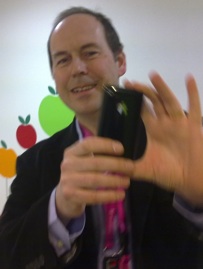
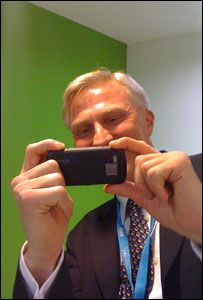 A case in point is Nokia's N97, a touchscreen phone with a very neat slide-out keyboard. When I went to interview Nokia's Anssi Vanjoki, we had a photographic face-off - his N97 versus my iPhone (I have brought a Nokia N95 and a Blackberry with me too, by the way). He was the clear winner, and the phone, which hits the shops in the summer, looks pretty good, as you can see here in my picture of him taken with my iPhone. Just below, is his photo of me with the iPhone. What I couldn't tell was just how much Nokia has improved the software on the phone to make it more intuitive.
And it's on software that Apple has really made a big impact. Ever tried to get onto the web with an N95? I found it too much of a struggle to bother, with this or other phones, and the statistics show that it was only the arrival of the iPhone which encouraged many users to see their phones as surfing devices.
Would we have seen the launch of phone application stores by both Nokia and Microsoft today if Apple's Apps Store hadn't shown there was a latent demand for useful, wacky or even totally pointless things to do on your mobile?
But what about Google? This show got underway with just one Android device - T-Mobile's G1 - on the market. As I arrived this morning, I saw a picture on the front of the show magazine of a new Android handset made by Huawei. I rushed to the firm's stand - and was turned away. But returning a couple of hours later I found the new Android behind a glass screen - it appeared to be a non-working prototype looking rather similar to, you've guessed it, the iPhone.
When I caught up with Google's mobile chief Hugo Barra, I asked him whether he was disappointed that Android hadn't yet taken over the world. He insisted that the hundreds of applications now being built for the new operating system proved that it was going to be very popular with all sorts of manufacturers - but pointed out that as it was an open-source system, he'd be the last to know what was in the pipeline because nobody needed to tell Google.
I am hearing rumours that a major operator will unveil its own Android handset on Tuesday - but it does seem that it's still too early to judge whether Google really has changed the rules of the game for this industry. Whereas Apple, with its very far from open operating system, seems to have everyone dancing to its tune.

Can Virgin satisfy the need for speed?
- 16 Feb 09, 12:57 GMT
Britain is widely seen as a bit of a laggard in the high speed broadband stakes when compared to countries like France, Sweden, Japan and Korea.
The average speed for most people in the UK is 3.6Mbps, according to Ofcom. Which is why Lord Carter's suggestion in his Digital Britain report that everybody had a minimum of 2Mbps feels a little backwards looking to some.
Many in the industry were hoping that Lord Carter would drive the adoption of high speed broadband by setting a much higher speed as the minimum for everyone.
But what does this high speed broadband world offer?
I've been lucky enough to have broadband at home for many years - first at a 512Kbps (which can now hardly be classed as broadband), then 1Mbps, then 4Mbps and now "up to 8Mbps" via ADSL.
And I'll be honest. I find the connection is often slow, especially when my wife is using her laptop at the same time I am doing something on mine.
Websites load slowly, downloads seem to crawl down the pipe and the overall experience is patchy at best.
And this is at speeds supposedly four times faster than the minimum laid down by Lord Carter.
But the reality is few of us ever achieve the maximum speeds that are on offer for reasons that are well known.
In the UK one of the fastest connections available to consumers is Virgin's 50Mbps service.
I've had the 50Mbps installed for more than a week on trial and I'm going to be writing a speed diary of my experiences over the next week or so.
I want to find out just how much bang for my buck I'm getting and experiment with the best ways of making use of a fast connection.
Virgin's 50Mbps service, known as the XXL package, costs £50 a month on its own, or £46 if you take a Virgin phone line as well.
For that money you get up to 50Mbps downstream and up to 1.5Mbps upstream. You get a cable modem with a single ethernet connection and a Netgear WNR 2000 wireless router that operates to the 802.11n specifications, which means in theory you should have the wireless bandwidth to get the best out of the fast connection.
You also get a .11n USB adaptor for your computer, in case your machine's existing wireless card doesn't support the standard.
I say "standard" - but I actually mean draft standard because .11n has yet to be officially ratified by the Institute of Electrical and Electronics Engineers Standards Association.
Unfortunately for me, the Netgear USB adaptor doesn't work on Apple Macs so I'm not able to take advantage of the greater bandwidth and speeds on my desktop machine.
Luckily, my laptop does already support .11n so it's not too much of an issue.
However, I've also been unable to connect my Xbox 360 wirelessly to the supplied router.
I'm not alone with this problem and it looks to be a hardware conflict between the 360's wi-fi adaptor and the Netgear router and is not in Virgin's control. But it does highlight some of the issues involved in using technology deployed with draft standards - not all devices will connect and it is best to check in advance.
Thankfully the router has plenty of ethernet ports and I was able to connect an Ethernet cable between the 360 and router. But if my Xbox 360 had been in another room then I do not know what the solution would have been.
Virgin has been waging a vigorous advertising campaign of late to promote its high-speed service but some of its claims were a little, er, too enthusiastic and had to be withdrawn after complaints.
Virgin had claimed in adverts that broadband suppliers that using copper wire - ie ADSL technology - were "struggling to cope".
The Advertising Standards Authority ruled that the claim was misleading because Virgin itself operates a traffic management policy which restricts bandwidth during peak times for heavy users. Currently, Virgin says it is implementing no traffic management of its 50Mbps users, but this is set to be reviewed in the future.
The ASA also rapped Virgin on the knuckles when it came to comparing its network to future plans from BT to deliver a national fibre optic network.
BT has spoken about plans to introduce a mix of fibre network to the home (FTTH) and fibre to the cabinet (FTTC), while Virgin's network delivers FTTC.
Virgin's claim that: "Everybody's talking about fibre optic broadband there's only one company actually doing it." was misleading, said the ASA.
So what's the difference between FTTH and FTTC? Well, FTTH means fibre optic cabling is run directly into your home, offering the fastest available connection.
FTTC is fibre to a cabinet with the "last mile" of connection - sometimes it's only a matter of yards - being delivered along coaxial cable, which means a reduction in the available speeds.
A few weeks back we reported on a company called Velocity1 which was offering 100Mbps downstream and 50Mbps upstreaconnections to a housing development in Wembley. It can achieve these speeds because it is piping fibre optic direct to the home.
And there are other "high-speed" broadband providers in the UK marketplace. O2, Be, Pipex, Tiscali and Sky are among those offering ADSL2+ technology which can, depending on where you live, offer between upto 16Mbps and 24Mbps downstream speeds.
BT is trialling ADSL2+ currently, and is also rolling out trials of FTTC in some homes later this year.
After plugging in my new Virgin cable modem and configuring the router I was up and running on the 50Mbps service.
Of course the first thing I did was test the speed. Virgin says that only two one website - thinkbroadband.comand speedtest.net had tests that could successfully gauge the speeds available to its users.
I used both tests - on both a wired and wireless connection - and my initial readings were between 13Mbps and 25Mbps downstream and 1.5Mbps upstream.
That's not bad - and at least double the best speed I was getting on my ADSL connection - but still someway short of the 50Mbps advertised speed.
Unfortunately after a day or two I found that the connection speed was dropping considerably when connected wirelessly - to below 1Mbps at one point which was clearly suspect.
After much hunting around on forums and a quick phonecall to Virgin I changed the encryption protocol on the router from WEP - the default setting - to WPA2 based on a recommendation. To my mind, this shouldn't make too great a difference in available speeds.
However, as soon as I changed the encryption protocol my speeds leaped back up to their previous high of about 25Mbps.
So what are my initial impressions of speed? You can never have too much speed, in my opinion, and the casual web surfer will notice a snappier experience when surfing the net.
Virgin does have direct peering into some high bandwidth sites, including the BBC, so there should be a speedy connection. Other ISPs, including PlusNet, have similar direct peering in place with sites like the BBC to maximise connection speeds.
But the real difference comes when downloading larger files.
Of course, the speed of any download all depends on how fast the server can deliver a file to you and the network content travels over. This varies from server to server, and from website to website.
For example - I downloaded a video file from an internal BBC server over wi-fi and I was getting downstream speeds of 3.7MB per second. (That equates to speeds of more than 31Mbps). A 600MB file landed on my machine in under three minutes, which is pretty quick by any yardstick.
Over the next week or two I'm going to be measuring the speeds on my 50Mbps line and looking at different ways of getting the most from the connecton.
From setting up my own web server, to online gaming, and broadcasting from my living room, I'm aiming to test the connection to its limits.
If you've got any suggestions of how I should test or use the connection, let me know. If you're a broadband speed merchant, perhaps using ADSL2+ connections, or are using Velocity1, let me know how you are finding the service, and what you are using it for.
UPDATE: Perhaps unsurprisingly, Virgin has been in touch to say there is no reason I shouldn't be seeing speeds of 50Mbps downstream on my connection. I want this test to be as fair as possible, and as realistic as possible, so I'm going to do some speed checks this evening, and if I still don't see an improvement, then a call to technical support will be in order.
UPDATE TWO I've made a change to the copy above. According to the Virgin site, only one speed test, the one supplied by Thinkbroadband.com is capable of measuring its 50Mbps connection.
Going mobile in Barcelona
- 16 Feb 09, 09:02 GMT
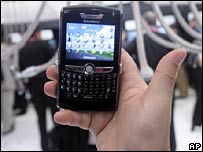 If you fancy a couple of days in Barcelona right now, my advice is to forget it. The flights are full, a hotel room will cost you a fortune, and the place is full of geeky types talking a strange language - LTE, MVNO, HSPA - and pointing excitedly at the tiny screens in their hands.
This is the week the Mobile World Congress comes to town, and the thousands gathered here are even less interested than normal in the glories of Gaudi, or a ramble down the Ramblas. For only the second time in its history the mobile industry is bracing itself for a year of contraction, with handsets sales forecast to drop.
But that doesn't mean that innovation has come to a halt - quite the opposite, with everyone even more desperate to prove that their handset or service can really bring something new to the table. So what are we hoping to see? Here's what's on my list:
Handsets
It seems using a mobile just to make a call is now very old hat, so expect more all-singing all-dancing phones-that-think-they're-computers. Sony Ericsson jumped the gun last night, with a phone combining a Walkman with an 8.1-megapixel camera, but Samsung may trump that with a phone which shoots video in HD (er, why?). There will be yet more touchscreen iPhone lookalikes - I'm interested in getting a look at Nokia's N97 and the Palm Pre which I've heard are the best efforts yet at knocking Apple from its smartphone perch. Energy efficiency is another theme, with a couple of solar-powered handsets on display. And at long last we may see a second Android phone based on Google's software platform - T-Mobile's G1 has had the field to itself so far. At the other end of the complexity spectrum, there is even wild talk of a Lego phone, which must be some kind of retro joke aimed at the yuppies who wielded those "brick" phones in the '80s.
Software
Now that just about every phone is a smartphone, it is the software that is becoming the differentiating factor. I spent yesterday evening at a preview event for some of the smaller exhibitors and just about every one seemed to be in software, not hardware. Turning voice messages into text may be one theme - Britain's Spinvox may see itself undercut by others doing a similar job at a lower price. Location-based services are another - but then again, the mobile industry has been selling the idea of arranging your social life via a mobile Google map for years, and I've sill not met anyone who does it.
As the High Street closes down, a whole new range of shops is opening up in the internet cloud, with Microsoft and others rushing to imitate Apple's iPhone Apps Store. Expect a flood of hopeful developers promising to turn your Nokia or your Windows Mobile into a musical instrument or a games arcade.
Mobile Money
No, not just the outlandish amounts of cash your operator charges you to surf the web whenever you leave the country, but the use of mobiles as "digital wallets", allowing users to pay for small items without cash. This has been a long time coming, but as we report elsewhere on this site, the convergence of two technologies - contactless cards and advanced mobile phones - could now spark a revolution in the way we pay. It's already happening in developing countries, where many people without bank accounts are now using phones to transfer money - I'll be looking out for more signs of the spread of mobile money.
In order to see this content you need to have both Javascript enabled and Flash installed. Visit BBC Webwise for full instructions. If you're reading via RSS, you'll need to visit the blog to access this content.
Mobile Broadband
If 2008 was the year of the dongle, expect a whole lot more progress on the mobile broadband front this year. I've already met one firm selling a device which takes a 3g signal and turns it into a portable wi-fi hotspot that you can share amongst a number of users in the home, the office - even in the car. But we're now moving beyond 3g to much faster networks, and Barcelona will be the scene for a battle between two rival technologies - LTE and WiMax - the backers of which believe that they provide the answer to the wireless broadband future.
There - in just one sentence I've used enough mobile industry jargon to convince anyone to steer clear of Barcelona this week. But I will try to decipher what they're talking about in the halls of the Mobile World Congress and pass on a translation to you.
In order to see this content you need to have both Javascript enabled and Flash installed. Visit BBC Webwise for full instructions. If you're reading via RSS, you'll need to visit the blog to access this content.
The BBC is not responsible for the content of external internet sites
This is dot.life - a blog about technology from BBC News.
Rory Cellan-Jones is the BBC's technology correspondent.
Maggie Shiels is the BBC's tech reporter based in Silicon Valley.
Archive
« January 2010
| Sun | Mon | Tue | Wed | Thu | Fri | Sat |
|---|---|---|---|---|---|---|
| 1 | 2 | |||||
| 3 | 4 | 5 | 6 | 7 | 8 | 9 |
| 10 | 11 | 12 | 13 | 14 | 15 | 16 |
| 17 | 18 | 19 | 20 | 21 | 22 | 23 |
| 24 | 25 | 26 | 27 | 28 |
Being Discussed Now
- Logging out... and straight back in(3)
- Gadgets of the Noughties(20)
- Plastic Logic's long journey to Vegas(21)
- Sexting teens(17)
- Wikipedia on the wane?(49)
- 'Cooling-off' for mobile phones? Not on the High Street(37)
- 2009 - the social year(36)
- Twitter, Iran and #uksnow(25)
- Broadband Britain - how far down the league?(55)
- Microsoft and Murdoch: Teaming up to bash Google?(34)
BBC Technology Headlines
- %28none%29
%28none%29 - %28none%29
%28none%29 - %28none%29
%28none%29
Visit the Technology index
Visit the BBC News website
Rory's TV/Radio reports
- Residents block Google car
Broadcast: 3 April 2009 - New adverts to tackle film piracy
Broadcast: 2 April 2009 - Call to scrap 'illegal databases'
Broadcast: 23 March 2009 - Female robot takes to the catwalk
Broadcast: 16 March 2009 - Super-charged battery breakthrough
Broadcast: 12 March 2009

- News Editors
- Sport Editors
- Journalism Labs
- BBC Internet Blog
- Radio 4 Blog
- Peston's Picks
- Nick Robinson's Newslog
- Stephanomics
- Mark Easton's UK
- Mark Mardell's America
- Nick Bryant's Australia
- Andrew Harding on Africa
- Gavin Hewitt's Europe
- Soutik Biswas' India
- dot.Rory
- Science: Jonathan Amos
- Richard Black on environment
- Today: Tom Feilden
- Fergus Walsh's medical files
- Newsnight: Paul Mason
- Newsnight: Mark Urban
- Torin Douglas
- Will Gompertz's arts
- Phil Coomes on photojournalism
- Magazine Monitor
- Mark D'Arcy in Westminster
- NI: Mark Devenport
- Scotland: Brian Taylor
- Scotland: Douglas Fraser
- Wales: Betsan Powys
- Martin Rosenbaum on FOI
- 5 Live Breakfast
- Newsnight
- PM programme (iPM)
- World Tonight: Robin Lustig
