


A Royal web event
- 12 Feb 09, 17:45 GMT
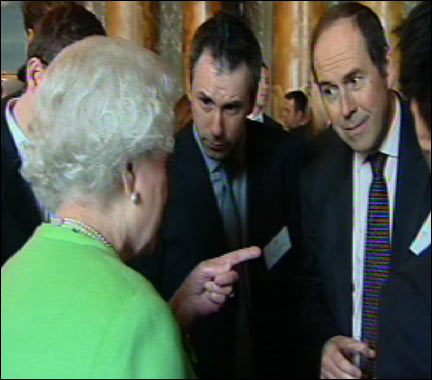 For Britain's technology crowd, Buckingham Palace is rather far from their usual beat. But inside the Palace at lunchtime, you would have found senior people from Google, Apple and AOL, assorted professors of computing, web entrepreneurs (from Brent Hoberman, founder of lastminute.com, to Michael Smith of Firebox), and just about anyone else who you'd normally find at a techie networking event. Oh, and a motley crew of technology journalists, including yours truly.
We were here to meet royalty - not just the Queen, but Sir Tim Berners-Lee, the creator of the world wide web and probably the only person for whom the technology world has unalloyed respect. Sir Tim was on hand to unveil the relaunched royal website, www.royal.gov.uk.
The website was born back in 1997, which now seems relatively early in the history of the web. It has now undergone major renovations, with far more video and more opportunities for interaction, including a Google map which allows you to track royal visits to your area.
At this stage you cannot email the Queen and there is no evidence that Her Majesty wishes to blog or join a social network. I do gather, however, that at least one member of the royal family is considering starting a blog.
Sir Tim gave us a brief history of the web and the royal site - and then handed over a remote control device to the Queen. After Her Majesty pressed a button there was a brief hiatus - and suddenly we were seeing the "surprise" element of the website, what the Palace is calling "virtual rooms". High-resolution pictures shot inside Windsor Castle and Buckingham Palace will now allow visitors to get a look around.
Sir Tim Berners-Lee hadn't actually knocked up a new website for the Queen. That was the responsibility of Emma Goodey from the Royal Household. I asked her whether she had some ornate title - Her Majesty's Webmaster? - but I'm afraid she doesn't. She told me that there had been months of effort, much of it involving working out just what it was that drew members of the public to the website and kept them there. "We didn't want to make assumptions about what people wanted - we wanted to go out there and find out".
So far, it seems to have done the job, with heavy traffic to the new site. When I looked mid-afternoon, the "virtual rooms" were not yet visible - the Palace told me that it was waiting for a bit of a lull before putting the bandwidth-hungry material up.
I grabbed a quick chat with Sir Tim to get his views on good website practice - for royal families, governments and other public bodies.
In order to see this content you need to have both Javascript enabled and Flash installed. Visit BBC Webwise for full instructions. If you're reading via RSS, you'll need to visit the blog to access this content.
The technology crowd at the launch seemed impressed by the new site, but they were not going to miss the opportunity to do some heavy networking, swapping rumours about other businesses and boosting their own. One executive from a social networking site told me they were about to have a "fabulous" relaunch, another told me that his interior design website was worthy of an hour long television programme.
And I think I may have achieved my own technology breakthrough - the first tweet from inside the Palace. And I sent a quick picture of Sir Tim Berners-Lee to Twitter just before the event got underway. Members of the Buckingham Palace press office told me they were pretty sure that this had never happened before. But I think we can be pretty confident that, whatever the technological progress made by the royal website, we won't be seeing tweets from the Queen.
The BBC is not responsible for the content of external internet sites
This is dot.life - a blog about technology from BBC News.
Rory Cellan-Jones is the BBC's technology correspondent.
Maggie Shiels is the BBC's tech reporter based in Silicon Valley.
Archive
« January 2010
| Sun | Mon | Tue | Wed | Thu | Fri | Sat |
|---|---|---|---|---|---|---|
| 1 | 2 | |||||
| 3 | 4 | 5 | 6 | 7 | 8 | 9 |
| 10 | 11 | 12 | 13 | 14 | 15 | 16 |
| 17 | 18 | 19 | 20 | 21 | 22 | 23 |
| 24 | 25 | 26 | 27 | 28 |
Being Discussed Now
- Logging out... and straight back in(3)
- Gadgets of the Noughties(20)
- Plastic Logic's long journey to Vegas(21)
- Sexting teens(17)
- Wikipedia on the wane?(49)
- 'Cooling-off' for mobile phones? Not on the High Street(37)
- 2009 - the social year(36)
- Twitter, Iran and #uksnow(25)
- Broadband Britain - how far down the league?(55)
- Microsoft and Murdoch: Teaming up to bash Google?(34)
BBC Technology Headlines
- %28none%29
%28none%29 - %28none%29
%28none%29 - %28none%29
%28none%29
Visit the Technology index
Visit the BBC News website
Rory's TV/Radio reports
- Residents block Google car
Broadcast: 3 April 2009 - New adverts to tackle film piracy
Broadcast: 2 April 2009 - Call to scrap 'illegal databases'
Broadcast: 23 March 2009 - Female robot takes to the catwalk
Broadcast: 16 March 2009 - Super-charged battery breakthrough
Broadcast: 12 March 2009

- News Editors
- Sport Editors
- Journalism Labs
- BBC Internet Blog
- Radio 4 Blog
- Peston's Picks
- Nick Robinson's Newslog
- Stephanomics
- Mark Easton's UK
- Mark Mardell's America
- Nick Bryant's Australia
- Andrew Harding on Africa
- Gavin Hewitt's Europe
- Soutik Biswas' India
- dot.Rory
- Science: Jonathan Amos
- Richard Black on environment
- Today: Tom Feilden
- Fergus Walsh's medical files
- Newsnight: Paul Mason
- Newsnight: Mark Urban
- Torin Douglas
- Will Gompertz's arts
- Phil Coomes on photojournalism
- Magazine Monitor
- Mark D'Arcy in Westminster
- NI: Mark Devenport
- Scotland: Brian Taylor
- Scotland: Douglas Fraser
- Wales: Betsan Powys
- Martin Rosenbaum on FOI
- 5 Live Breakfast
- Newsnight
- PM programme (iPM)
- World Tonight: Robin Lustig
