


Yahoo's silent Chief
- 28 Jan 09, 12:29 GMT
Only eight days into the job as chief executive officer of Yahoo, and Carol Bartz had the fairly thankless task of announcing the company's quarterly results for the end of 2008 amid one of the worst economic periods for years.
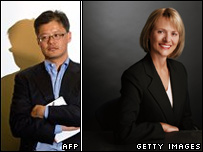 Joining her was chief financial officer Blake Jorgensen who played his part throughout, crunching the numbers. The other person along for the earnings announcement ride was co-founder, ex-ceo and now Chief Yahoo, Jerry Yang. But here's the thing, during the roughly hour long presentation and question and answer session, Mr Yang said nada.
It seemed rather strange that his presence was announced not once but twice, yet he said nothing - and none of the analysts called on him to speak. Neither did Ms Bartz, though she certainly referred to him in more oblique ways.
From the get-go Ms Bartz made it clear that she has her work cut out after taking over from Mr Yang. "There are fundamental issues that need to be addressed," she said, "sharpening strategic focus, increasing the pace of decision making and continuing to streamline the business."
For those not paying attention Ms Bartz added: "We need to bring more clarity to our strategy, speed innovation and be maniacally focused on users ... These things are absolutely addressable."
Forgive me if I am wrong, but was she hinting every so slightly that these were all areas the company had not excelled in under Mr Yang's stewardship and she is going to have to clean up his mess?
Well, just in case anyone was labouring under a misapprehension, Ms Bartz later stated: "I did mention it twice that this organisation is very complex. It is hard for people to get speedy answers and to make decisions. The good news is that's easy to fix. I happen to be pretty good at that sort of stuff."
I could imagine Mr Yang staring hard at his hands or some speck of dust throughout these various exchanges. But whatever he felt, he kept his own counsel and said nothing. For all intents and purposes, he might as well not have been there.
On other matters, Ms Bartz tackled the other elephant in the room - namely whether Yahoo is going to sell its search business to Microsoft.
While on the one hand she said "I didn't come here to sell the company", she also said "everything is on the table." And that might include a possible deal with AOL.
But if anyone is thinking of low-balling Ms Bartz, or trying to get her to sign a quick deal for quick bucks, she had this message: "This is not a company that needs to be pulled apart and left for the chickens. That's my Wisconsin coming through!"
Data Privacy Day
- 28 Jan 09, 11:15 GMT
At the moment there is no greetings card for Data Privacy Day, but this is its second year and 27 countries around Europe, Canada and here in America will use it as a springboard to educate and make users aware of the best way to protect their information online.
 As the first state in the nation to set up an office of privacy protection, Governor Arnold Schwarzenegger has proclaimed Wednesday "California Privacy Day."
A range of events are being held throughout the world to mark the day from panel discussions to cocktail parties and from outreach projects to seminars and workshops.
With a constant barrage of reports of how cyber criminals are wreaking havoc on the internet, there is a renewed effort by privacy advocates to push for more to be done to protect consumers and to hold companies accountable for what they do with information that is gleaned from our online activities.
In the States, a group called the Future of Privacy Forum is calling on President Obama to appoint a chief privacy officer to create standards for how personal information can be captured by search engines, social networks and mobile browsers.
"With this administration, how data is handled is going to be far more central than ever before," Jules Polonetsky, co-chair of the Forum and a former chief privacy officer at AOL told the Washington Post.
"We have people enthusiastically interacting with the government - wanting Barack to be our Facebook friend - yet we don't have an accountable figure to help shape information policy."
Microsoft, once the target of so many privacy groups, has commissioned some research into what concerns users have about going online.
For its study the company spoke to a sample of people in Dallas and in San Francisco.
Their comments ranged from: "Once you get in the internet, I don't think there's any control" to "I think we should be as cautious as we can, but also the companies that we're dealing with should protect the information."
And from: "We're aware of the risks and the safeguards to take, there are other people who maybe aren't as aware" to "I find I have more trust in a company when I have the option of opting out....or unsubscribing to them."
The software giant's chief privacy officer Peter Cullen told me that their findings refute the belief that most people, especially the young, are cavalier about the information they give away about themselves.
"There is a sense of resignation," explained Mr Cullen. "Most people realise they are making trade-offs when online. While they are not always comfortable about those trade-offs, they do it because of the value they get from the services online or sharing information online gives them.
"They would prefer to have much more control and feel better about sharing that information and that's where education comes in."
To that end Microsoft is involved in hosting a major community discussion on the issue in San Francisco for Data Privacy Day.
I'll be moderating the debate at the city's public library and I'll let you know how I got on.
The BBC is not responsible for the content of external internet sites
This is dot.life - a blog about technology from BBC News.
Rory Cellan-Jones is the BBC's technology correspondent.
Maggie Shiels is the BBC's tech reporter based in Silicon Valley.
Archive
« January 2010
| Sun | Mon | Tue | Wed | Thu | Fri | Sat |
|---|---|---|---|---|---|---|
| 1 | 2 | |||||
| 3 | 4 | 5 | 6 | 7 | 8 | 9 |
| 10 | 11 | 12 | 13 | 14 | 15 | 16 |
| 17 | 18 | 19 | 20 | 21 | 22 | 23 |
| 24 | 25 | 26 | 27 | 28 |
Being Discussed Now
- Logging out... and straight back in(3)
- Gadgets of the Noughties(20)
- Plastic Logic's long journey to Vegas(21)
- Sexting teens(17)
- Wikipedia on the wane?(49)
- 'Cooling-off' for mobile phones? Not on the High Street(37)
- 2009 - the social year(36)
- Twitter, Iran and #uksnow(25)
- Broadband Britain - how far down the league?(55)
- Microsoft and Murdoch: Teaming up to bash Google?(34)
BBC Technology Headlines
- %28none%29
%28none%29 - %28none%29
%28none%29 - %28none%29
%28none%29
Visit the Technology index
Visit the BBC News website
Rory's TV/Radio reports
- Residents block Google car
Broadcast: 3 April 2009 - New adverts to tackle film piracy
Broadcast: 2 April 2009 - Call to scrap 'illegal databases'
Broadcast: 23 March 2009 - Female robot takes to the catwalk
Broadcast: 16 March 2009 - Super-charged battery breakthrough
Broadcast: 12 March 2009

- News Editors
- Sport Editors
- Journalism Labs
- BBC Internet Blog
- Radio 4 Blog
- Peston's Picks
- Nick Robinson's Newslog
- Stephanomics
- Mark Easton's UK
- Mark Mardell's America
- Nick Bryant's Australia
- Andrew Harding on Africa
- Gavin Hewitt's Europe
- Soutik Biswas' India
- dot.Rory
- Science: Jonathan Amos
- Richard Black on environment
- Today: Tom Feilden
- Fergus Walsh's medical files
- Newsnight: Paul Mason
- Newsnight: Mark Urban
- Torin Douglas
- Will Gompertz's arts
- Phil Coomes on photojournalism
- Magazine Monitor
- Mark D'Arcy in Westminster
- NI: Mark Devenport
- Scotland: Brian Taylor
- Scotland: Douglas Fraser
- Wales: Betsan Powys
- Martin Rosenbaum on FOI
- 5 Live Breakfast
- Newsnight
- PM programme (iPM)
- World Tonight: Robin Lustig
