


Compulsory broadband?
- 23 Jan 09, 17:52 GMT
Should a broadband connection be compulsory for every UK resident ? Well of course not, but if you haven't got one yet, prepare to be battered into submission.
Digital Britain - a major report from the technology minister on our high-tech future - is due to be published next week (which is very inconsiderate of Lord Carter as I will be away on holiday). And it looks as though the report will focus on measures to close the digital divide and ensure that everyone in the UK gets access to broadband. So how are we going to get there?
Right now around 60% of households have broadband. That leaves the government with two issues to address - finding a way to connect the 1% who just cannot get it, and persuading the 39% who haven't bothered that they really, really need it.
The 1% problem may not be too tricky to solve - as long as enough money is thrown at it. Mobile and satellite solutions should patch the holes in the fixed-line network.
But what is going to make over a third of all households decide that finally it's time to get connected? Someone in the broadband industry admitted to me that ISPs haven't really worked very hard at this. "The market has never been very good at this - it just doesn't understand this type of consumer. They'd rather concentrate on competing for the two-thirds who've got it and upgrading them, rather than going for the one-third which they don't understand and don't know how to get to."
So what do we know about these people? There is evidence that, with take-up of broadband slowing, there is now quite a substantial slice of the population which is in no hurry to join the revolution. An Ofcom report last year looked at reasons for people not having broadband - which it describes as "voluntary or involuntary non-ownership".
"Voluntary" non-ownership means people who just don't want it - that accounted for 16% of the population in Ofcom's survey and most of them said they just did not need it. "Involuntary" is that group which would like broadband, but finds it too costly or too difficult to use.
So this latter group may have to be wooed with cheaper and more user-friendly services. The problem here is finding ways of subsidising the minority, without distorting a market that works pretty well for the majority right now. So if you're paying £15 a month for your broadband, how will you feel about your neighbour getting "broadbandforall" at just £5?
Getting everyone online will be hard. After all, nearly 30% of households don't even have a computer at home. The answer here, according to someone I chatted with at a big ISP, is television.
Just about everyone has one of these, so they may have to be the route to the fast internet for many - though linking the TV screen to a broadband line won't necessarily deliver the educational benefits the government is seeking. Do we really want children who don't have a computer at home to do their homework on the telly?
One measure that would drive take-up amongs the "voluntary" non-users is making more government services available exclusively online. But just how popular a measure would it be to tell the elderly, for instance, that they could collect their pensions online but not at the post office?
So I will be interested to hear what ideas Lord Carter has to make the internet as common a utility in British homes as running water. But maybe compulsory broadband isn't the answer.

Steve Jobs Health Hoax - Again
- 23 Jan 09, 12:51 GMT
For a certain kind of person, posting hoaxes about the health of Apple boss Steve Jobs seems to be a growing sport, albeit one in very bad taste.
Among the most notable was a citizen journalist report on CNN last year claiming Mr Jobs had had a heart attack. And then there was the accidental publication of his obituary by Bloomberg.
In the latest case someone distributed a "breaking news story" purporting to come from Wired.com under the name of one of their reporters, John C Abell.
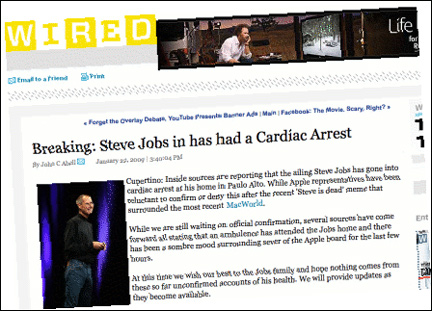
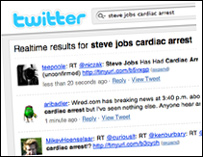
At a brief glance it could have looked genuine enough, and for a while on the Twitterverse plenty of people believed it and tweeted about it. Other sites like Mashable and Gizmodo also joined in the chatter. It was apparently one of the most shared links on Twitter for a few hours.
But the headline should have been a pure giveaway: "Breaking: Steve Jobs in has had a Cardiac Arrest." And the article is littered with spelling mistakes - "Paulo Alto", "ambulence", and so on.
 Wired.com explains "the hoaxer was able to create a cursorily valid-looking page using our public upload image viewer, whose URL was not a secret and which generates a page containing an image under a genuine Wired logo banner". Wired says this has now been patched.
These and other reports have all affected the stock price. Even announcements from Apple and Mr Jobs himself - or sometimes their absence - have caused the markets to wobble.
For months some Apple investors and analysts have complained that the company should be more forthcoming about the health of someone who is regarded as being so closely tied to its fortunes. The usual reply from Apple has been that Mr Jobs' health is a private matter.
And while we in the media try not to over-react to every rumour and half-rumour, they can be hard to ignore when the Apple PR machine refuses to throw cold water on them and instead responds with the simple answer that it doesn't comment on rumour and speculation.
Until the recent announcements by Mr Jobs about the true nature of his health problems, the previous hoaxes were so believable because everyone could see how gaunt he looked and Apple's code of silence worked against itself.
This time round this particular piece of fiction was pretty poorly written but it was cloaked in a credible looking veneer. Of course Apple can't spend its every second responding to every cockamamie story. But the company may be asking itself whether, had they been more willing in the past to speak up, then these false rumours might never be able to get off the ground.
The BBC is not responsible for the content of external internet sites
This is dot.life - a blog about technology from BBC News.
Rory Cellan-Jones is the BBC's technology correspondent.
Maggie Shiels is the BBC's tech reporter based in Silicon Valley.
Archive
« January 2010
| Sun | Mon | Tue | Wed | Thu | Fri | Sat |
|---|---|---|---|---|---|---|
| 1 | 2 | |||||
| 3 | 4 | 5 | 6 | 7 | 8 | 9 |
| 10 | 11 | 12 | 13 | 14 | 15 | 16 |
| 17 | 18 | 19 | 20 | 21 | 22 | 23 |
| 24 | 25 | 26 | 27 | 28 |
Being Discussed Now
- Logging out... and straight back in(3)
- Gadgets of the Noughties(20)
- Plastic Logic's long journey to Vegas(21)
- Sexting teens(17)
- Wikipedia on the wane?(49)
- 'Cooling-off' for mobile phones? Not on the High Street(37)
- 2009 - the social year(36)
- Twitter, Iran and #uksnow(25)
- Broadband Britain - how far down the league?(55)
- Microsoft and Murdoch: Teaming up to bash Google?(34)
BBC Technology Headlines
- %28none%29
%28none%29 - %28none%29
%28none%29 - %28none%29
%28none%29
Visit the Technology index
Visit the BBC News website
Rory's TV/Radio reports
- Residents block Google car
Broadcast: 3 April 2009 - New adverts to tackle film piracy
Broadcast: 2 April 2009 - Call to scrap 'illegal databases'
Broadcast: 23 March 2009 - Female robot takes to the catwalk
Broadcast: 16 March 2009 - Super-charged battery breakthrough
Broadcast: 12 March 2009

- News Editors
- Sport Editors
- Journalism Labs
- BBC Internet Blog
- Radio 4 Blog
- Peston's Picks
- Nick Robinson's Newslog
- Stephanomics
- Mark Easton's UK
- Mark Mardell's America
- Nick Bryant's Australia
- Andrew Harding on Africa
- Gavin Hewitt's Europe
- Soutik Biswas' India
- dot.Rory
- Science: Jonathan Amos
- Richard Black on environment
- Today: Tom Feilden
- Fergus Walsh's medical files
- Newsnight: Paul Mason
- Newsnight: Mark Urban
- Torin Douglas
- Will Gompertz's arts
- Phil Coomes on photojournalism
- Magazine Monitor
- Mark D'Arcy in Westminster
- NI: Mark Devenport
- Scotland: Brian Taylor
- Scotland: Douglas Fraser
- Wales: Betsan Powys
- Martin Rosenbaum on FOI
- 5 Live Breakfast
- Newsnight
- PM programme (iPM)
- World Tonight: Robin Lustig
